
Interpretable Machine Learning-Based Multiclass Prediction of Vascular Complication Profiles in Type 2 Diabetes: A Comparative Study
Keywords:
Diabetes and its complications, Machine learning, Study design and data sourceAbstract
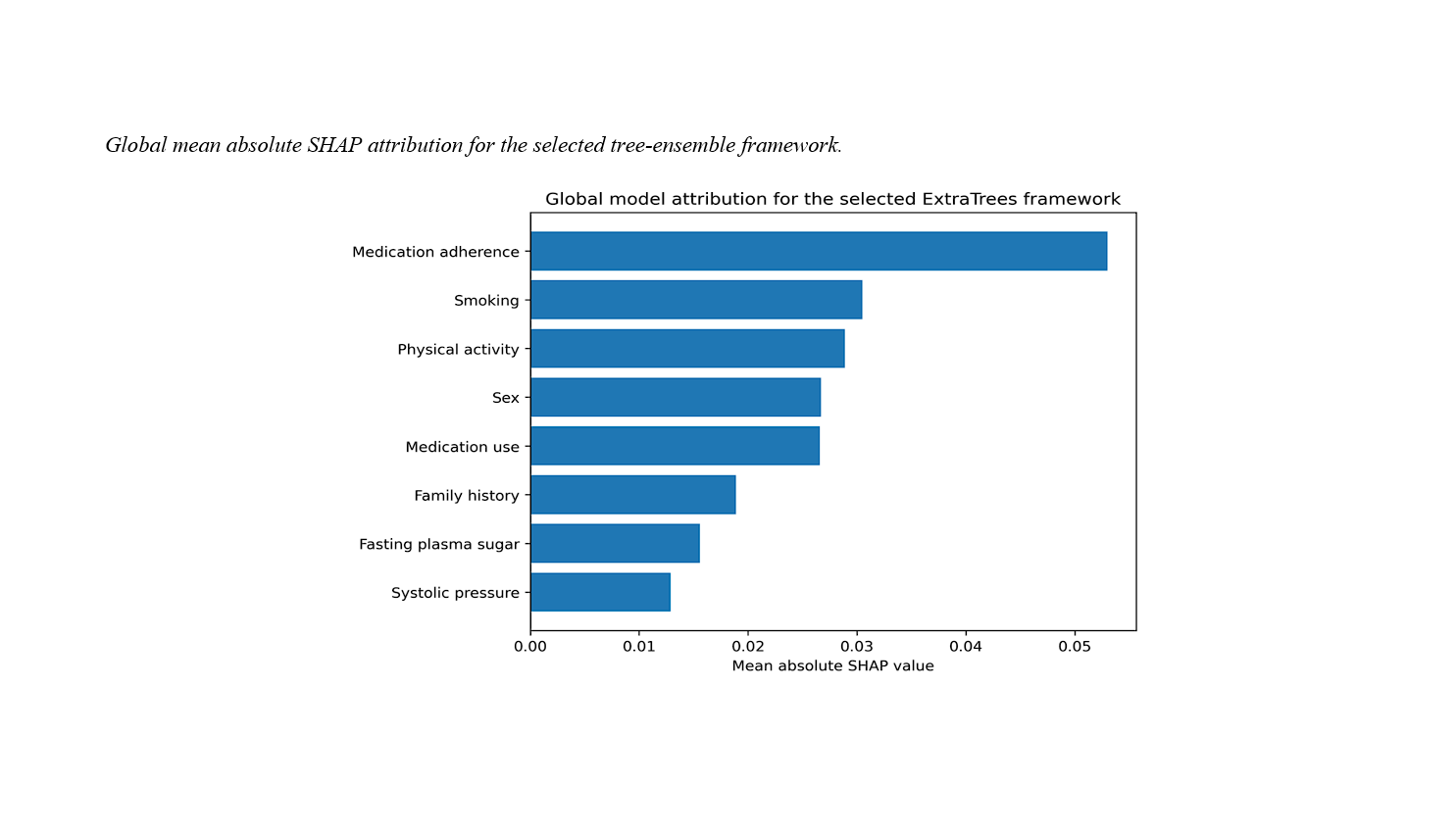
Vascular complications are common and heterogeneous in type 2 diabetes, yet multiclass classification is challenging because of substantial class imbalance. This study evaluated interpretable machine-learning approaches for characterizing microvascular and macrovascular complication profiles. After removing duplicated clinical profiles, 1,068 profiles were classified into four categories: no complications, microvascular only, macrovascular only, and both. Multiple machine-learning models and imbalance-handling strategies were compared using stratified five-fold cross-validation and an independent test set. Performance was assessed using macro-F1, balanced accuracy, class-specific metrics, bootstrap confidence intervals, and SHAP-based feature interpretation. SMOTENC achieved the strongest overall balance between minority-class performance and discrimination, with a cross-validation macro-F1 of 0.273 ± 0.011 and balanced accuracy of 0.294 ± 0.026. On the independent test set, macro-F1 was 0.277 (95% CI, 0.213–0.343) and balanced accuracy was 0.299 (95% CI, 0.220–0.385). The macrovascular-only class remained particularly difficult to distinguish. Medication adherence, smoking, physical activity, sex, and medication use were among the most influential features. Machine-learning classification of vascular complication profiles remains challenging in this imbalanced dataset. Nevertheless, explicit imbalance handling and class-balanced evaluation provided a more informative assessment of model performance than accuracy alone. These findings support the use of interpretable, imbalance-aware frameworks for future studies and highlight the need for larger, longitudinal, and externally validated datasets before clinical application.
Downloads
References
1. Kulkarni A, Thool AR, Daigavane S. Understanding the Clinical Relationship Between Diabetic Retinopathy, Nephropathy, and Neuropathy: A Comprehensive Review. Cureus. 2024;16(3):e56674. doi: 10.7759/cureus.56674.
2. Goldney J. Age at onset of type 2 diabetes and prevalence of vascular disease and heart failure: Systematic review and dose-response meta-analysis. Journal of Diabetes and Its Complications. 2024.
3. Nicolucci A, Romeo L, Bernardini M, Vespasiani M, Rossi MC, Petrelli M, et al. Prediction of complications of type 2 Diabetes: A Machine learning approach. Diabetes Research and Clinical Practice. 2022;190:110013. doi: 10.1016/j.diabres.2022.110013.
4. Ma Y, Wang Z, Yao Z, Lu B, He Y. Machine learning in the prediction of diabetic peripheral neuropathy: a systematic review. BMC Medical Informatics and Decision Making. 2025;25(1):344. doi: 10.1186/s12911-025-03201-6B.
5. Mesquita F, Bernardino J, Henriques J, Raposo JF, Ribeiro RT, Paredes S. Machine learning techniques to predict the risk of developing diabetic nephropathy: a literature review. Journal of Diabetes & Metabolic Disorders. 2024;23:825-39. doi: 10.1007/s40200-023-01357-4.
6. Nur AN. Predicting the risks of stroke, cardiovascular disease, and peripheral vascular disease among people with type 2 diabetes with artificial intelligence models: A systematic review and meta-analysis. Narra J. 2025;5(1):e2116. doi: 10.52225/narra.v5i1.2116.
7. Schallmoser S, Zueger T, Kraus M, Saar-Tsechansky M, Stettler C, Feuerriegel S. Machine Learning for Predicting Micro- and Macrovascular Complications in Individuals With Prediabetes or Diabetes: Retrospective Cohort Study. Journal of Medical Internet Research. 2023;25:e42181. doi: 10.2196/42181.
8. Ye S, Ye J, Ye X, Ni X. Interpretable prediction model for assessing diabetes complication risks in Chinese sufferers. Diabetes Research and Clinical Practice. 2024;209:111560. doi: 10.1016/j.diabres.2024.111560.
9. Muscillo L, Otesteanu CF, Menon C. Machine learning approaches for diabetic plantar foot classification from RGB and thermal images. Discover Artificial Intelligence. 2026. doi: 10.1007/s44163-026-01667-5.
10. Lehmann V, Hilpert M, Mostaani Z, Hovsepyan S, Wallace E, Verzat C, et al. Listening to hypoglycemia: Voice as a biomarker for detection of a medical emergency using machine learning. Diabetes Care. 2026;49(1):105-10. doi: 10.2337/dc25-1680.
11. Xie X, Wu C, Huang Z, Zhou Y, Huang J, Dao F. Artificial intelligence-powered prediction of diabetic complications: from clinical data to molecular omics. Briefings in Bioinformatics. 2026;27(1):bbag083. doi: 10.1093/bib/bbag083.
12. Ghafoor B, Zaccardi F, Khunti K, Shabnam S. Comparative predictive accuracy of machine learning versus traditional statistical methods for diabetes-related complications: A systematic review and analysis. Diabetic Medicine. 2026:e70398. doi: 10.1111/dme.70398.
13. Tan KR, Seng JJB, Kwan YH. Evaluation of Machine Learning Methods Developed for Prediction of Diabetes Complications: A Systematic Review. Journal of Diabetes Science and Technology. 2023;17(2):474-89. doi: 10.1177/19322968211056917.
14. Carriero A, Luijken K, de Hond A, Moons KGM, van Calster B, van Smeden M. The Harms of Class Imbalance Corrections for Machine Learning Based Prediction Models: A Simulation Study. Statistical Medicine. 2025;44(3–4):e10320. doi: 10.1002/sim.10320.
15. Ponce-Bobadilla AV, Schmitt V, Maier CS, Mensing S, Stodtmann S. Practical guide to SHAP analysis: Explaining supervised machine learning model predictions in drug development. Clinical and Translational Science. 2024;17(11):e70056. doi: 10.1111/cts.70056.
16. Collins GS, Moons KGM, Dhiman P, Riley RD, Beam AL, Van Calster B. TRIPOD+AI statement: updated guidance for reporting clinical prediction models that use regression or machine learning methods. BMJ. 2024;385:e078378. doi: 10.1136/bmj-2023-078378.
17. Moons KGM, Damen JAA, Kaul T, Hooft L, Andaur Navarro C, Dhiman P. PROBAST+AI: an updated quality, risk of bias, and applicability assessment tool for prediction models using regression or artificial intelligence methods. BMJ. 2025;388:e082505. doi: 10.1136/bmj-2024-082505.
18. Scheideman AF, Shao MM, Zelada H, Cuadros J, Foreman J, Sarder P. Machine Learning to Diagnose Complications of Diabetes. Journal of Diabetes Science and Technology. 2025;19(6):1650-70. doi: 10.1177/19322968251365245.
19. McCoy RG, Patel S, Faust L, Heien HC, Zhang N, Caffo B, et al. Predicting acute and chronic diabetes complications among adults newly diagnosed with diabetes: development and validation of dynamic risk prediction models. Nature Communications. 2026. doi: 10.1038/s41467-026-76673-3.
20. Vamsi B, Bhattacharyya D. Micro and Macro vascular complications in Type_II diabetes. Version 1 ed: Mendeley Data; 2021.
Downloads
Publication Timeline
- Submitted
- Revised
- Accepted