The Effect of Core Stability Training on Shooting Accuracy and Balance in Petanque Athletes
DOI:
https://doi.org/10.61838/kman.intjssh.4537Keywords:
Core stability, Shooting accuracy, Static balance, Dynamic balanceAbstract
Objective: Petanque is a precision sport that requires postural stability and precise motor control. Core stability, which encompasses the strength and coordination of the trunk and pelvic muscles, is considered fundamental in maintaining balance and improving technical performance, particularly in shooting movements. Core stability training, though, has not yet been extensively implemented in petanque training programs. This research aimed to examine the impact of a core stability training program on petanque athletes’ shooting accuracy and balance (static and dynamic).
Methods & Materials: A quasi-experimental design was employed with 20 petanque athletes aged between 14 and 25, who were assigned to either an experimental group (n = 10) or a control group (n = 10). The experimental group received a 6-week core stability exercise program (three times a week), whereas the control group continued regular training without intervention. Pre- and post-tests were administered using a shooting accuracy test, One-Leg Stance Test (static balance), and Y-Balance Test (dynamic balance). Paired and independent t-tests were used to analyze data with a significance level of p < 0.05.
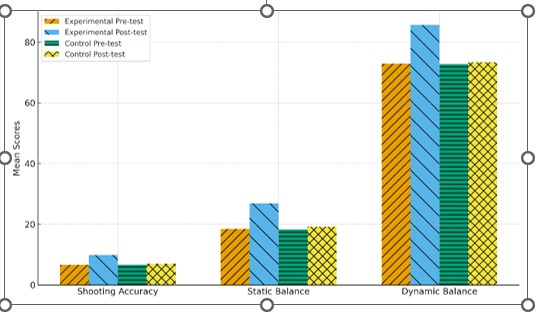
Results: The intervention group demonstrated significant improvements in shooting accuracy (p = 0.000), static balance (p = 0.000), and dynamic balance (p = 0.000), whereas the control group showed no significant changes. Additionally, inter-group comparisons conducted after the test revealed significant differences in all variables in favour of the experimental group.
Conclusion: Core stability training significantly enhances shooting accuracy and both forms of balance in petanque athletes. Integrating structured core training into regular conditioning routines is recommended to optimise technical performance and physical control in precision-based sports.
Downloads
References
[1] B. Helmi, T. Hidayah, H. Pramono, and M. Hartono, “Using a Biomechanical Analysis Approach to the Accuracy of Shooting Throws in Petanque Sport: Literature Review,” Phys. Educ. Theory Methodol., vol. 24, pp. 130–135, 2024, doi: 10.17309/tmfv.2024.1.16.
[2] E. Zemková and Z. Kováčiková, “Sport-specific training induced adaptations in postural control and their relationship with athletic performance.,” Front. Hum. Neurosci., vol. 16, p. 1007804, 2022, doi: 10.3389/fnhum.2022.1007804.
[3] D. Lang and A. Zhou, “Relationships between postural balance, aiming technique and performance in elite rifle shooters.,” Eur. J. Sport Sci., vol. 22, no. 10, pp. 1493–1498, Oct. 2022, doi: 10.1080/17461391.2021.1971775.
[4] R. Jati, A. Nasrulloh, and R. Yuniana, “Correlation between Balance and Hand-Eye Coordination towards the Shooting Accuracy of Petanque Athletes of UNY,” Int. J. Multidiscip. Res. Anal., vol. 08, 2025, doi: 10.47191/ijmra/v8-i03-10.
[5] C. Hrysomallis, “Balance Ability and Athletic Performance,” Sports Med., vol. 41, pp. 221–232, 2011, doi: 10.2165/11538560-000000000-00000.
[6] R. S. Pratama et al., “Analysis of the main physical condition factors in petanque,” Retos, vol. 60, pp. 103–109, 2024, [Online]. Available: https://recyt.fecyt.es/index.php/retos/article/download/102677/79661/434652
[7] C. E. Rivera, “Core and Lumbopelvic Stabilization in Runners.,” Phys. Med. Rehabil. Clin. N. Am., vol. 27, no. 1, pp. 319–337, Feb. 2016, doi: 10.1016/j.pmr.2015.09.003.
[8] A. Andreeva et al., “Postural Stability in Athletes: The Role of Age, Sex, Performance Level, and Athlete Shoe Features,” Sports, vol. 8, no. 6, 2020, doi: 10.3390/sports8060089.
[9] V. Akuthota, A. Ferreiro, T. Moore, and M. Fredericson, “Core stability exercise principles.,” Curr. Sports Med. Rep., vol. 7, no. 1, pp. 39–44, Feb. 2008, doi: 10.1097/01.CSMR.0000308663.13278.69.
[10] R. Szafraniec, J. Bartkowski, and A. Kawczyński, “Effects of Short-Term Core Stability Training on Dynamic Balance and Trunk Muscle Endurance in Novice Olympic Weightlifters.,” J. Hum. Kinet., vol. 74, pp. 43–50, Aug. 2020, doi: 10.2478/hukin-2020-0012.
[11] B. Amiri and E. Zemková, “Trunk stability and breathing exercises superior to foam rolling for restoring postural stability after core muscle fatigue in sedentary employees,” Sci. Rep., vol. 15, no. 1, pp. 1–15, 2025, doi: 10.1038/s41598-025-98284-6.
[12] K. Dong, T. Yu, and B. Chun, “Effects of Core Training on Sport-Specific Performance of Athletes: A Meta-Analysis of Randomized Controlled Trials.,” Behav. Sci. (Basel, Switzerland), vol. 13, no. 2, Feb. 2023, doi: 10.3390/bs13020148.
[13] I. Santosa, I. P. Adiatmika, N. M. Wulanyani, L. P. Sundari, and M. S. Indonesia, “Sidhakarya state conditioning in improving shooting accuracy of petanque athletes in Bali (O condicionamento do estado de Sidhakarya na melhoria da precisão do remate dos atletas de petanca em Bali),” Retos, vol. 59, p. 105523, 2024, doi: 10.47197/retos.v59.105523.
[14] J. Gong, H. Gao, J. Sui, and F. Qi, “The effect of core stability training on the balance ability of young male basketball players.,” Front. Physiol., vol. 14, p. 1305651, 2023, doi: 10.3389/fphys.2023.1305651.
[15] M. Hessam, K. Fathalipour, A. Behdarvandan, and S. Goharpey, “The Effect of McGill Core Stability Training on Movement Patterns, Shooting Accuracy, and Throwing Performance in Male Basketball Players: A Randomized Controlled Trial,” J. Sport Rehabil., pp. 1–9, 2023, doi: 10.1123/jsr.2022-0036.
[16] G. C. Sinka et al., “Effects of a Specific Trunk and Shoulder Strength Training Program on Throwing Velocity and Accuracy: A Study Among Hungarian First-League Female Handball Players,” Sports, vol. 12, no. 11, 2024, doi: 10.3390/sports12110296.
[17] R. Permadi and Nurhidayat, “Contribution Hand-Eye Coordination And Balance To Petanque Shooting Ability In Sports Education Students At Muhammadiyah University Of Surakarta,” Int. J. Educ. Res. Soc. Sci., vol. 2, no. 4, pp. 773–780, 2021, [Online]. Available: https://www.ijersc.org/index.php/go/article/view/134
[18] E. D. Barrio, R. Ramirez-Campillo, A. Garcia de Alcaraz Serrano, and R. RaquelHernandez-García, “Effects of core training on dynamic balance stability: A systematic review and meta-analysis.,” J. Sports Sci., vol. 40, no. 16, pp. 1815–1823, Aug. 2022, doi: 10.1080/02640414.2022.2110203.
[19] F. Chaari, S. Boyas, H. Rebai, A. Rahmani, and S. Sahli, “Effectiveness of 12-Week Core Stability Training on Postural Balance in Soccer Players With Groin Pain: A Single-Blind Randomized Controlled Pilot Study.,” Sports Health, vol. 17, no. 3, pp. 533–544, 2025, doi: 10.1177/19417381241259988.
[20] A. Fogliata, F. Silvestri, L. Marcelli, M. C. Gallotta, and D. Curzi, “How Body-Centering Improves the Effects of Core Stability Training on the Motor Skills in Adolescent Female Volleyball Players,” J. Funct. Morphol. Kinesiol., vol. 10, no. 2, 2025, doi: 10.3390/jfmk10020144.
[21] A. Imai, K. Kaneoka, Y. Okubo, and H. Shiraki, “Effects of two types of trunk exercises on balance and athletic performance in youth soccer players.,” Int. J. Sports Phys. Ther., vol. 9, no. 1, pp. 47–57, Feb. 2014.
[22] A. H. Saeterbakken, R. van den Tillaar, and S. Seiler, “Effect of core stability training on throwing velocity in female handball players.,” J. strength Cond. Res., vol. 25, no. 3, pp. 712–718, Mar. 2011, doi: 10.1519/JSC.0b013e3181cc227e.
[23] D. G. Behm, E. J. Drinkwater, J. M. Willardson, and P. M. Cowley, “The use of instability to train the core musculature.,” Appl. Physiol. Nutr. Metab. = Physiol. Appl. Nutr. Metab., vol. 35, no. 1, pp. 91–108, Feb. 2010, doi: 10.1139/H09-127.
[24] A. H. Saeterbakken, V. Andersen, D. G. Behm, E. K. Krohn-Hansen, M. Smaamo, and M. S. Fimland, “Resistance-training exercises with different stability requirements: time course of task specificity.,” Eur. J. Appl. Physiol., vol. 116, no. 11–12, pp. 2247–2256, Dec. 2016, doi: 10.1007/s00421-016-3470-3.
[25] D. T. McMaster, N. Gill, J. Cronin, and M. McGuigan, “A brief review of strength and ballistic assessment methodologies in sport.,” Sports Med., vol. 44, no. 5, pp. 603–623, May 2014, doi: 10.1007/s40279-014-0145-2.
[26] N. Vuillerme, N. Pinsault, and J. Vaillant, “Postural control during quiet standing following cervical muscular fatigue: effects of changes in sensory inputs.,” Neurosci. Lett., vol. 378, no. 3, pp. 135–139, Apr. 2005, doi: 10.1016/j.neulet.2004.12.024.
[27] J. B. Caccese, F. V Santos, F. K. Yamaguchi, T. A. Buckley, and J. J. Jeka, “Persistent Visual and Vestibular Impairments for Postural Control Following Concussion: A Cross-Sectional Study in University Students.,” Sports Med., vol. 51, no. 10, pp. 2209–2220, Oct. 2021, doi: 10.1007/s40279-021-01472-3.
[28] K. E. Cullen and O. A. Zobeiri, “Proprioception and the predictive sensing of active self-motion.,” Curr. Opin. Physiol., vol. 20, pp. 29–38, Apr. 2021, doi: 10.1016/j.cophys.2020.12.001.
[29] Á. Rodríguez-Perea et al., “Core training and performance: a systematic review with meta-analysis.,” Biol. Sport, vol. 40, no. 4, pp. 975–992, Oct. 2023, doi: 10.5114/biolsport.2023.123319.
[30] V. Krishna, T. Noronha, and A. A. Pathak, “Association between core strength and dynamic balance of throwing hand in professional healthy cricket fast bowlers: A cross sectional study.,” J. Bodyw. Mov. Ther., vol. 39, pp. 156–161, Jul. 2024, doi: 10.1016/j.jbmt.2024.02.045.
[31] L. Zhang, “The impact of single-leg stability training on injury reduction in throwing athletes,” Mol. Cell. Biomech., vol. 22, no. 4, p. 1016, 2025, doi: 10.62617/mcb1016.
[32] U. Granacher, A. Gollhofer, T. Hortobágyi, R. W. Kressig, and T. Muehlbauer, “The importance of trunk muscle strength for balance, functional performance, and fall prevention in seniors: a systematic review.,” Sports Med., vol. 43, no. 7, pp. 627–641, Jul. 2013, doi: 10.1007/s40279-013-0041-1.
[33] T. Paillard, “Plasticity of the postural function to sport and/or motor experience.,” Neurosci. Biobehav. Rev., vol. 72, pp. 129–152, Jan. 2017, doi: 10.1016/j.neubiorev.2016.11.015.
[34] O. Prieske, T. Muehlbauer, and U. Granacher, “The Role of Trunk Muscle Strength for Physical Fitness and Athletic Performance in Trained Individuals: A Systematic Review and Meta-Analysis.,” Sports Med., vol. 46, no. 3, pp. 401–419, Mar. 2016, doi: 10.1007/s40279-015-0426-4.
[35] R. Watanabe and T. Higuchi, “Postural strategy for two potential targets considering motor costs for postural stabilization and probabilistic information.,” J. Neurophysiol., vol. 133, no. 4, pp. 1191–1204, Apr. 2025, doi: 10.1152/jn.00308.2024.
Downloads
Publication Timeline
- Submitted
- Revised
- Accepted