Knowledge, Attitudes, and Practices toward Dietary Supplement Use among Sport Sciences Students
DOI:
https://doi.org/10.61838/kman.intjssh.5073Keywords:
Dietary supplements; Knowledge; Attitudes; Practices; Sport sciences studentsAbstract
Objective: This study aimed to assess the levels of knowledge, attitudes, and practices (KAP) toward dietary supplement use among students of the Faculty of Sport Sciences and to examine whether these levels differed according to gender, specialization, and academic year.
Methods and Materials: A descriptive analytical cross-sectional design was used. Data were collected from 100 male and female students using a structured questionnaire based on the KAP framework. The questionnaire assessed knowledge, attitudes, and self-reported practices related to dietary supplement use. Descriptive statistics, independent-samples t-tests, and one-way analysis of variance (ANOVA) were used to analyze the data at a significance level of α ≤ 0.05.
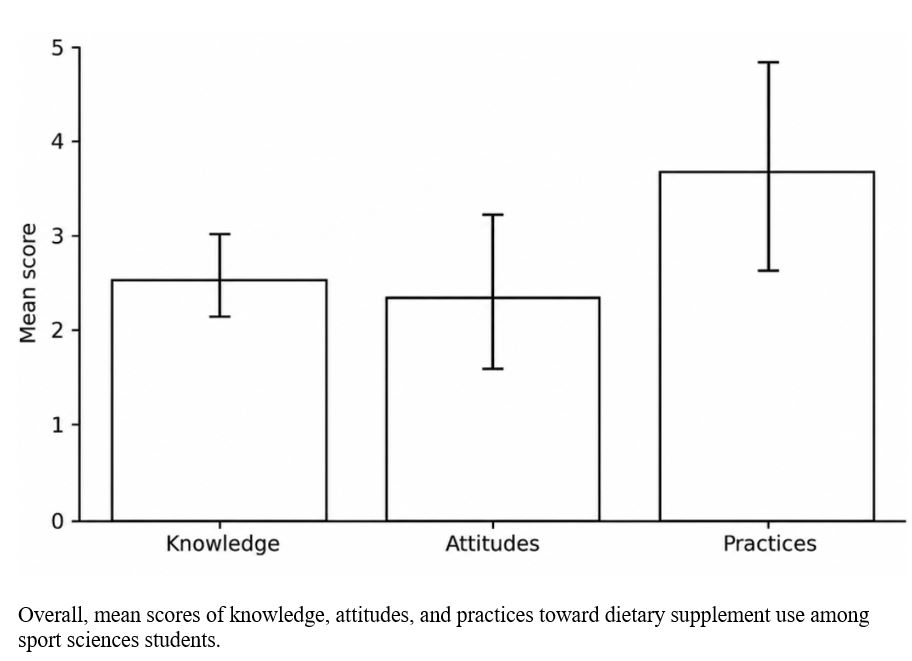
Findings: Students showed a high level of knowledge regarding dietary supplements (M = 2.52, SD = 0.37), moderate attitudes (M = 2.36, SD = 0.78), and relatively high but variable practices (M = 3.70, SD = 1.10). No statistically significant differences were found in KAP scores according to gender, specialization, or academic year.
Conclusion: Although sport sciences students demonstrated adequate knowledge of dietary supplements, this knowledge was not consistently reflected in more favorable attitudes or uniform evidence-based practices. Applied nutrition education and targeted awareness programs are therefore needed to promote safe and responsible supplement use.
Downloads
References
[1] D. T. Thomas, K. A. Erdman, and L. M. Burke, “Position of the Academy of Nutrition and Dietetics, Dietitians of Canada, and the American College of Sports Medicine: nutrition and athletic performance,” J. Acad. Nutr. Diet., vol. 116, no. 3, pp. 501–528, 2016.
[2] A. Amawi et al., “Athletes’ nutritional demands: a narrative review of nutritional requirements,” Front. Nutr., vol. 10, 2023, doi: https://doi.org/10.3389/fnut.2023.1331854.
[3] M. Gleeson and A. Jeukenbrup, Sport nutrition: an introduction to energy production and performance. Human Kinetics, 2004.
[4] D. Kirk, Physical education futures. Routledge, 2009.
[5] K. Hardman and J. Marshall, “Update on the state and status of physical education world-wide,” 2nd World Summit on Physical Education, Magglingen, Switzerland, 2–3 December 2005, pp. 1–17, 2005.
[6] W. J. Alkasasbeh, T. Alawamleh, and W. A. Alrahahleh, “Investigating Nutrition Literacy Levels among Adolescent Swimmers,” International Journal of Human Movement and Sports Sciences, vol. 12, no. 2, pp. 403–413, 2024, doi: 10.13189/saj.2024.120215.
[7] W. J. AlKasasbeh and A. T. Amawi, “The Effectiveness of Using Mobile Learning Application on Undergraduates’ Intrinsic Motivation and Their General Nutrition Knowledge,” International Journal of Interactive Mobile Technologies, vol. 17, no. 17, pp. 19–37, 2023, doi: 10.3991/ijim.v17i17.40959.
[8] I. Spronk, S. E. Heaney, T. Prvan, and H. T. O’Connor, “Relationship between general nutrition knowledge and dietary quality in elite athletes,” Int. J. Sport Nutr. Exerc. Metab., vol. 25, no. 3, pp. 243–251, 2015.
[9] S. Heaney, H. O’Connor, S. Michael, J. Gifford, and G. Naughton, “Nutrition knowledge in athletes: a systematic review,” Int. J. Sport Nutr. Exerc. Metab., vol. 21, no. 3, pp. 248–261, 2011.
[10] I. Alaunyte, J. L. Perry, and T. Aubrey, “Nutritional knowledge and eating habits of professional rugby league players: does knowledge translate into practice?,” J. Int. Soc. Sports Nutr., vol. 12, no. 1, p. 18, 2015.
[11] B. E. Orhan, W. J. Alkasasbeh, A. Karaçam, U. Canlı, N. S. Adıgüzel, and A. T. Amawi, “Nutrition knowledge and healthy-eating attitudes: the role of physical activity and lifestyle factors in adults,” Front. Nutr., vol. 13, p. 1754963, 2026.
[12] W. A. Jumah, T. Alawamleh, T. Farash, and H. Aloran, “Enhancing sports nutrition knowledge among undergraduate student-athletes through educational interventions,” Retos, vol. 70, pp. 11–23, 2025, doi: 10.47197/retos.v70.114500.
[13] I. R. Contento, “Nutrition education: linking research, theory, and practice,” 2007.
[14] S. Heaney, H. O’Connor, G. Naughton, and J. Gifford, “Towards an understanding of the barriers to good nutrition for elite athletes,” Int. J. Sports Sci. Coach., vol. 3, no. 3, pp. 391–401, 2008.
[15] T. Alawamleh and W. AlKasasbeh, “Exploring the Landscape of eHealth in Promoting Physical Activity and Healthy Dietary Intake,” Univers. J. Public Health, vol. 12, no. 1, pp. 120–127, 2024, doi: 10.13189/ujph.2024.120113.
[16] W. J. AlKasasbeh, B. E. Orhan, T. Alawamleh, G. V Grivas, and A. T. Amawi, “Correlation between food habits and perceived barriers to healthy eating in student-athletes: a cross-sectional study with moderation analysis,” Discover Public Health, vol. 23, no. 1, p. 366, 2026, doi: https://doi.org/10.1186/s12982-026-01761-0.
[17] Z. Yurtslzoǧlu, S. Pashaie, H. Golmohammadi, and N. A. Kohan, “Exploring the Influence of a Competitive Environment and Marketing Trends on Sports Coaches’ Attitudes Towards Advertising,” Physical Culture and Sport, Studies and Research, vol. 107, no. 1, pp. 60–76, Mar. 2025, doi: 10.2478/pcssr-2025-0006.
[18] W. J. AlKasasbeh et al., “Educational intervention using a mobile app to enhance sports nutrition knowledge and dietary habits in student-athletes: a randomized controlled trial,” Front. Educ. (Lausanne)., vol. 10, 2025, doi: 10.3389/feduc.2025.1622166.
[19] A. T. Amawi et al., “Knowledge and Attitude of Dietary Supplements among Arab Olympic Athletes and Coaches in Preparation Program for Tokyo 2020 Olympic Games,” International Journal of Human Movement and Sports Sciences, vol. 11, no. 2, pp. 368–377, Apr. 2023, doi: 10.13189/saj.2023.110214.
[20] F. N. Jacka et al., “Association of Western and traditional diets with depression and anxiety in women,” American journal of psychiatry, vol. 167, no. 3, pp. 305–311, 2010.
[21] W. J. Alkasasbeh and A. T. Amawi, “Impact of Eating Habits on the Psychological State of Jordanian Athletes: A Descriptive Study,” Food Science and Technology (United States), vol. 11, no. 3, pp. 168–181, 2023, doi: 10.13189/fst.2023.110305.
[22] S. H. Akroush, W. J. Alkasasbeh, M. A. M. Sha’lan, E. Abdi, and M. A. F. Khatatbeh, “Psychological mood patterns among Jordanian handball players,” Retos, vol. 62, 2025, doi: 10.47197/retos.v62.109407.
[23] D. Benton and R. T. Donohoe, “The effects of nutrients on mood,” Public Health Nutr., vol. 2, no. 3a, pp. 403–409, 1999.
[24] W. J. Alkasasbeh, H. A. Shlool, N. Natshah, and B. E. Orhan, “Knowledge and Behaviors of Dietary Supplement Consumption: A Survey of Gym Attendees in Amman,” Food Science and Technology (United States), vol. 12, no. 3, 2024, doi: 10.13189/fst.2024.120305.
[25] R. J. Maughan, F. Depiesse, and H. Geyer, “The use of dietary supplements by athletes,” J. Sports Sci., vol. 25, no. S1, pp. S103–S113, 2007.
[26] K. Kaliyaperumal, “Guideline for conducting a knowledge, attitude and practice (KAP) study,” AECS illumination, vol. 4, no. 1, p. 7, 2004.
[27] A. Launiala, “How much can a KAP survey tell us about people’s knowledge, attitudes and practices? Some observations from medical anthropology research on malaria in pregnancy in Malawi,” Anthropology Matters, vol. 11, no. 1, 2009.
[28] S. Heaney, H. O’Connor, S. Michael, J. Gifford, and G. Naughton, “Nutrition knowledge in athletes: a systematic review,” Int. J. Sport Nutr. Exerc. Metab., vol. 21, no. 3, pp. 248–261, 2011.
[29] M. R. N. Bentley, N. Mitchell, and S. H. Backhouse, “Sports nutrition interventions: A systematic review of behavioural strategies used to promote dietary behaviour change in athletes,” Appetite, vol. 150, p. 104645, 2020.
[30] O. F. Folasire, A. A. Akomolafe, and R. A. Sanusi, “Does nutrition knowledge and practice of athletes translate to enhanced athletic performance? Cross-sectional study amongst Nigerian undergraduate athletes,” Glob. J. Health Sci., vol. 7, no. 5, p. 215, 2015.
[31] T. L. McKenzie and M. A. F. Lounsbery, “The pill not taken: Revisiting physical education teacher effectiveness in a public health context,” Res. Q. Exerc. Sport, vol. 85, no. 3, pp. 287–292, 2014.
[32] J. García-Fernández, J. Karimi, S. Pashaei, H. Golmohammadi, and M. Piątkowska, “Innovative Strategies and Competitive Dynamics in Non-Profit Sports Clubs: From Transformation to Performance,” International Journal of Sport Studies for Health, vol. 8, no. 4, Oct. 2025, doi: 10.61838/kman.intjssh.8.4.7.
[33] N. A. Elsahoryi et al., “Prevalence of dietary supplement use and knowledge, attitudes, practice (KAP) and associated factors in student population: A cross-sectional study,” Heliyon, vol. 9, no. 4, Apr. 2023, doi: 10.1016/j.heliyon.2023.e14736.
[34] W. AlKasasbeh and S. Akroush, “Investigating the interrelationships among food habits, sports nutrition knowledge, and perceived barriers to healthy eating: a study of adolescent swimmers,” Front. Nutr., vol. 11, 2024, doi: 10.3389/fnut.2024.1381801.
[35] J. J. Son, M. J. Lee, D.-R. Lee, S.-S. Park, and J.-Y. Sung, “A study on the awareness and education status of sports nutrition in college students majoring in physical education: based on the career selection,” Phys. Act. Nutr., vol. 29, no. 1, p. 25, 2025.
[36] S. R. Patton, C. Odar, L. K. Midyett, and M. A. Clements, “Pilot study results for a novel behavior plus nutrition intervention for caregivers of young children with type 1 diabetes,” J. Nutr. Educ. Behav., vol. 46, no. 5, pp. 429–433, 2014.
[37] F. K. Alhomoud, M. Basil, and A. Bondarev, “Knowledge, attitudes and practices (KAP) relating to dietary supplements among health sciences and non-health sciences students in one of the universities of United Arab Emirates (UAE),” J. Clin. Diagn. Res., vol. 10, no. 9, p. JC05, 2016.
[38] F. Sirico et al., “Habits and beliefs related to food supplements: Results of a survey among Italian students of different education fields and levels,” PLoS One, vol. 13, no. 1, p. e0191424, 2018.
[39] G. Singh, S. Bala, M. Kaur, S. Phagna, and A. J. S. Bio, “Exploring Public Awareness and Attitudes towards Dietary Supplements,” 2024, doi: 10.33472/AFJBS.6.6.2024.7288-7299.
[40] S. Bezak et al., “Knowledge of Dietary Supplements and Attitudes Towards Complementary Medicine Among University Students: A Cross-Sectional Study,” Foods, vol. 15, no. 1, p. 61, 2025.
[41] P. Jovanov et al., “Prevalence, knowledge and attitudes towards using sports supplements among young athletes,” J. Int. Soc. Sports Nutr., vol. 16, no. 1, p. 27, 2019.
[42] A. Broniecka, A. Sarachman, A. Zagrodna, and A. Książek, “Dietary supplement use and knowledge among athletes: Prevalence, compliance with AIS classification, and awareness of certification programs,” J. Int. Soc. Sports Nutr., vol. 22, no. 1, p. 2496450, 2025.
[43] R. L. Gibbs and T. B. Becker, “General and sport-specific nutrition knowledge and behaviors of adolescent athletes,” J. Int. Soc. Sports Nutr., vol. 22, no. 1, p. 2477060, 2025.
[44] M. Kamruzzaman, S. Islam, M. P. Zahan, A. Al Maruf, and A. Islam, “Knowledge of nutrition in sports science students of Chittagong University,” Journal of Biomed Research, vol. 5, no. 1, p. 0, 2024.
[45] I. Jahan et al., “Tendencies and attitudes towards dietary supplements use among undergraduate female students in Bangladesh,” PLoS One, vol. 16, no. 4, p. e0249897, 2021.
[46] I. Angeles-Agdeppa et al., “MALAYSIAN JOURNAL OF NUTRITION.” [Online]. Available: www.nutriweb.org.my
Downloads
Publication Timeline
- Submitted
- Revised
- Accepted