Psychophysiological Responses to Competitive Anxiety, Stress Biomarkers (sCort and sAA), and Performance in Elite Female Basketball Players
DOI:
https://doi.org/10.61838/kman.intjssh.5162Keywords:
Competitive anxiety, Cortisol, Alpha Amylase, Basketball, PerformanceAbstract
Objective: This study examined the associations between competitive anxiety, self-confidence, salivary cortisol (sCort), salivary alpha-amylase (sAA), and performance outcomes in elite female basketball players.
Methods and Materials: In this observational cross-sectional study, 30 elite female basketball players (mean age = 16.4 ± 0.9 years) competing at national and international levels were included. Psychological states were assessed using the Persian version of the Competitive State Anxiety Inventory-2 Revised (CSAI-2R) approximately 1 hour prior to competition. Saliva samples were collected 30 minutes before competition to measure sCort and sAA. Pearson correlation and multiple regression analyses were performed to examine associations and exploratory multivariable relationships.
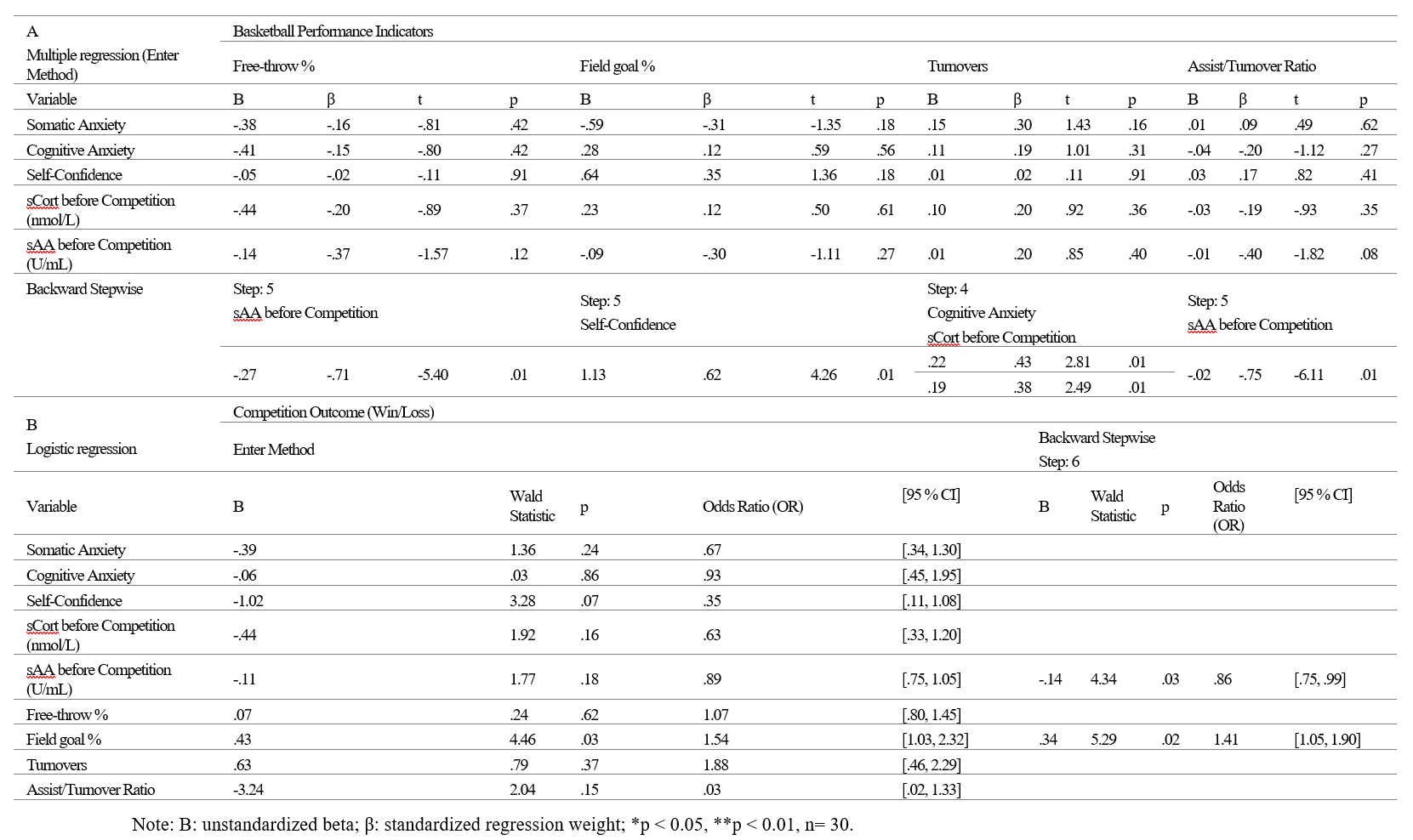
Results: Higher levels of cognitive and somatic anxiety were significantly associated with lower free-throw and field-goal percentages and with more turnovers, whereas self-confidence showed the opposite pattern. Pre-competition sCort and sAA were positively associated with anxiety and negatively associated with self-confidence. In exploratory multivariable analyses, overall regression models were significant for several performance indicators, although individual predictors in enter models were not significant, suggesting substantial shared variance among predictors. In backward exploratory models, sAA, self-confidence, and cognitive anxiety/sCort combinations were retained in models of selected performance outcomes.
Conclusion: These findings highlight the importance of integrated psychophysiological monitoring in elite sport. Combined psychological and physiological assessments may support coaches and practitioners in optimizing performance and managing competitive stress in high-level athletes.
Downloads
References
1. Scanlan AT, Dalbo VJ. Improving practice and performance in basketball. 2019;7:197. [PMID: 31461839] [PMCID: PMC6783966]
2. Branquinho D, Ferraz R, Marinho DA, Neiva HP, Teixeira JE, Forte P, et al. The development of basketball players: current perspectives and future directions. Open Science Journal. 2022;7(3).
3. Martens R, Vealey RS, Burton D. Competitive anxiety in sport1990.
4. Boas Junior MV, Ucha FG, Souza VHd, Manzini M, Corrêa MdF, Angelo DL, et al. The relationship between emotional regulation and sports performance: A systematic review. Journal of Physical Education. 2024;35:e3530.
5. Shapiro JL, Bartlett M. Arousal, stress, and anxiety in sport, exercise, and performance: Concepts and management strategies. Sport, Exercise, and Performance Psychology: Routledge; 2018. p. 87-109.
6. Janelle CM, Fawver BJ, Beatty GF. Emotion and sport performance. Handbook of sport psychology2020. p. 254-98.
7. Lucia S, Bianco V, Di Russo F. Specific effect of a cognitive-motor dual-task training on sport performance and brain processing associated with decision-making in semi-elite basketball players. Psychology of Sport and Exercise. 2023;64:102302. [PMID: 37665802]
8. Ayranci M, Aydin MK. The complex interplay between psychological factors and sports performance: A systematic review and meta-analysis. PloS one. 2025;20(8):e0330862. [PMID: 40857296] [PMCID: PMC12380335]
9. Peng F, Zhang LW. The Relationship of Competitive Cognitive Anxiety and Motor Performance: Testing the Moderating Effects of Goal Orientations and Self-Efficacy Among Chinese Collegiate Basketball Players. Front Psychol. 2021;12:685649. [PMID: 34140921] [PMCID: PMC8203911]
10. Kamarauskas P, Conte D. The effect of basketball matches on salivary markers: A systematic review. Biology of Sport. 2022;39(4):791-808. [PMID: 35959323] [PMCID: PMC9331335]
11. Sánchez I, de la Rubia Ortí JE, Platero JL, Mariscal G, Barrios C. Modification of diurnal cortisol secretion in women’s professional basketball. A pilot study. International Journal of Environmental Research and Public Health. 2021;18(17):8961. [PMID: 34501551] [PMCID: PMC8430658]
12. Blascovich J. The biopsychosocial model of challenge and threat: Reflections, theoretical ubiquity, and new directions. Neuroscience of prejudice and intergroup relations: Psychology Press; 2013. p. 229-42.
13. Budala DG, Luchian I, Virvescu DI, Tudorici T, Constantin V, Surlari Z, et al. Salivary biomarkers as a predictive factor in anxiety, depression, and stress. Current Issues in Molecular Biology. 2025;47(7):488. [PMID: 40728957] [PMCID: PMC12293726]
14. Arul QA, Debnath D. Salivary α-Amylase: A Reliable Stress Biomarker. European Dental Research and Biomaterials Journal. 2024;5(01/02):028-9.
15. Ali N, Pruessner JC. The salivary alpha amylase over cortisol ratio as a marker to assess dysregulations of the stress systems. Physiology & behavior. 2012;106(1):65-72. [PMID: 22019784]
16. Iwona GG, Wietrzyk A, Aleksandra T, Katarzyna PS, Agata H, Marek P. Salivary Alpha-Amylase and Cortisol Changes in Response to Basketball Training in Men and Women. Polish Journal of Sport and Tourism. 2025;32(4):3-10.
17. Miguel-Ortega Á, Calleja-González J, Mielgo-Ayuso J. Interactions between stress levels and hormonal responses related to sports performance in pro women’s basketball team. Journal of Functional Morphology and Kinesiology. 2024;9(3):133. [PMID: 39189218] [PMCID: PMC11348037]
18. Madrigal LA, Wilson PB. Salivary hormone and anxiety responses to free-throw shooting competition in collegiate female basketball players. Journal of Clinical Sport Psychology. 2017;11(3):240-53.
19. Tabassum Y, Sattar S, Iqbal MA, Butt MZI, Adnan MAJ, Roohi N. Effect of playing venue on pre-competition cortisol level and competitive state anxiety in university basketball players. Journal of Pharmaceutical Research International. 2021;33(43B):248-55.
20. Mazdarani FH, Khaledi N, Hedayati M. Effects of Official Basketball Competition on the Levels of Salivary Cortisol and Immunoglobulin (A) among female children. Journal of Childhood Obesity. 2016;3:12.
21. Faul F, Erdfelder E, Lang AG, Buchner A. G* Power 3: A flexible statistical power analysis program for the social, behavioral, and biomedical sciences. Behavior research methods. 2007;39(2):175-91. [PMID: 17695343]
22. Mehrsafar AH, Khabiri M, Moghadamzadeh A. Factorial validity and reliability of Persian version of competitive state anxiety inventory-2 (CSAI-2) in intensity, direction and frequency dimensions. Journal of Sports and Motor Development and Learning. 2016;8(2):253-79.
23. Strahler J, Skoluda N, Kappert MB, Nater UM. Simultaneous measurement of salivary cortisol and alpha-amylase: application and recommendations. Neuroscience & Biobehavioral Reviews. 2017;83:657-77. [PMID: 28864234]
24. Sarlis V, Tjortjis C. Sports analytics—Evaluation of basketball players and team performance. Information Systems. 2020;93:101562.
25. Gál-Pottyondy A, Petró B, Czétényi A, Négyesi J, Nagatomi R, Kiss RM. Collection and advice on basketball field tests—A literature review. Applied Sciences. 2021;11(19):8855.
26. Ali N, Nater UM. Salivary alpha-amylase as a biomarker of stress in behavioral medicine. International journal of behavioral medicine. 2020;27(3):337-42. [PMID: 31755033] [PMCID: PMC7239706]
27. de Arruda AFS, Aoki MS, Paludo AC, Drago G, Moreira A. Competition stage influences perceived performance but does not affect rating of perceived exertion and salivary neuro-endocrine-immune markers in elite young basketball players. Physiology & behavior. 2018;188:151-6. [PMID: 29425971]
28. Chun DR, Lee MY, Kim SW, Cho EY, Lee BH. The mediated effect of sports confidence on competitive state anxiety and perceived performance of basketball game. International Journal of Environmental Research and Public Health. 2022;20(1):334. [PMID: 36612655] [PMCID: PMC9819433]
29. McEwen BS, Akil H. Revisiting the stress concept: implications for affective disorders. Journal of Neuroscience. 2020;40(1):12-21. [PMID: 31896560] [PMCID: PMC6939488]
30. Giancamilli F, Galli F, Chirico A, Fegatelli D, Mallia L, Palombi T, et al. When the going gets tough, what happens to quiet eye? The role of time pressure and performance pressure during basketball free throws. Psychology of Sport and Exercise. 2022;58:102057.
31. Mascret N, Vors O, Marqueste T, Cury F. Stress responses, competition, and free-throw performance: The predicting role of other-approach goals. Psychological reports. 2022;125(6):3049-68. [PMID: 34412542]
32. Cabarkapa D, Cabarkapa DV, Fry AC. Game-related statistics that discriminate winning from losing in NCAA Division-I men's basketball. Frontiers in Sports and Active Living. 2024;6:1387918. [PMID: 38840953] [PMCID: PMC11150523]
33. de Almeida MB, Canuto SC, Lima GS, Oliveira WG. Performance analysis in elite basketball differentiating game outcome and gender. European Journal of Human Movement. 2022;49.
34. Kim EJ, Kim JJ. Neurocognitive effects of stress: a metaparadigm perspective. Molecular psychiatry. 2023;28(7):2750-63. [PMID: 36759545] [PMCID: PMC9909677]
35. Harris D, Wilkinson S, Ellmers T. From fear of falling to choking under pressure: a predictive processing perspective of disrupted motor control under anxiety. Neuroscience & Biobehavioral Reviews. 2023;148:105115. [PMID: 36906243]
36. Xin Z, Gu S, Yi L, Li H, Wang F. Acute exposure to the cold pressor stress impairs working memory functions: an electrophysiological study. Frontiers in Psychiatry. 2020;11:544540. [PMID: 33329085] [PMCID: PMC7719763]
37. Wagstaff CR, Hings RF, Quartiroli A. Emotion regulation in sport contexts. Handbook of emotion regulation at work: Edward Elgar Publishing; 2025. p. 247-66.
38. Lochbaum M, Sherburn M, Sisneros C, Cooper S, Lane AM, Terry PC. Revisiting the self-confidence and sport performance relationship: a systematic review with meta-analysis. International Journal of Environmental Research and Public Health. 2022;19(11):6381. [PMID: 35681963] [PMCID: PMC9180271]
39. Riley RD, Snell KI, Ensor J, Burke DL, Harrell Jr FE, Moons KG, et al. Minimum sample size for developing a multivariable prediction model: PART II‐binary and time‐to‐event outcomes. Statistics in medicine. 2019;38(7):1276-96. [PMID: 30357870] [PMCID: PMC6519266]
40. Steyerberg EW. Clinical prediction models: Springer; 2019. [PMCID: PMC12468558]
41. Van Smeden M, Moons KG, de Groot JA, Collins GS, Altman DG, Eijkemans MJ, et al. Sample size for binary logistic prediction models: beyond events per variable criteria. Statistical methods in medical research. 2019;28(8):2455-74. [PMID: 29966490] [PMCID: PMC6710621]
42. Ong NC, Chua JH. Effects of psychological interventions on competitive anxiety in sport: A meta-analysis. Psychology of Sport and Exercise. 2021;52:101836.
Downloads
Publication Timeline
- Submitted
- Revised
- Accepted