Digital Gaming Behavior Among University Students: Interactions of Attitudes, Motivation, and Addiction Awareness Across Demographic Factors
DOI:
https://doi.org/10.61838/kman.intjssh.5286Keywords:
Digital game addiction, awareness, motivation, attitude, university studentsAbstract
Objective: The present study aims to investigate digital gaming behavior among university students by examining the interactions between digital game playing attitudes, gaming motivation, and digital game addiction awareness. Specifically, the study seeks to determine how these psychological dimensions vary across key demographic factors, including gender, faculty type, and grade level. In addition, the study aims to analyze the relationships among attitudes, motivation, and awareness to provide a comprehensive understanding of the underlying mechanisms shaping digital gaming behavior in this population.
Method: A quantitative cross-sectional survey design was employed. The sample consisted of 337 university students (aged 17–32) selected through convenience sampling. Data were collected via validated scales measuring digital game addiction awareness, game playing motivation, and attitudes toward digital games. Statistical analyses were conducted using SPSS, including independent samples t-tests, one-way ANOVA, and Pearson correlation analysis, with significance set at p < 0.05.
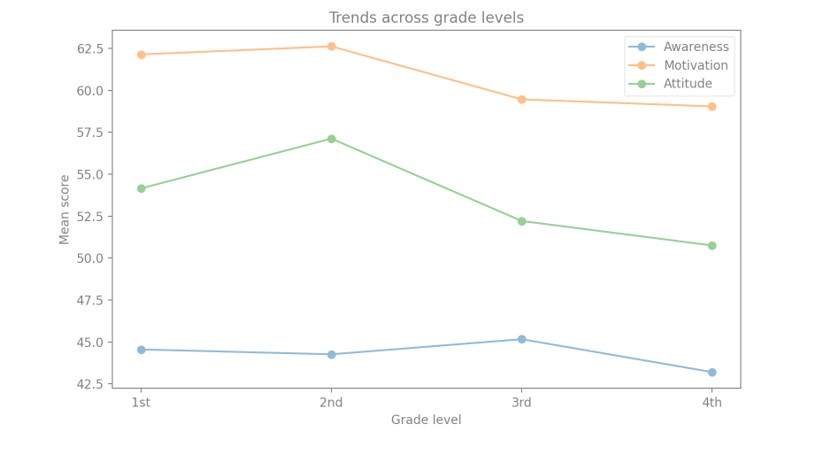
Results: Female students demonstrated significantly higher levels of digital game addiction awareness (M = 46.32) compared to males (M = 41.66, p < .001), whereas male students showed higher motivation (M = 65.64 vs. 57.25, p < .001) and more positive attitudes (M = 57.22 vs. 49.92, p < .001). Students from the Faculty of Sports Sciences had lower awareness levels than students from other faculties (p < .001), while no significant differences were observed in motivation or attitudes. Grade level did not significantly affect awareness or motivation; however, differences were found in attitudes (p < .05). Correlation analysis revealed a weak negative relationship between awareness and motivation (r = -0.141, p < .01) and attitudes (r = -0.136, p < .05), and a very strong positive relationship between motivation and attitudes (r = 0.924, p < .001).
Conclusion: Digital gaming behavior among university students is influenced by an interaction of awareness, motivation, and attitudes. Interventions should adopt an integrated approach focusing on increasing awareness and regulating motivation to promote balanced gaming behaviors.
Downloads