The Association Between Sprint Speed Test and Isokinetic Knee Strength in Healthy Male Volleyball Players
DOI:
https://doi.org/10.61838/kman.intjssh.4.2.8Keywords:
Volleyball Player, Isokinetic, Strength, SpeedAbstract
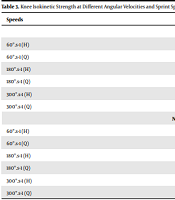
Background: Volleyball is a sport with technical elements and explosive power. Objectives: This study investigates the relationship between sprint speed and isokinetic knee strength applied at different angular velocities in male volleyball players. Methods: This study was conducted on 15 volunteer male volleyball players (age; 17 - 25 years, height; 1.75 + 0.12 m). Isomedx 2002 isokinetic dynamometer is employed to measure the isokinetic strength, and a 20 m sprint test is conducted to measure the speed. In measuring knee flexion and isokinetic extension strength, quadriceps and hamstring concentric/eccocentric are measured separately on both legs at 60°/sec angular velocity for three repetitions, at 180°/sec for six repetitions, and at 300°/sec for nine repetitions. For statistical analysis, the Spearman’s correlation test was performed using SPSS 18.0 (SPSS Inc., USA) software. Results: The highest torque value in subjects was recorded on both sides at 60°/sec angular velocity, 180 and 300 degrees, respectively, were lower. There was no significant relationship between speed and isokinetic strength at different angular velocities. Conclusions: Based on our results, the highest peak torque in volleyball players was found to be at 60°/sec angular velocity while no significant correlation was found between isokinetic strength of the knee at different angular velocities and speed of volleyball players.Downloads
References
1. ¸Sim¸sekB,ErtanH,GöktepeAS,Yazıcıo˘ gluK.Bayanvoleybolculardadiz
kas kuvvetinin sıçrama yüksekli˘ gine etkisi. Egzersiz. 2007;1(1):36–43.
Turkish.
2. SchonsP,DaRosaRG,FischerG,Berriel GP, Fritsch CG, Nakamura FY,
et al. The relationship between strength asymmetries and jumping
performance in professional volleyball players. Sports Biomech.
2019;18(5):515–26. doi:
10.1080/14763141.2018.1435712. [PubMed:
29578379].
3. SchonsP,FischerG,RosaRGD,BerrielGP,Peyré-TartarugaLA.Correla
tions between the strength of knee extensor and flexor muscles and
jumpperformanceinvolleyballplayers: Areview.JPhysEduc.2018;29.
doi: 10.4025/jphyseduc.v29i1.2926.
4. Didehdar D, Sobhani S. The effect of cold-water immersion on
physical performance. J Bodyw Mov Ther. 2019;23(2):258–61. doi:
10.1016/j.jbmt.2018.05.001. [PubMed: 31103105].
5. HadzicV,SattlerT,MarkovicG,VeselkoM,DervisevicE.Theisokinetic
strengthprofileofquadricepsandhamstringsinelitevolleyballplay
ers. Isokinet Exerc Sci. 2010;18(1):31–7. doi: 10.3233/ies-2010-0365.
6. Hadzic V, Sattler T, Veselko M, Markovic G, Dervisevic E. Strength
asymmetry of the shoulders in elite volleyball players. J Athl
Train. 2014;49(3):338–44. doi: 10.4085/1062-6050-49.2.05. [PubMed:
24673238]. [PubMedCentral: PMC4080589].
7. Wagner H, Tilp M, von Duvillard SP, Mueller E. Kinematic analysis
of volleyball spike jump. Int J Sports Med. 2009;30(10):760–5. doi:
10.1055/s-0029-1224177. [PubMed: 19585402].
8. Coleman SG, Benham AS, Northcott SR. A three-dimensional
cinematographical analysis of the volleyball spike. J Sports Sci.
1993;11(4):295–302. doi:
10.1080/02640419308729999. [PubMed:
8230389].
9. Wagner H, Pfusterschmied J, Tilp M, Landlinger J, von Duvillard SP,
Muller E. Upper-body kinematics in team-handball throw, tennis
serve, and volleyball spike. Scand J Med Sci Sports. 2014;24(2):345–54.
doi: 10.1111/j.1600-0838.2012.01503.x. [PubMed: 22813080].
10. Reeser JC, Fleisig GS, Bolt B, Ruan M. Upper limb biomechanics dur
ing the volleyball serve and spike. Sports Health. 2010;2(5):368–74.
doi: 10.1177/1941738110374624. [PubMed: 23015961]. [PubMed Central:
PMC3445065].
11. Rodriguez-Ruiz D, Diez-Vega I, Rodriguez-Matoso D, Fernandez-del
Valle M, Sagastume R, Molina JJ. Analysis of the response speed of
musculature of the knee in professional male and female volleyball
players. Biomed Res Int. 2014;2014:239708. doi: 10.1155/2014/239708.
[PubMed: 25003109].[PubMedCentral: PMC4070587].
12. Cengizel E. Effects of 4-month basketball training on speed, agility
andjumpinginyouthbasketballplayers.AfrEducResJ.2020;8(2):417
21. doi: 10.30918/aerj.82.20.089.
13. Cengizel E. The relationship between speed and isokinetic knee
strength in female volleyball players. Afr Educ Res J. 2020;8(2):406–9.
doi: 10.30918/aerj.82.20.090.
14. Sattler T, Sekulic D, Esco MR, Mahmutovic I, Hadzic V. Analysis of the
association between isokinetic knee strength with offensive and de
fensive jumpingcapacityinhigh-levelfemalevolleyballathletes.JSci
MedSport.2015;18(5):613–8.doi: 10.1016/j.jsams.2014.08.002.[PubMed:
25218817].
15. AkarcesmeC,Aktu˘ GZB,AkaH, ˙ Ibi¸sS.Aninvestigationoflegandshoul
der muscle strength ratios of elite female volleyball players. Turk J
Sport Exe. 2017;19(2):284–8. doi: 10.15314/tsed.337441.
16. Teixeira J, Carvalho P, Moreira C, Santos R. Isokinetic assessment of
muscle imbalances and bilateral differences between knee exten
sores and flexores’ strength in basketball, footbal, handball and vol
leyball athletes. Int J Sports Sci. 2014;4(1):1–6.
17. Cheung RT, Smith AW, Wong del P. H:q ratios and bilateral leg
strength in college field and court sports players. J Hum Kinet.
2012;33:63–71. doi: 10.2478/v10078-012-0045-1. [PubMed: 23487043].
[PubMedCentral: PMC3588678].
18. Kabaci´ nski J, Murawa M, Fryzowicz A, Dworak LB. A Comparison
of Isokinetic Knee Strength and Power Output Ratios Between Fe
male Basketball and Volleyball Players. Hum Mov. 2017;18(3). doi:
10.1515/humo-2017-0022.
19. Dellagrana RA, Diefenthaeler F, Carpes FP, Hernandez SG, de Cam
pos W. Evidence for Isokinetic Knee Torque Asymmetries in Male
Long Distance-Trained Runners. Int J Sports Phys Ther. 2015;10(4):514
9. [PubMed: 26346973].[PubMedCentral: PMC4527198].
20. Rouis M, Coudrat L, Jaafar H, Filliard JR, Vandewalle H, Barthelemy
Y, et al. Assessment of isokinetic knee strength in elite young female
basketball players: correlation with vertical jump. J Sports Med Phys
Fitness. 2015;55(12):1502–8. [PubMed: 25373468].
21. Sliwowski R, Grygorowicz M, Hojszyk R, Jadczak L. The isokinetic
strength profile of elite soccer players according to playing posi
tion. PLoS One. 2017;12(7). e0182177. doi: 10.1371/journal.pone.0182177.
[PubMed: 28759603].[PubMedCentral: PMC5536282].
22. Çelenk B, Öz E, Öner AG, Öz E. The relationship between isokinetic
knee strength and jumping in young male volleyball players. Turk J
Sport Exe. 2019;21(1):12–5. doi: 10.15314/tsed.521569.
23. Didehdar D, Jazayeri Shushtari SM, Taghizadeh S. [Evaluation of
changes in nerve conduction velocity in the lower limbs of football
players]. J Kerman Univ Medical Sci. 2013;20(6):566–77. Persian.
24. Lidor R, Ziv G. Physical and physiological attributes of female vol
leyball players–a review. J Strength Cond Res. 2010;24(7):1963–73. doi:
10.1519/JSC.0b013e3181ddf835. [PubMed: 20543736].
25. Shalfawi S, Tønnessen E, Enoksen E, Ingebrigtsen J. Assessing day-to
Int J Sport StudHlth. 2021;4(2):e126504.
dayreliability of theNewtest2000SprintTimingsystem.SerbJSports
Sci. 2011;5(107-13).
26. Alt T, Knicker AJ, Strüder HK. Factors influencing the reproducibility
of isokinetic knee flexion and extension test findings. Isokinet Exerc
Sci. 2014;22(4):333–42. doi: 10.3233/ies-140555.
27. Kim CG, Jeoung BJ. Assessment of isokinetic muscle function in
Korea male volleyball athletes. J Exerc Rehabil. 2016;12(5):429–37.
doi: 10.12965/jer.1632710.355. [PubMed: 27807521]. [PubMed Central:
PMC5091058].
28. Ozcakar L, Kunduracyoolu B, Cetin A, Ulkar B, Guner R, Hascelik Z.
Comprehensive isokinetic knee measurements and quadriceps ten
donevaluationsinfootballers for assessing functional performance.
BrJSportsMed.2003;37(6):507–10.doi: 10.1136/bjsm.37.6.507.[PubMed:
14665589]. [PubMedCentral: PMC1724691].
29. Newman MA, Tarpenning KM, Marino FE. Relationships between
isokinetic knee strength, single-sprint performance, and repeated
sprint ability in football players. J Strength Cond Res. 2004;18(4):867
72. doi: 10.1519/13843.1. [PubMed: 15574095].
30. Cotte T, Chatard JC. Isokinetic Strength and Sprint Times in En
glishPremierLeagueFootballPlayers.BiolSport.2011;28(2):89–94.doi:
10.5604/942736.
31. Lockie RG, Schultz AB, Jeffriess MD, Callaghan SJ. The relationship
between bilateral differences of knee flexor and extensor isokinetic
strengthandmulti-directionalspeed.IsokinetExercSci.2012;20(3):211
9. doi: 10.3233/ies-2012-0461.
32. Alemdaroglu U. The relationship between muscle strength, anaer
obic performance, agility, sprint ability and vertical jump perfor
manceinprofessional basketball players. J Hum Kinet. 2012;31:149–58.
doi: 10.2478/v10078-012-0016-6. [PubMed: 23486566]. [PubMed Cen
tral: PMC3588656].
33. Yapıcı A. Evaluation of the relationship between isokinetic strength
and field performance in professional male volleyball players. Euro
pean Journal of Physical Education and Sport Science. 2016;2(6):39–49.
doi: 10.5281/zenodo.215206.
Downloads
Publication Timeline
Issue
Section
License

This work is licensed under a Creative Commons Attribution-NonCommercial 4.0 International License.