Effect of Combined Feedback and Verbal Encouragement on Anaerobic Performance, Technical and Physiological Aspects During Small-Sided Basketball Games for Students’ Girls
DOI:
https://doi.org/10.61838/kman.intjssh.7.1.1Keywords:
Intervention, Physical Education, Performance, Motivation, StudentsAbstract
Objective: The aim of this research is to determine the effect of combined feedback and verbal encouragement on anaerobic performance, technical and physiological aspects during small-sided Basketball games for adolescent schoolgirls.
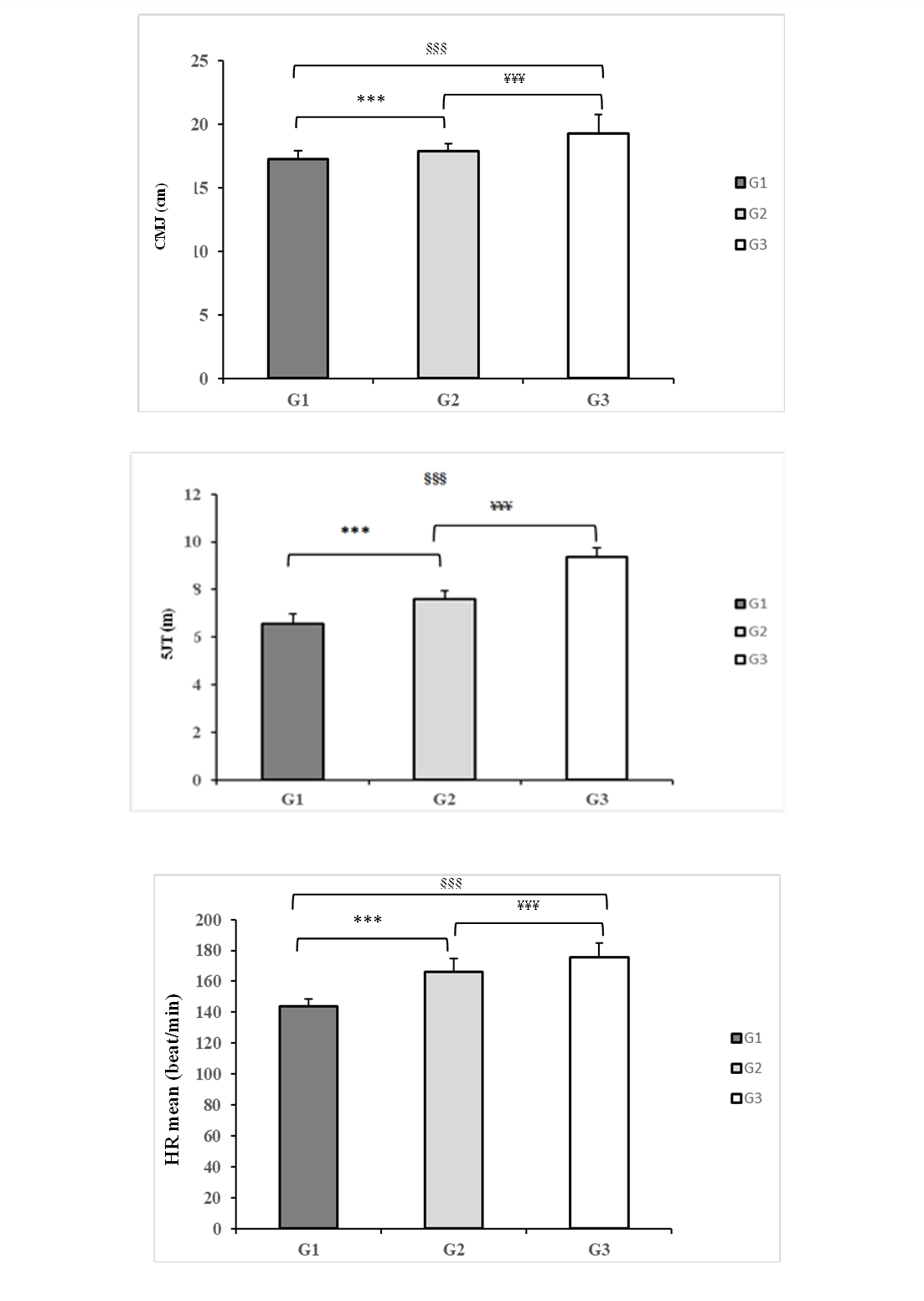
Material and Methods: Sixty schoolgirls were divided into 3 groups of 20 girls: control group (G1) (mean ± standard deviation (M±SD); age:15.45 ± 0.41years), verbal encouragement group (G2) (M±SD; age:15.65 ± 0.61years) and combined feedback and verbal encouragement group (G3) (M±SD; age:15.55 ± 0.51 years). Muscle power (countermovement jump (CMJ); 5-Jump-Test (5JT)), agility (Illinois-test), sprint speed (10 and 30 m)]; technical skill and heart rate (HR) responses during 3 vs. 3 small sided basketball game (SSBG) were measured. Additionally, HR was continuously recorded and video analysis was used to quantify technical actions during SSBG.
Results: The results showed greater improvements in muscle power of CMJ and 5JT for G3 compared to G2 (P<0.001, ES=1.21, moderate, p<0.001, ES= 4.74, large, respectively) and for G3 compared to G1 (P<0.001, ES= 1.72 large; p=0.001, ES =6.86 large respectively). The time in the 10 m, 30 m sprints and agility decreased more profoundly for G3 compared to G2 (p<0.001, ES=4.93, large; p<0.001, ES=3.27, large, p<0.001, ES=1.14, large, respectively).For technical skill, the ball contacts, successful balls, number of shots and successful shots were higher in G2compared with G1 (p<0.001, ES=1.48 moderate; p<0.001, ES=3.83, large; p<0.001, ES=1.99, large; p=0.001, ES=2.41, large respectively), higher in G3 compared with G2 (p<0.001,ES=-0.89, large, p=0.001, ES=-1.48 moderate; p=0.001, ES= 3.97, large; p<0.001, ES=4.93, large, respectively). Furthermore, average heart rate was higher in G3 compared with G2 and G1 (p<0.001, ES = 1.06, large; p<0.001, ES=4.64, large, respectively).
Conclusion: These findings indicate that the combination of feedback and verbal encouragement are more effective for achieving better results in physical fitness and technical skill than verbal encouragement group and control group.
Downloads
References
1. Aydi B, Selmi O, Souissi MA, Sahli H, Rekik G,
Crowley-McHattan ZJ, et al. The Effects of Verbal Encouragement
during a Soccer Dribbling Circuit on Physical and
Psychophysiological Responses: An Exploratory Study in a
Physical Education Setting. Children. 2022;9(6):907. [PMID:
35740844] [PMCID: PMC9222130] [DOI]
2. Trost S, van der Mars H. Why we should not cut PE.
Educational Leadership. 2009;67(4):60-5.
3. Sheeran P, Klein WM, Rothman AJ. Health behavior
change: Moving from observation to intervention. Annual review
of psychology. 2017;68:573-600. [PMID: 27618942] [DOI]
4. Alexe DI, Cîrtiţă BC, Tohănean DI, Larion A, Alexe CI,
Dragos P, Burgueño R. Interpersonal Behaviors Questionnaire in
Sport: Psychometric Analysis With Romanian Professional
Athletes. Perceptual and Motor Skills. 2023;130(1):497-519.
[PMID: 36278731] [DOI]
5. Alexe DI, Abalasei BA, Mares G, Rata BC, Iconomescu
TM, Mitrache G, Burgueño R. Psychometric Assessment of the
Need Satisfaction and Frustration Scale with Professional
Romanian Athletes. International Journal of Environmental
Research and Public Health. 2022;19(3):1696. [PMID: 35162719]
[PMCID: PMC8834736] [DOI]
6. Alexe CI, Alexe DI, Mareş G, Tohănean DI, Turcu I,
Burgueño R. Validity and reliability evidence for the Behavioral
Regulation in Sport Questionnaire with Romanian professional
athletes. PeerJ. 2022;10:e12803. [PMID: 35047241] [PMCID:
PMC8759356] [DOI]
7. Pulido CM, Ruiz-Eugenio L, Redondo-Sama G,
Villarejo-Carballido B. A New Application of Social Impact in
Social Media for Overcoming Fake News in Health. International
Journal of Environmental Research and Public Health.
2020;17(7):2430. [PMID: 32260048] [PMCID: PMC7177765]
[DOI]
8. Woods JA, Hutchinson NT, Powers SK, Roberts WO,
Gomez-Cabrera MC, Radak Z, et al. The COVID-19 pandemic and
physical activity. Sports Medicine and Health Science.
2020;2(2):55-64. [PMID: 34189484] [PMCID: PMC7261095]
[DOI]
9. Halperin I, Pyne DB, Martin DT. Threats to Internal
Validity in Exercise Science: A Review of Overlooked
Confounding Variables. International Journal of Sports Physiology
and Performance. 2015;10(7):823-9. [PMID: 25756869] [DOI]
10. Ferguson B. ACSM’s guidelines for exercise testing and
prescription 9th Ed. 2014. The Journal of the Canadian
Chiropractic Association. 2014;58(3):328.
11. Nicaise V, Cogérino G, Bois J, Amorose AJ. Students’
Perceptions of Teacher Feedback and Physical Competence in
Physical Education Classes: Gender Effects. Journal of Teaching in
Physical Education. 2006;25(1):36-57. [DOI]
12. Strube G, Strand B. Can Feedback Affect Motivation?
Journal of the Oklahoma Association for Health, Physical
Education, Recreation, and Dance. 2015;52(2).
13. Coker C. Motor learning and control for practitioners:
Routledge; 2017. [DOI]
14. Van der Schaaf M, Baartman L, Prins F, Oosterbaan A,
Schaap H. Feedback Dialogues That Stimulate Students' Reflective
Thinking. Scandinavian Journal of Educational Research.
2013;57(3):227-45. [DOI]
15. Caffarella RS, Barnett BG. Teaching Doctoral Students
to Become Scholarly Writers: The importance of giving and
receiving critiques. Studies in Higher Education. 2000;25(1):39-52.
[DOI]
16. Pajares F. Motivational role of self-efficacy beliefs in
self-regulated learning. Motivation and self-regulated learning:
Routledge; 2012. p. 111-39.
17. Badami R, VaezMousavi M, Wulf G, Namazizadeh M.
Feedback After Good Versus Poor Trials Affects Intrinsic
Motivation. Research Quarterly for Exercise and Sport.
2011;82(2):360-4. [PMID: 21699117] [DOI]
18. Smither JW, London M, Reilly RR. Does performance
improve following multisource feedback? A theoretical model,
meta-analysis, and review of empirical findings. Personnel
Psychology. 2005;58(1):33-66. [DOI]
19. Miller W, Jeon S, Kang M, Song JS, Ye X. Does
Performance-Related Information Augment the Maximal Isometric
Force in the Elbow Flexors? Applied Psychophysiology and
Biofeedback. 2021;46(1):91-101. [PMID: 33095393] [DOI]
20. Pacholek M, Zemková E. Effects of Verbal
Encouragement and Performance Feedback on Physical Fitness in
Young Adults. Sustainability. 2022;14(3):1753. [DOI]
21. Vallerand RJ. Intrinsic and Extrinsic Motivation in Sport.
In: Spielberger CD, editor. Encyclopedia of Applied Psychology.
New York: Elsevier; 2004. p. 427-35. [DOI]
22. During J, Webster C. A new method of assessing fatness
and desirable weight for use in the Armed Service Army
department. Technical Report: Ministry of Defence. USA; 1985.
23. Chamari K, Chaouachi A, Hambli M, Kaouech F,
Wisløff U, Castagna C. The Five-Jump Test for Distance as a Field
Test to Assess Lower Limb Explosive Power in Soccer Players.
The Journal of Strength & Conditioning Research. 2008;22(3):944-
50. [PMID: 18438217] [DOI]
24. Miller MG, Herniman JJ, Ricard MD, Cheatham CC,
Michael TJ. The effects of a 6-week plyometric training program
on agility. Journal of sports science & medicine. 2006;5(3):459.
25. Pauole K, Madole K, Garhammer J, Lacourse M,
Rozenek R. Reliability and Validity of the T-Test as a Measure of
Agility, Leg Power, and Leg Speed in College-Aged Men and
Women. The Journal of Strength & Conditioning Research.
2000;14(4):443-50. [DOI]
26. Roozen M. Illinois agility test. NSCA's Performance
Training Journal. 2003;3:5-6.
27. Santos EJAM, Janeira MAAS. Effects of Complex
Training on Explosive Strength in Adolescent Male Basketball
Players. The Journal of Strength & Conditioning Research.
2008;22(3):903-9. [PMID: 18438223] [DOI]
28. Klinzing JE. Training for improved jumping ability of
basketball players. Strength & Conditioning Journal.
1991;13(3):27-33. [DOI]
29. Hopkins WG, Marshall SW, Batterham AM, Hanin J.
Progressive Statistics for Studies in Sports Medicine and Exercise
Science. Medicine & Science in Sports & Exercise. 2009;41(1):3-
12. [PMID: 19092709] [DOI]
30. Cohen J. Statistical power analysis for the behavioral
sciences: Routledge; 2013. [DOI]
31. Hammami MA, Guerchi M, Selmi O, Sehli F, Ghouili H,
Stângaciu OA, et al. Effect of Verbal Encouragement on Physical
Fitness, Technical Skill and Physiological Response during SmallSided Soccer Games. Sustainability. 2023;15(4):3624. [DOI]
32. Porter JM, Wu WFW, Crossley RM, Knopp SW,
Campbell OC. Adopting an External Focus of Attention Improves
Sprinting Performance in Low-Skilled Sprinters. The Journal of
Strength & Conditioning Research. 2015;29(4):947-53. [PMID:
25811269] [DOI]
33. Hammami R, Nebigh A, Selmi MA, Rebai H, Versic S,
Drid P, et al. Acute Effects of Verbal Encouragement and Listening
to Preferred Music on Maximal Repeated Change-of-Direction
Performance in Adolescent Elite Basketball Players—Preliminary
Report. Applied Sciences. 2021;11(18):8625. [DOI]
34. Lee H, Shin J, Kim D, Park J. Effect of verbal
encouragement on quadriceps and knee joint function during three
sets of knee extension exercise. Isokinetics and Exercise Science.
2021;29:155-62. [DOI]
35. Argus CK, Gill ND, Keogh JW, Hopkins WG. Acute
Effects of Verbal Feedback on Upper-Body Performance in Elite
Athletes. The Journal of Strength & Conditioning Research.
2011;25(12):3282-7. [PMID: 22076083] [DOI]
36. Práxedes A, Moreno A, Sevil J, García-González L, Del
Villar F. A Preliminary Study of the Effects of a Comprehensive
Teaching Program, Based on Questioning, to Improve Tactical
Actions in Young Footballers. Perceptual and Motor Skills.
2016;122(3):742-56. [PMID: 27207601] [DOI]
37. García JA, Sabido R, Barbado D, Moreno FJ. Analysis of
the relation between throwing speed and throwing accuracy in
team-handball according to instruction. European Journal of Sport
Science. 2013;13(2):149-54. [DOI]
38. Chiviacowsky S, Wulf G. Self-Controlled Feedback Is
Effective if It Is Based on the Learner's Performance. Research
Quarterly for Exercise and Sport. 2005;76(1):42-8. [PMID:
15810769] [DOI]
39. Chiviacowsky S, Wulf G. Feedback After Good Trials
Enhances Learning. Research Quarterly for Exercise and Sport.
2007;78(2):40-7. [PMID: 17479573] [DOI]
Downloads
Publication Timeline
Issue
Section
License
Copyright (c) 2024 Rim Mekni, Mohamed Ali Hammami, Faten Sahli, Okba Selmi, Gabriel Stanica, Adelina Elena Panaet, Cristina Ioana Alexe, Omar Trabelsi, Lamia Ben Ezzeddine (Author)

This work is licensed under a Creative Commons Attribution-NonCommercial 4.0 International License.