The Ethical Compass: Establishing ethical guidelines for research practices in sports medicine and exercise science
DOI:
https://doi.org/10.61838/kman.intjssh.7.2.4Keywords:
Research Misconduct, Transparency in Research, Authorship Standards, Academic Integrity, Sports Medicine Ethics, Publication EthicsAbstract
Objective: Research in sports medicine and exercise science has experienced significant growth over recent years. With this expansion, there has been a concomitant rise in ethical challenges specific to these disciplines. While various ethical guidelines exist for numerous scientific fields, a comprehensive set tailored specifically for sports medicine and exercise science is lacking. Aiming to bridge this gap, this paper proposes a comprehensive, updated set of ethical guidelines specifically targeted at researchers in sports medicine and exercise science, providing them with a thorough framework to ensure research integrity.
Methods: A collaborative approach was adopted, involving contributions from a diverse group of international experts in the field. A thorough review of existing ethical guidelines was conducted, followed by the identification and detailed examination of 15 specific ethical topics relevant to the discipline. Each topic was discussed in terms of its definition, consequences, and preventive measures.
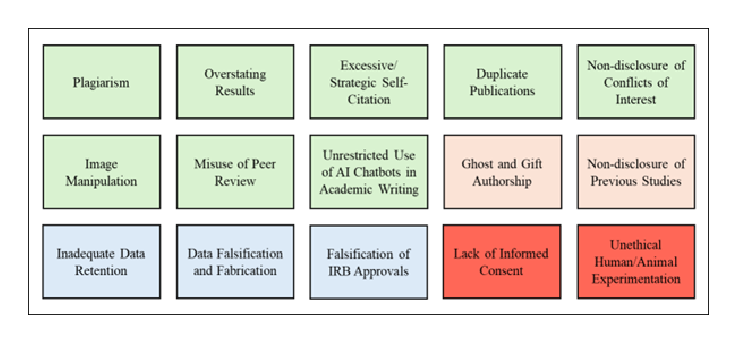
Results: The research in sports medicine and exercise science has grown significantly, bringing to the fore ethical challenges unique to these disciplines. Our comprehensive review identifies 15 key ethical challenges: plagiarism, data falsification, role of artificial intelligence chatbots in academic writing, overstating results, excessive/strategic self-citation, duplicate publications, non-disclosure of conflicts of interest, image manipulation, misuse of peer review, ghost and gift authorship, inadequate data retention, data fabrication, falsification of IRB approvals, lack of informed consent, and unethical human or animal experimentation. For each identified challenge, we propose practical solutions and best practices, enriched by the diverse perspectives of our collaborative international expert panel. This endeavor aims to offer a foundational set of ethical guidelines tailored to the nuanced needs of sports medicine and exercise science, ensuring research integrity and promoting ethical responsibility across these vital fields.
Conclusion: This article represents a seminal contribution to the establishment of essential ethical guidelines specifically designed for the fields of sports medicine and exercise science. This article charts a clear course for researchers, clinicians, and policymakers by integrating these ethical principles at the heart of our scholarly and clinical activities. Consequently, it envisions a future where the principles of research integrity and ethical responsibility consistently inform every scientific discovery and every clinical engagement.
Downloads
References
1. Poteiger J. ACSM's Introduction to exercise science:
Lippincott Williams & Wilkins; 2023.
2. Guelmami N, Aissa MB, Ammar A, Dergaa I, Trabelsi
K, Jahrami H. Guidelines for applying psychometrics in sports
science: Transitioning from traditional methods to the AI Era.
Tunisian Journal of Sports Science and Medicine. 2023;1(1):32-47.
[DOI]
3. Harriss D, MacSween A, Atkinson G. Ethical standards
in sport and exercise science research: 2020 update. International
journal of sports medicine. 2019;40(13):813-7. [PMID: 31614381]
[DOI]
4. Shephard RJ. Ethics in exercise science research. Sports
Medicine. 2002;32:169-83. [PMID: 11839080] [DOI]
5. Dwivedi YK, Hughes L, Ismagilova E, Aarts G, Coombs
C, Crick T, et al. Artificial Intelligence (AI): Multidisciplinary
perspectives on emerging challenges, opportunities, and agenda for
research, practice and policy. International Journal of Information
Management. 2021;57:101994. [DOI]
6. Claxton LD. Scientific authorship: Part 1. A window into
scientific fraud? Mutation Research/Reviews in Mutation
Research. 2005;589(1):17-30. [PMID: 15652224] [DOI]
7. Baerlocher MO, O'Brien J, Newton M, Gautam T, Noble
J. Data integrity, reliability and fraud in medical research. European
journal of internal medicine. 2010;21(1):40-5. [PMID: 20122612]
[DOI]
8. Hofseth LJ. Getting rigorous with scientific rigor.
Carcinogenesis. 2018;39(1):21-5. [PMID: 28968787] [PMCID:
PMC5862244] [DOI]
9. Petousi V, Sifaki E. Contextualising harm in the
framework of research misconduct. Findings from discourse
analysis of scientific publications. International Journal of
Sustainable Development. 2020;23(3-4):149-74. [DOI]
10. Ekmekci PE. An increasing problem in publication
ethics: Publication bias and editors’ role in avoiding it. Medicine,
Health Care and Philosophy. 2017;20:171-8. [PMID: 28342053]
[DOI]
11. Elsayed DEM. Fraud and misconduct in publishing
medical research. Sudan Journal of Medical Sciences (SJMS).
2020:131–41. [DOI]
12. Faintuch J, Faintuch S. Past and current status of
scientific, academic, and research fraud. Integrity of Scientific
Research: Fraud, Misconduct and Fake News in the Academic,
Medical and Social Environment: Springer; 2022. p. 3-8. [DOI]
13. Johnson A. Manufacturing invisibility in “the field”:
Distributed ethics, wearable technologies, and the case of exercise
physiology. Sports, society, and technology: Bodies, practices, and
knowledge production. 2020:41-71. [DOI]
14. Wager E, Kleinert S. Cooperation between research
institutions and journals on research integrity cases: Guidance from
the committee on publication ethics. Saudi journal of anaesthesia.
2012;6(2):155-60. [DOI]
15. Smith R. Misconduct in research: editors respond: the
committee on publication ethics (COPE) is formed. British Medical
Journal Publishing Group; 1997. p. 201-2. [PMID: 9253258]
[PMCID: PMC2127155] [DOI]
16. Guerrero-Dib JG, Portales L, Heredia-Escorza Y. Impact
of academic integrity on workplace ethical behaviour. International
Journal for Educational Integrity. 2020;16(1):2. [DOI]
17. Roig M. Avoiding plagiarism, self-plagiarism, and other
questionable writing practices: A guide to ethical writing. The
Office of Research Integrity (ORI). 2015.
18. Khemiss M, Berrezouga L, Ben Khelifa M, Masmoudi T,
Ben Saad H. Understanding of plagiarism among North-African
university hospital doctors (UHDs): A pilot study. Accountability
in Research. 2019;26(2):65-84. [PMID: 30572716] [DOI]
19. Drisko JW. What Is Plagiarism, How to Identify It, and
How to Educate to Avoid It. Journal of Social Work Education.
2023;59(3):744-55. [DOI]
20. Silver I, Shaw A. No harm, still foul: Concerns about
reputation drive dislike of harmless plagiarizers. Cognitive science.
2018;42:213-40. [PMID: 28474738] [DOI]
21. Shah JN, Shah J, Baral G, Baral R, Shah J. Types of
plagiarism and how to avoid misconduct: Pros and cons of
plagiarism detection tools in research writing and publication.
Nepal Journal of Obstetrics & Gynaecology. 2021;16(2). [DOI]
22. Malik MA, Mahroof A, Ashraf MA. Online university
students’ perceptions on the awareness of, reasons for, and
solutions to plagiarism in higher education: The Development of
the AS&P model to combat plagiarism. Applied Sciences.
2021;11(24):12055. [DOI]
23. Anil A, Saravanan A, Singh S, Shamim MA, Tiwari K,
Lal H, et al. Are paid tools worth the cost? A prospective crossover study to find the right tool for plagiarism detection. Heliyon.
2023;9(9). [PMID: 37809482] [PMCID: PMC10558310] [DOI]
24. Ahmed K. Academic integrity: Challenges and strategies
for Asia and the Middle East. Accountability in research.
2020;27(5):256-70. [PMID: 31328546] [DOI]
25. Sousa-Silva R. Investigating academic plagiarism: A
forensic linguistics approach to plagiarism detection. International
Journal for Educational Integrity. 2014;10(1). [DOI]
26. Dergaa I, Saad HB, Ghouili H, Glenn JM, El Omri A,
Slim I, et al. Evaluating the Applicability and Appropriateness of
ChatGPT as a Source for Tailored Nutrition Advice: A MultiScenario Study. New Asian Journal of Medicine. 2024;2(1):1-16.
[DOI]
27. Menachemi N, Tajeu G, Sen B, Ferdinand AO, Singleton
C, Utley J, et al. Overstatement of results in the nutrition and
obesity peer-reviewed literature. American journal of preventive
medicine. 2013;45(5):615-21. [PMID: 24139775] [DOI]
28. Speed HD, Andersen MB. What exercise and sport
scientists don't understand. Journal of Science and Medicine in
Sport. 2000;3(1):84-92. [PMID: 10839232] [DOI]
29. Pham HNA, Triantaphyllou E. The impact of overfitting
and overgeneralization on the classification accuracy in data
mining. Soft computing for knowledge discovery and data mining.
2008:391-431. [DOI]
30. Gülen S, Fonnes S, Andresen K, Rosenberg J. More than
one-third of Cochrane reviews had gift authors, whereas ghost
authorship was rare. Journal of Clinical Epidemiology.
2020;128:13-9. [PMID: 32781115] [DOI]
31. Khaji A, Saadat S. Is self-citation ethical? Iranian Journal
of Microbiology. 2014;6(1).
32. da Silva JAT. The ethics of peer and editorial requests for
self-citation of their work and journal. Medical Journal Armed
Forces India. 2017;73(2):181-3. [PMID: 28924321] [PMCID:
PMC5592272] [DOI]
33. Liu M-Y, Chien T-W, Chou W. The Hirsch-index in selfcitation rates with articles in Medicine (Baltimore): bibliometric
analysis of publications in two stages from 2018 to 2021. Medicine.
2022;101(45):e31609. [PMID: 36397355] [PMCID:
PMC9666158] [DOI]
34. Szomszor M, Pendlebury DA, Adams J. How much is too
much? The difference between research influence and self-citation
excess. Scientometrics. 2020;123(2):1119-47. [DOI]
35. Tolsgaard MG, Ellaway R, Woods N, Norman G.
Salami-slicing and plagiarism: How should we respond? : Springer;
2019. p. 3-14. [PMID: 30756257] [DOI]
36. Ding D, Nguyen B, Gebel K, Bauman A, Bero L.
Duplicate and salami publication: a prevalence study of journal
policies. International journal of epidemiology. 2020;49(1):281-8.
[PMID: 32244256] [DOI]
37. Werner MU. Salami-slicing and duplicate publication:
gatekeepers challenges. De Gruyter; 2021. p. 209-11. [PMID:
34387966] [DOI]
38. Thirumoorthy T. Conflicts of interest in medicine:
understanding the concepts to preserve the integrity of professional
judgement and promote trust in the profession. Singapore Medical
Journal. 2023;64(2):121-6. [PMID: 36814176] [PMCID:
PMC10071851] [DOI]
39. Noguera Pardo C. Conflicts of Interest in Research.
Handbook of Bioethical Decisions Volume II: Scientific Integrity
and Institutional Ethics: Springer; 2023. p. 65-74. [DOI]
40. Macdonald H, Ragavooloo S, Abbasi K, Drezner JA.
Update on the investigation into the publication record of former
BJSM editor-in-chief Paul McCrory. BMJ Publishing Group Ltd
and British Association of Sport and Exercise Medicine; 2022. p.
1327-8. [PMID: 36216388] [DOI]
41. Sarlis V, Papageorgiou G, Tjortjis C. Injury Patterns and
Impact on Performance in the NBA League Using Sports Analytics.
Computation. 2024;12(2):36. [DOI]
42. Maugeri G, Musumeci G. Research and Publication
Ethics in Journal of Functional Morphology and Kinesiology.
MDPI; 2020. p. 42. [PMID: 33467258] [PMCID: PMC7739350]
[DOI]
43. Garcia Valencia OA, Suppadungsuk S, Thongprayoon C,
Miao J, Tangpanithandee S, Craici IM, Cheungpasitporn W.
Ethical implications of chatbot utilization in nephrology. Journal of
Personalized Medicine. 2023;13(9):1363. [PMID: 37763131]
[PMCID: PMC10532744] [DOI]
44. Day A. Exploratory analysis of text duplication in peerreview reveals peer-review fraud and paper mills. Scientometrics.
2022;127(10):5965-87. [DOI]
45. Dergaa I, Fekih-Romdhane F, Glenn JM, Fessi MS,
Chamari K, Dhahbi W, et al. Moving Beyond the Stigma:
Understanding and Overcoming the Resistance to the Acceptance
and Adoption of Artificial Intelligence Chatbots. New Asian
Journal of Medicine. 2023;1(2):29-36. [DOI]
46. Dergaa I, Fekih-Romdhane F, Hallit S, Loch AA, Glenn
JM, Fessi MS, et al. ChatGPT is not ready yet for use in providing
mental health assessment and interventions. Frontiers in
Psychiatry. 2024;14:1277756. [PMID: 38239905] [PMCID:
PMC10794665] [DOI]
47. Waisberg E, Ong J, Masalkhi M, Zaman N, Sarker P, Lee
AG, Tavakkoli A. A Comparative Analysis of ChatGPT and
Google’s AI’s “Bard” in Medicine. New Asian Journal of
Medicine. 2023;1(2):37-43. [DOI]
48. Dergaa I, Saad HB, El Omri A, Glenn J, Clark C, Washif
J, et al. Using artificial intelligence for exercise prescription in
personalised health promotion: A critical evaluation of OpenAI’s
GPT-4 model. Biology of Sport. 2023;41(2):221-41. [PMID:
38524814] [PMCID: PMC10955739] [DOI]
49. Dergaa I, Chamari K, Glenn JM, Aissa MB, Guelmami
N, Saad HB. Towards responsible research: examining the need for
preprint policy reassessment in the era of artificial intelligence.
EXCLI journal. 2023;22:686.
50. Dergaa I, Chamari K, Zmijewski P, Saad HB. From
human writing to artificial intelligence generated text: examining
the prospects and potential threats of ChatGPT in academic writing.
Biology of Sport. 2023;40(2):615-22. [PMID: 37077800] [PMCID:
PMC10108763] [DOI]
51. Dergaa I, Saad HB. Artificial Intelligence and Promoting
Open Access in Academic Publishing. La Tunisie Medicale.
2023;101(06):533-6
52. Washif J, Pagaduan J, James C, Dergaa I, Beaven C.
Artificial intelligence in sport: Exploring the potential of using
ChatGPT in resistance training prescription. Biology of Sport.
2023;41(2):209-20. [PMID: 38524820] [PMCID: PMC10955742]
[DOI]
53. Jeon J, Lee S, Choe H. Beyond ChatGPT: A conceptual
framework and systematic review of speech-recognition chatbots
for language learning. Computers & Education. 2023:104898.
[DOI]
54. Dergaa I, Zakhama L, Dziri C, Saad HB. Enhancing
scholarly discourse in the age of artificial intelligence: A guided
approach to effective peer review process. La Tunisie Medicale.
2023;101(10):721-6.
55. Strong E, DiGiammarino A, Weng Y, Kumar A,
Hosamani P, Hom J, Chen JH. Chatbot vs medical student
performance on free-response clinical reasoning examinations.
JAMA internal medicine. 2023;183(9):1028-30. [PMID:
37459090] [DOI]
56. Altay S, Hacquin A-S, Chevallier C, Mercier H.
Information delivered by a chatbot has a positive impact on
COVID-19 vaccines attitudes and intentions. Journal of
Experimental Psychology: Applied. 2023;29(1):52. [PMID:
34726454] [DOI]
57. Aliukonis V, Poškutė M, Gefenas E. Perish or publish
dilemma: challenges to responsible authorship. Medicina.
2020;56(3):123. [PMID: 32178434] [PMCID: PMC7142498]
[DOI]
58. Donovan SK. On accuracy in references. Learned
Publishing. 2008;21(1):74-5. [DOI]
59. Sauvayre R. Misreferencing Practice of Scientists: Inside
Researchers’ Sociological and Bibliometric Profiles. Social
Epistemology. 2022;36(6):719-30. [DOI]
60. Wilken R, Burgess J, Albury K. Dating apps and data
markets: A political economy of communication approach.
Computational Culture. 2019;7:1-26.
61. Tenopir C, Allard S, Douglass K, Aydinoglu AU, Wu L,
Read E, et al. Data sharing by scientists: practices and perceptions.
PloS one. 2011;6(6):e21101. [PMID: 21738610] [PMCID:
PMC3126798] [DOI]
62. Li W, van Wely M, Gurrin L, Mol BW. Integrity of
randomized controlled trials: challenges and solutions. Fertility and
Sterility. 2020;113(6):1113-9. [PMID: 32387277] [DOI]
63. Isbell DR, Brown D, Chen M, Derrick DJ, Ghanem R,
Arvizu MNG, et al. Misconduct and questionable research
practices: The ethics of quantitative data handling and reporting in
applied linguistics. The Modern Language Journal.
2022;106(1):172-95. [DOI]
64. Fanelli D. How many scientists fabricate and falsify
research? A systematic review and meta-analysis of survey data.
PloS one. 2009;4(5):e5738. [PMID: 19478950] [PMCID:
PMC2685008] [DOI]
65. Dal-Ré R, Bouter LM, Cuijpers P, Gluud C, Holm S.
Should research misconduct be criminalized? Research Ethics.
2020:174701611989840. [DOI]
66. Okonta P, Rossouw T. Prevalence of Scientific
Misconduct Among a Group of Researchers in N igeria.
Developing world bioethics. 2013;13(3):149-57. [PMID:
22994914] [PMCID: PMC3530634] [DOI]
67. Hoffman JA, Miller EA. Addressing the consequences of
school closure due to COVID‐19 on children's physical and mental
well‐being. World medical & health policy. 2020;12(3):300-10.
[PMID: 32904951] [PMCID: PMC7461306] [DOI]
68. Dergaa I, Ammar A, Souissi A, Fessi MS, Trabelsi K,
Glenn JM, et al. COVID-19 lockdown: impairments of objective
measurements of selected physical activity, cardiorespiratory and
sleep parameters in trained fitness coaches. EXCLI journal.
2022;21:1084.
69. Chtourou H, Guelmami N, Trabelsi K, Dergaa I. The
Beginning of Our Journey: The Launch of the Tunisian Journal of
Sports Science and Medicine. Tunisian Journal of Sports Science
and Medicine. 2023;1(1):1-3. [DOI]
70. Peek L, Tobin J, van de Lindt JW, Andrews A. Getting
Interdisciplinary Teams into the Field: Institutional Review Board
Preapproval and Multi‐Institution Authorization Agreements for
Rapid Response Disaster Research. Risk analysis.
2021;41(7):1204-12. [PMID: 33960513] [PMCID: PMC8360063]
[DOI]
71. Nneoma UC, Udoka EVH, Nnenna UJ, Chukwudi OF,
Paul-Chima UO. Ethical Publication Issues in the Collection and
Analysis of Research Data. Newport International Journal of
Scientific and Experimental Sciences (NIJSES). 2023;3(2):132-40.
72. Xu A, Baysari MT, Stocker SL, Leow LJ, Day RO,
Carland JE. Researchers’ views on, and experiences with, the
requirement to obtain informed consent in research involving
human participants: a qualitative study. BMC medical ethics.
2020;21:1-11. [PMID: 33008387] [PMCID: PMC7531157] [DOI]
73. Barber B. The ethics of experimentation with human
subjects. Constructing the Social System: Routledge; 2021. p. 417-
36. [DOI]
74. Resnik DB. Citizen Scientists as Human Subjects:
Ethical Issues. Citizen Science: Theory & Practice. 2019;4(1).
[DOI]
75. Levine SB, Abbruzzese E, Mason JW. Reconsidering
informed consent for trans-identified children, adolescents, and
young adults. Journal of Sex & Marital Therapy. 2022;48(7):706-
27. [PMID: 35300570] [DOI]
76. Fernandez Lynch H. The right to withdraw from
controlled human infection studies: justifications and avoidance.
Bioethics. 2020;34(8):833-48. [PMID: 31976568] [DOI]
Downloads
Additional Files
Publication Timeline
Issue
Section
License
Copyright (c) 2024 Noomen Guelmami, Lamia Ben Ezzeddine, Ghouili Hatem, Omar Trabelsi, Helmi Ben Saad, Jordan M Glenn, Abdelfatteh El Omri, Nasr Chalghaf, Morteza Taheri, Anissa Bouassida , Mohamed Ben Aissa, Khaled Trabelsi, Achraf Ammar, Mohamed Mansour Bouzouraa, Mouna Saidane, Özgür Eken, Cain Craig Truman Clark, Kamdin Parsakia, Wissem Dhahbi, Lolwa Barakat, Luis Felipe Reynoso-Sánchez, Hesham R. El-Seedi, Laisa Liane Paineiras-Domingos, Mohamed Romdhani, Ramzi Al-Horani, Jad Adrian Washif, Sheikh Shoib, Osamah Mohammed Alyasiri, Leonardo Jose Mataruna-Dos-Santos, Najim Z Alshahrani, Rodrigo Luiz Vancini, Halil İbrahim Ceylan, Haijiang Dai, Nicola Luigi Bragazzi, Sarya Swed, Beat Knechtle, Piotr Zmijewski, Hamdi Chtourou, Karim Chamari, Ismail Dergaa (Author)

This work is licensed under a Creative Commons Attribution-NonCommercial 4.0 International License.