The Effect of DLPFC Stimulation Compared to Mindfulness Exercises on Cognitive Performance in Children with Attention Deficit Hyperactivity Disorder
DOI:
https://doi.org/10.61838/kman.intjssh.7.2.9Keywords:
transcranial direct current stimulation, neurodevelopmental disorders, ADHD, DLPFC, consciousness, Cognitive functionAbstract
Objective: Mindfulness programs and transcranial direct current stimulation (tDCS), particularly of the dorsolateral prefrontal cortex (DLPFC), are increasingly used for therapeutic purposes in Attention Deficit Hyperactivity Disorder (ADHD). The aim of the present study was to investigate the effect of DLPFC stimulation compared to mindfulness exercises on cognitive performance in children with ADHD.
Materials and Methods: In this quasi-experimental study, 45 children with ADHD participated in a between-group design (mindfulness program, DLPFC stimulation, and sham stimulation) with two measurement phases (pre-test and post-test). All subjects underwent 15 intervention sessions according to their respective group. At various stages, participants were tested on cognitive flexibility (Wisconsin Card Sorting Test) and working memory (Wechsler Intelligence Scale).
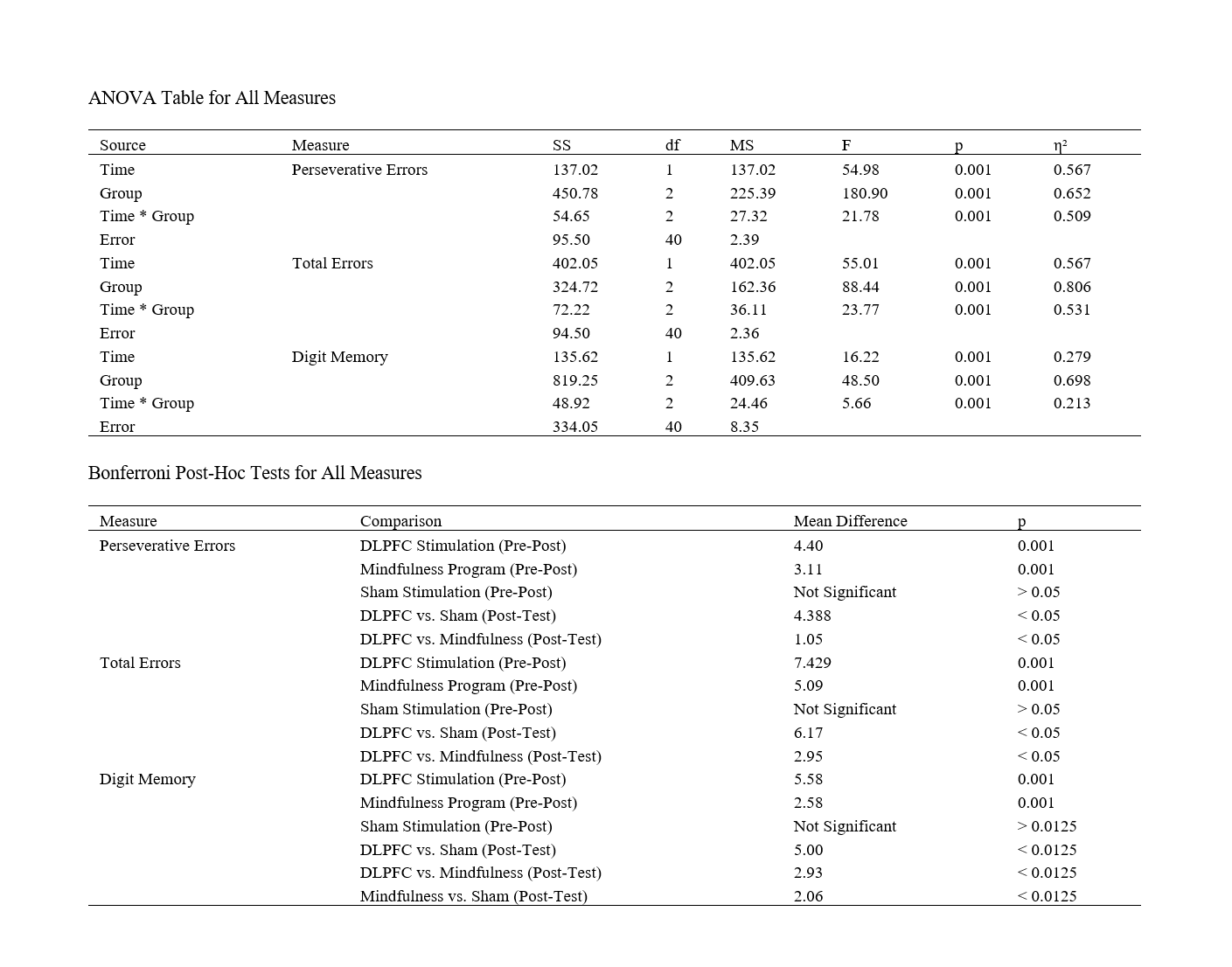
Findings: The results of the composite analysis of variance showed significant main effects of time, group, and the time-group interaction for the research variables, including cognitive flexibility (perseverative error and total error) and working memory. Post hoc test results indicated that the DLPFC stimulation group had significantly better scores in cognitive flexibility (perseverative error and total error) and working memory compared to the mindfulness group.
Conclusion: Hypoactivity of the dorsolateral prefrontal cortex underlies executive function deficits in individuals with ADHD, and transcranial direct current stimulation increases activation of the dorsolateral prefrontal cortex through anodal stimulation.
Downloads
References
1. Kim M, Lee S, Lee JE, Kim JH, Ha EK, Han M, et al. A
nationwide cohort study on the risk of ADHD in children with
amblyopia mediated by fine motor skill impairment in East Asia.
Scientific Reports. 2022;12(1):6932. [PMID: 35484195] [PMCID:
PMC9051132] [DOI]
2. Mokobane M, Pillay BJ, Meyer A. Fine motor deficits
and attention deficit hyperactivity disorder in primary school
children. South African Journal of Psychiatry. 2019;25. [PMID:
30899581 ] [PMCID: PMC6424539] [DOI]
3. American Psychiatric Association A. Diagnostic and
statistical manual of mental disorders: DSM-5-TR: Washington,
DC: American psychiatric association; 2022.
4. Biederman J, Petty CR, Clarke A, Lomedico A, Faraone
SV. Predictors of persistent ADHD: an 11-year follow-up study.
Journal of psychiatric research. 2011;45(2):150-5. [PMID:
20656298] [PMCID: PMC3068747] [DOI]
5. Glozman JM, Shevchenko IA. Executive function in
children with ADHD. Psychology & Neuroscience. 2014;7(4):453.
[DOI]
6. Barkley RA. The important role of executive functioning
and self-regulation in ADHD. J Child Neuropsy. 2011;113(21):41-
56.
7. Huguet A, Ruiz DM, Haro JM, Alda JA. A Pilot Study of
the Efficacy of a Mindfulness Program for Children Newly
Diagnosed with Attention-Deficit Hyperactivity Disorder: Impact
on Core Symptoms and Executive Functions. International Journal
of Psychology & Psychological Therapy. 2017;17(3).
8. McClintock CH, Lau E, Miller L. Phenotypic dimensions
of spirituality: Implications for mental health in China, India, and
the United States. Frontiers in Psychology. 2016;7:1600. [PMID:
27833570] [PMCID: PMC5082226] [DOI]
9. Schmalzl L, Crane-Godreau MA, Payne P. Movementbased embodied contemplative practices: definitions and
paradigms. Frontiers in human neuroscience. 2014;8:205. [DOI]
10. Smalley SL, Loo SK, Hale TS, Shrestha A, McGough J,
Flook L, et al. Mindfulness and attention deficit hyperactivity
disorder. Journal of clinical psychology. 2009;65(10):1087-98.
[PMID: 19681107] [PMCID: PMC2827240] [DOI]
11. Brunoni AR, Nitsche MA, Bolognini N, Bikson M,
Wagner T, Merabet L, et al. Clinical research with transcranial
direct current stimulation (tDCS): challenges and future directions.
Brain stimulation. 2012;5(3):175-95. [PMID: 22037126] [PMCID:
PMC3270156] [DOI]
12. Krause B, Kadosh RC. Can transcranial electrical
stimulation improve learning difficulties in atypical brain
development? A future possibility for cognitive training.
Developmental cognitive neuroscience. 2013;6:176-94. [PMID:
23770059] [PMCID: PMC4064117] [DOI]
13. Palm U, Segmiller FM, Epple AN, Freisleder F-J,
Koutsouleris N, Schulte-Körne G, et al. Transcranial direct current
stimulation in children and adolescents: a comprehensive review.
Journal of neural transmission. 2016;123:1219-34. [PMID:
27173384] [DOI]
14. Vecchio F, Di Iorio R, Miraglia F, Granata G, Romanello
R, Bramanti P, et al. Transcranial direct current stimulation
generates a transient increase of small-world in brain connectivity:
an EEG graph theoretical analysis. Experimental Brain Research.
2018;236:1117-27. [PMID: 29441471] [DOI]
15. Iannone A, Santiago I, Ajao ST, Brasil-Neto J, Rothwell
JC, Spampinato DA. Comparing the effects of focal and
conventional tDCS on motor skill learning: A proof of principle
study. Neuroscience Research. 2022;178:83-6. [PMID: 35123828]
[PMCID: PMC9042790] [DOI]
16. Dubreuil-Vall L, Gomez-Bernal F, Villegas AC, Cirillo
P, Surman C, Ruffini G, et al. Transcranial direct current
stimulation to the left dorsolateral prefrontal cortex improves
cognitive control in patients with attention-deficit/hyperactivity
disorder: a randomized behavioral and neurophysiological study.
Biological Psychiatry: Cognitive Neuroscience and Neuroimaging.
2021;6(4):439-48. [PMID: 33549516] [PMCID: PMC8103824]
[DOI]
17. Nejati V, Salehinejad MA, Nitsche MA, Najian A, Javadi
A-H. Transcranial direct current stimulation improves executive
dysfunctions in ADHD: implications for inhibitory control,
interference control, working memory, and cognitive flexibility.
Journal of attention disorders. 2020;24(13):1928-43. [PMID:
28938852] [DOI]
18. Soltaninejad Z, Nejati V, Ekhtiari H. Effect of anodal and
cathodal transcranial direct current stimulation on DLPFC on
modulation of inhibitory control in ADHD. Journal of Attention
Disorders. 2019;23(4):325-32. [PMID: 26689935] [DOI]
19. Westwood SJ, Bozhilova N, Criaud M, Lam S-L, Lukito
S, Wallace-Hanlon S, et al. The effect of transcranial direct current
stimulation (tDCS) combined with cognitive training on EEG
spectral power in adolescent boys with ADHD: A double-blind,
randomized, sham-controlled trial. IBRO neuroscience reports.
2022;12:55-64. [PMID: 35746969] [PMCID: PMC9210460]
[DOI]
20. Rosen ML, Stern CE, Michalka SW, Devaney KJ,
Somers DC. Cognitive control network contributions to memoryguided visual attention. Cerebral Cortex. 2016;26(5):2059-73.
[PMID: 25750253 ] [PMCID: PMC4830287] [DOI]
21. Klomjai W, Siripornpanich V, Aneksan B, Vimolratana
O, Permpoonputtana K, Tretriluxana J, et al. Effects of cathodal
transcranial direct current stimulation on inhibitory and attention
control in children and adolescents with attention-deficit
hyperactivity disorder: A pilot randomized sham-controlled
crossover study. Journal of Psychiatric Research. 2022;150:130-41.
[PMID: 35367657] [DOI]
22. Yazdi-Ravandi S, Shamsaei F, Matinnia N, Shams J,
Moghimbeigi A, Ghaleiha A, et al. Cognitive process in patients
with obsessive-compulsive disorder: A cross-sectional analytic
study. Basic and Clinical Neuroscience. 2018;9(6):448. [PMID:
30719259] [PMCID: PMC6359683] [DOI]
23. Jacoby N, Lavidor M. Null tDCS effects in a sustained
attention task: the modulating role of learning. Frontiers in
psychology. 2018;9:476. [PMID: 29681876] [PMCID:
PMC5897507] [DOI]
24. Nejati V, Alavi MM, Nitsche MA. The impact of
attention deficit-hyperactivity disorder symptom severity on the
effectiveness of transcranial direct current stimulation (tDCS) on
inhibitory control. Neuroscience. 2021;466:248-57. [PMID:
34015371] [DOI]
25. Haase L, May AC, Falahpour M, Isakovic S, Simmons
AN, Hickman SD, et al. A pilot study investigating changes in
neural processing after mindfulness training in elite athletes.
Frontiers in Behavioral Neuroscience. 2015;9:229. [PMID:
26379521] [PMCID: PMC4550788] [DOI]
26. Hölzel BK, Carmody J, Vangel M, Congleton C,
Yerramsetti SM, Gard T, et al. Mindfulness practice leads to
increases in regional brain gray matter density. Psychiatry research:
neuroimaging. 2011;191(1):36-43. [PMID: 21071182 ] [PMCID:
PMC3004979] [DOI]
27. Jankowski T, Holas P. Metacognitive model of
mindfulness. Consciousness and cognition. 2014;28:64-80. [DOI]
28. Lee Y-C, Chen C-R, Lin K-C. Effects of MindfulnessBased Interventions in Children and Adolescents with ADHD: A
Systematic Review and Meta-Analysis of Randomized Controlled
Trials. International Journal of Environmental Research and Public
Health. 2022;19(22):15198. [PMID: 36429915] [PMCID:
PMC9690476] [DOI]
29. Nien J-T, Wu C-H, Yang K-T, Cho Y-M, Chu C-H,
Chang Y-K, et al. Mindfulness training enhances endurance
performance and executive functions in athletes: An event-related
potential study. Neural plasticity. 2020;2020. [PMID: 32908483]
[PMCID: PMC7474752] [DOI]
30. Siebelink NM, Bögels SM, Speckens AE, Dammers JT,
Wolfers T, Buitelaar JK, et al. A randomised controlled trial
(MindChamp) of a mindfulness‐based intervention for children
with ADHD and their parents. Journal of Child Psychology and
Psychiatry. 2022;63(2):165-77. [PMID: 34030214] [PMCID:
PMC9292876] [DOI]
31. Wong KF, Teng J, Chee MW, Doshi K, Lim J. Positive
effects of mindfulness-based training on energy maintenance and
the EEG correlates of sustained attention in a cohort of nurses.
Frontiers in human neuroscience. 2018;12:80. [PMID: 29545746]
[PMCID: PMC5838011] [DOI]
Downloads
Additional Files
Publication Timeline
Issue
Section
License
Copyright (c) 2024 Ashraf Amini , Amineh Eslamizad , Mehdi Hosseini , Namaan Moradizade (Author)

This work is licensed under a Creative Commons Attribution-NonCommercial 4.0 International License.