The Role of Sports in Promoting Social Inclusion and Health in Marginalized Communities
DOI:
https://doi.org/10.61838/kman.intjssh.7.3.6Keywords:
Social inclusion, health, marginalized communities, sports participation, qualitative research, mental health, community cohesion, personal developmentAbstract
Objective: This study aims to explore the role of sports in promoting social inclusion and health within marginalized communities.
Methods and Materials: A qualitative research design was employed, utilizing semi-structured interviews to gather in-depth insights from participants. Individuals from various marginalized communities, including ethnic minorities, low-income groups, and those with disabilities, were purposefully sampled. Data collection continued until theoretical saturation was achieved, with interviews being transcribed verbatim and analyzed using NVivo software. A thematic analysis approach was used to identify and categorize recurring themes and patterns in the data.
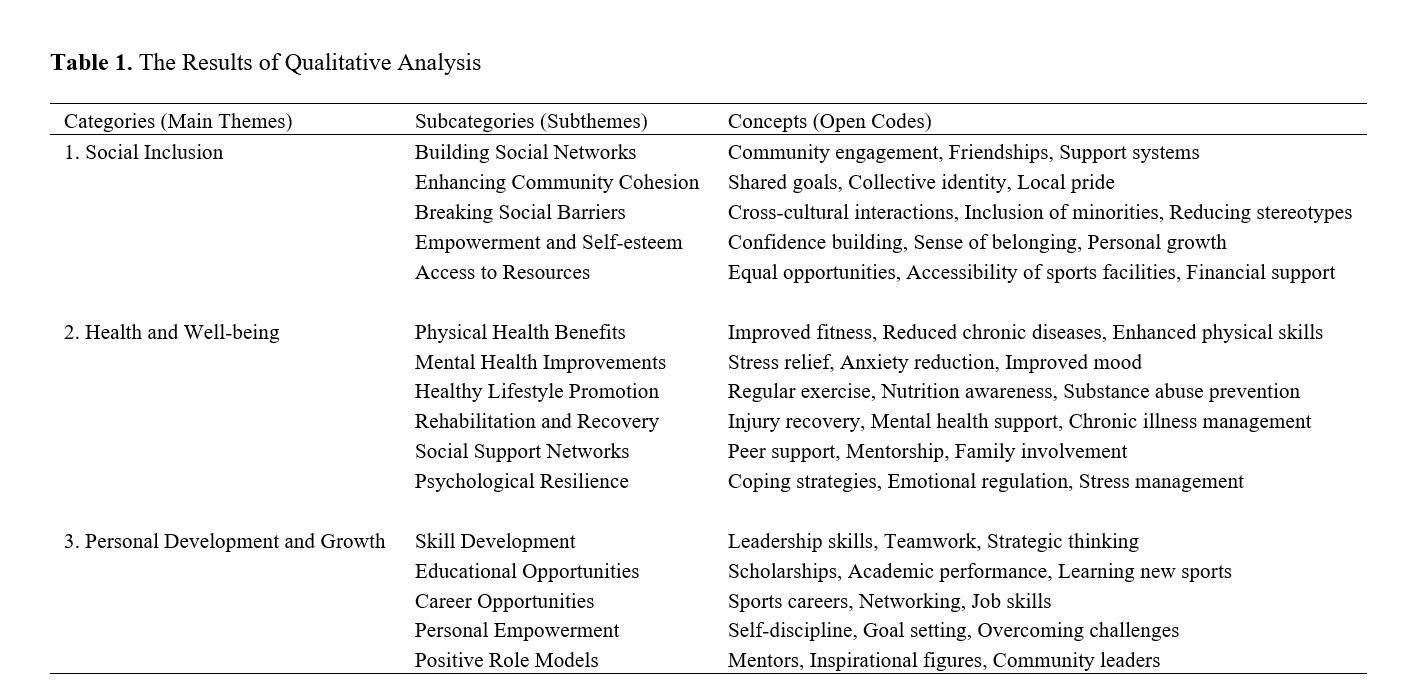
Results: The study identified three main themes: social inclusion, health and well-being, and personal development and growth. Participants reported that sports participation significantly enhanced their social networks, community cohesion, and broke down social barriers, fostering a sense of belonging and empowerment. Physical health benefits included improved fitness and reduced chronic diseases, while mental health improvements encompassed stress relief, anxiety reduction, and mood enhancement. Sports also facilitated personal development by fostering leadership skills, teamwork, and providing educational and career opportunities.
Conclusion: Sports play a crucial role in promoting social inclusion and health within marginalized communities. The findings underscore the multifaceted benefits of sports participation, including enhanced social connections, improved physical and mental health, and personal empowerment. The study suggests that increasing access to inclusive sports programs and addressing barriers to participation can further amplify these benefits.
Downloads
References
1. Lee SA, Ju YJ, Lee JE, Hyun IS, Nam JY, Han K-T, et
al. The relationship between sports facility accessibility and
physical activity among Korean adults. BMC Public Health.
2016;16(1):893. [PMID: 27565430] [PMCID: PMC5002151]
[DOI]
2. Taheri M, Esmaeili A, Irandoust K, Mirmoezzi M,
Souissi A, Laher I, et al. Mental health, eating habits and physical
activity levels of elite Iranian athletes during the COVID-19
pandemic. Science & Sports. 2023;38(5):527-33. [PMID:
37362084] [PMCID: PMC10243596]
3. Vaughan R, Carter GL, Cockroft D, Maggiorini L.
Harder, better, faster, stronger? Mental toughness, the dark triad
and physical activity. Personality and Individual Differences.
2018;131:206-11. [DOI]
4. Ebrahimi Z, Esmaeilzadeh Ghandehari MR, Veisi K. The
Effect of Physical Activity Based on Intergenerational Programs on
the Quality of Life of Older Adults. Salmand: Iranian Journal of
Ageing. 2020;14(4):406-21. [DOI]
5. Eskandarnejhad M, Vakili J, Alezadeh R. Predicting
social anxiety and mental fitness of skilled badminton players by
physical fitness. Sociology and lifestyle management.
2021;6(16):114-30.
6. Eather N, Wade L, Pankowiak A, Eime R. The Impact of
Sports Participation on Mental Health and Social Outcomes in
Adults: A Systematic Review and the ‘Mental Health Through
Sport’ Conceptual Model. Systematic Reviews. 2023;12(1).
[PMID: 37344901] [PMCID: PMC10286465] [DOI]
7. Eime R, Young J, Harvey J, Charity M, Payne W. A
Systematic Review of the Psychological and Social Benefits of
Participation in Sport for Children and Adolescents: Informing
Development of a Conceptual Model of Health Through Sport.
International Journal of Behavioral Nutrition and Physical Activity.
2013;10(1):98. [PMID: 23945179] [PMCID: PMC3751802] [DOI]
8. Jeanes R. A Mixed-Method Analysis of the Contribution
of Informal Sport to Public Health in Australia. Health Promotion
International. 2024;39(3). [PMID: 38809233] [PMCID:
PMC11135211] [DOI]
9. Zhu M, Zhao Y. Research on the Health System of
Community Sports Framework Based on Function Orientation.
Revista Brasileira De Medicina Do Esporte. 2021;27(5):472-5.
[DOI]
10. Sherry E. (Re)engaging Marginalized Groups Through
Sport: The Homeless World Cup. International Review for the
Sociology of Sport. 2010;45(1):59-71. [DOI]
11. Stenner BJ, Buckley JD, Mosewich AD. Reasons Why
Older Adults Play Sport: A Systematic Review. Journal of Sport
and Health Science. 2020;9(6):530-41. [PMID: 33308804]
[PMCID: PMC7749227] [DOI]
12. Hughes D, Saw R, Perera NKP, Mooney M, Wallett A,
Cooke J, et al. The Australian Institute of Sport Framework for
Rebooting Sport in a COVID-19 Environment. Journal of Science
and Medicine in Sport. 2020;23(7):639-63. [PMID: 32451268]
[PMCID: PMC7200343] [DOI]
13. Toffoletti K, Palmer C. New Approaches for Studies of
Muslim Women and Sport. International Review for the Sociology
of Sport. 2016;52(2):146-63. [DOI]
14. Beacom A. Sport for Development and Peace: A Critical
Sociology. Sport in Society. 2013;17(2):274-8. [DOI]
15. Veken KVd, Lauwerier E, Willems S. How Community
Sport Programs May Improve the Health of Vulnerable Population
Groups: A Program Theory. International Journal for Equity in
Health. 2020;19(1). [PMID: 32448226] [PMCID: PMC7245920]
[DOI]
16. Milistetd M, Camiré M, Ciampolini V, Quinaud RT,
Nascimento JVd. Psychosocial Development and Mental Health in
Youth Brazilian Club Athletes: Examining the Effects of Age,
Sport Type, and Training Experience. Brazilian Journal of
Kinanthropometry and Human Performance. 2021. [DOI]
17. Miri Rami SF, Delgoshaei Y, Mahmoudi AH.
Identification and Analysis of Effective Factors on the Strategic
Intelligence of Education Districts Managers of Tehran City and
Provide an Appropriate Model. Iranian Journal of Educational
Sociology. 2022;5(1):113-25. [DOI]
18. Moosavi F, Haydari F, Azimi S. Relationship between
Emotional Intelligence and Mental Health with Social Adjustment
of Athlete Students of Islamic Azad University- Kermanshah
Branch. Strategic Studies On Youth and Sports. 2019;17(42):129-
44.
19. Navah A, Moltafet M, Ghelichi M. Effect of Social
Support and Religiosity on Students' Mental Health (A Case Study:
Students of Shahid Chamran University of Ahvaz). Strategic
Studies on Youth and Sports. 2020;18(46):265-88.
20. Nezhad MAS, Besharat MA. Relations of resilience and
hardiness with sport achievement and mental health in a sample of
athletes. Procedia - Social and Behavioral Sciences. 2010;5:757-
63.
21. Navarro M, van der Kamp J, Schor P, Savelsbergh GJP.
Implicit learning increases shot accuracy of football players when
making strategic decisions during penalty kicking. Human
Movement Science. 2018;61:72-80. [PMID: 30031272] [DOI]
22. Jenkin C, Eime R, Westerbeek H, Uffelen Jv. Sport for
Adults Aged 50+ Years: Participation Benefits and Barriers.
Journal of Aging and Physical Activity. 2018;26(3):363-71.
[PMID: 28952860] [DOI]
Downloads
Additional Files
Publication Timeline
Issue
Section
License
Copyright (c) 2024 Valerie Karstensen , Oriana Piskorz-Ryń , Wioleta Karna , Angel Lee , Xian Seng Neo , Daniela Gottschlich (Author)

This work is licensed under a Creative Commons Attribution-NonCommercial 4.0 International License.