The Role of Sports Psychology in Managing Concussion Recovery and Return to Play
DOI:
https://doi.org/10.61838/kman.intjssh.7.4.9Keywords:
Concussion recovery, sports psychology, return to play, psychological readiness, fear of re-injury, social supportAbstract
Objective: This study explores the role of sports psychology in managing concussion recovery and facilitating athletes’ readiness to return to play.
Methods and Materials: A qualitative research design was utilized, involving semi-structured online interviews with athletes who had experienced concussions, sports psychologists, and medical professionals. 36 Participants were recruited through purposeful sampling, and data collection continued until theoretical saturation was achieved. The interviews were transcribed and analyzed using NVivo software through an inductive thematic approach, allowing for the emergence of key themes. Reflexivity and researcher triangulation were employed to ensure the rigor and reliability of the findings.
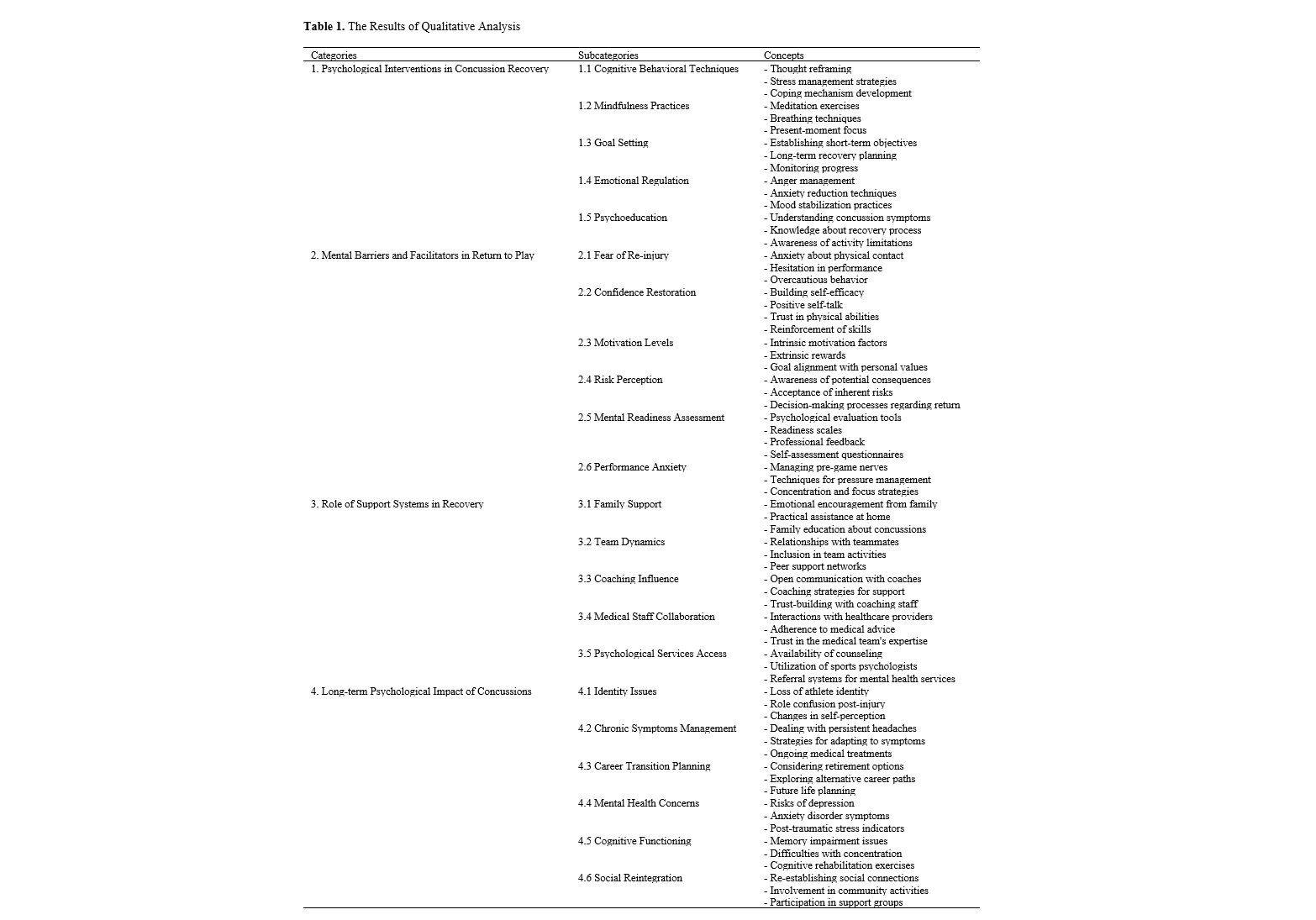
Findings: Four main themes emerged: psychological interventions, mental barriers and facilitators in return to play, the role of support systems, and the long-term psychological impact of concussions. Psychological interventions, such as cognitive-behavioral techniques and mindfulness practices, were effective in reducing anxiety and enhancing resilience. Fear of re-injury and performance anxiety were significant barriers, while confidence restoration and motivation levels facilitated recovery. Social support from family, teammates, and coaches played a crucial role in alleviating psychological distress. The long-term impact included identity crises, chronic symptoms, and ongoing mental health concerns, emphasizing the need for holistic support.
Conclusion: The findings underscore the importance of integrating psychological interventions in concussion recovery. Addressing fear, anxiety, and identity loss, while enhancing confidence and social support, is crucial for a successful return to play. This study highlights the necessity for comprehensive recovery protocols that consider both physical and psychological readiness. Practitioners should prioritize individualized psychological assessments and foster supportive environments to improve recovery outcomes.
Downloads
References
1. Fones L, Kostyun R, Cohen AD, Pace JL. Patient-Reported
Outcomes, Return-to-Sport Status, and Reinjury Rates After Anterior
Cruciate Ligament Reconstruction in Adolescent Athletes: Minimum
2-Year Follow-Up. Orthopaedic Journal of Sports Medicine.
2020;8(11). [PMID: 33283005] [PMCID: PMC7686622] [DOI]
2. Ardern CL, Kvist J. BAck iN the Game (BANG) – A
Smartphone Application to Help Athletes Return to Sport Following
Anterior Cruciate Ligament Reconstruction: Protocol for a MultiCentre, Randomised Controlled Trial. BMC Musculoskeletal
Disorders. 2020;21(1). [PMID: 32770983] [PMCID: PMC7414541]
[DOI]
3. Olds M, Webster KE. Factor Structure of the Shoulder
Instability Return to Sport After Injury Scale: Performance Confidence,
Reinjury Fear and Risk, Emotions, Rehabilitation and Surgery. The
American Journal of Sports Medicine. 2021;49(10):2737-42. [PMID:
34213365] [DOI]
4. Kvist J, Ardern CL. Biopsychosocial Factors Associated
With Return to Preinjury Sport After ACL Injury Treated Without
Reconstruction: NACOX Cohort Study 12-Month Follow-Up. Sports
Health a Multidisciplinary Approach. 2022;15(2):176-84. [PMID:
35633030] [PMCID: PMC9950991] [DOI]
5. Kvist J, Silbernagel KG. Fear of Movement and Reinjury in
Sports Medicine: Relevance for Rehabilitation and Return to Sport.
Physical Therapy. 2021;102(2). [PMID: 34971375] [DOI]
6. Forsdyke D, Madigan DJ, Gledhill A, Smith A. Perceived
Social Support, Reinjury Anxiety, and Psychological Readiness to
Return to Sport in Soccer Players. Journal of Sport Rehabilitation.
2022;31(6):749-55. [PMID: 35405636] [DOI]
7. Reis-Júnior JRd, Bassi‐Dibai D, Morais DN, Pontes‐Silva
A, Mendes LP, Pinheiro JS, et al. Translation, Cross-Cultural
Adaptation, and Validation of the Athlete Fear Avoidance
Questionnaire (AFAQ) Into Brazilian Portuguese. BMC
Musculoskeletal Disorders. 2022;23(1). [PMID: 36357871] [PMCID:
PMC9647760] [DOI]
8. Aizawa J, Hirohata K, Ohji S, Ohmi T, Koga H, Yagishita
K. Factors Associated With Psychological Readiness to Return to
Sports With Cutting, Pivoting, and Jump-Landings After Primary ACL
Reconstruction. Orthopaedic Journal of Sports Medicine. 2020;8(11).
[PMID: 33244476] [PMCID: PMC7678401] [DOI]
9. Aizawa J, Hirohata K, Ohji S, Ohmi T, Mitomo S, Koga H,
et al. Relationships Between Physical Function and Psychological
Readiness to Return to Sport After Anterior Cruciate Ligament
Reconstruction. 2021. [DOI]
10. Lambert C, Guenther D, Schütz L-M, Kern N, Ritzmann R,
Reinert N, et al. Psychological Readiness Is Related to Return to Sport
in Judo Injuries: A Cross-Sectional Study. BMC Sports Science
Medicine and Rehabilitation. 2023;15(1). [PMID: 36797731]
[PMCID: PMC9933272] [DOI]
11. Owusu-Ansah GE. Psychological Readiness to Return to
Sport After Shoulder Instability. JBJS Reviews. 2023;11(9). [PMID:
37656825] [DOI]
12. Shitrit E. The ALR‐RSI Score Can Be Used to Evaluate
Psychological Readiness to Return to Sport After Acute Achilles
Tendon Tear. Knee Surgery Sports Traumatology Arthroscopy.
2023;31(11):4961-8. [PMID: 37612477] [PMCID: PMC10598148]
[DOI]
13. Longo UG. The Impact of Psychological Factors on Return
to Sports After Anterior Cruciate Ligament Reconstruction: A
Systematic Review. Osteology. 2023;3(3):78-93. [DOI]
14. Garcia AV. Substantial Influence of Psychological Factors
on Return to Sports After Anterior Shoulder Instability Surgery: A
Systematic Review and Meta‐analysis. Knee Surgery Sports
Traumatology Arthroscopy. 2023;31(12):5913-23. [PMID: 37991534]
[DOI]
15. Webster KE, Klemm HJ, Feller JA. Rates and Determinants
of Returning to Australian Rules Football in Male Nonprofessional
Athletes After Anterior Cruciate Ligament Reconstruction.
Orthopaedic Journal of Sports Medicine. 2022;10(2). [PMID:
35178464] [PMCID: PMC8844735] [DOI]
16. Webster KE, McPherson AL, Hewett TE, Feller JA. Factors
Associated With a Return to Preinjury Level of Sport Performance
After Anterior Cruciate Ligament Reconstruction Surgery. The
American Journal of Sports Medicine. 2019;47(11):2557-62. [PMCID:
31381373] [DOI]
17. Oladeji LO, Reynolds GL, Gonzales H, DeFroda SF.
Anterior Cruciate Ligament Return to Play: Where Are We Now? The
Journal of Knee Surgery. 2023;37(08):586-92. [PMID: 37459893]
[DOI]
18. Rossi L, Pasqualini I, Brandariz R, Fuentes N, Fieiras C,
Tanoira I, et al. Relationship of the SIRSI Score to Return to Sports
After Surgical Stabilization of Glenohumeral Instability. The American
Journal of Sports Medicine. 2022;50(12):3318-25. [PMID: 36018821]
[DOI]
19. Rossi L, Pasqualini I, Tanoira I, Ranalletta M. Factors That
Influence the Return to Sport After Arthroscopic Bankart Repair for
Glenohumeral Instability. Open Access Journal of Sports Medicine.
2022;Volume 13:35-40. [PMID: 35401017] [PMCID: PMC8985826]
[DOI]
20. Slagers A, Dams OC, Zalinge SDv, Geertzen JHB, Zwerver
J, Reininga IHF, et al. Psychological Factors Change During the
Rehabilitation of an Achilles Tendon Rupture: A Multicenter
Prospective Cohort Study. Physical Therapy. 2021;101(12). [PMID:
34636920] [PMCID: PMC8697845] [DOI]
21. O’Connor S, Moran K, Sheridan A, Brady S, Bruce C,
Beidler E, et al. Fear Avoidance After Injury and Readiness to Return
to Sport in Collegiate Male and Female Gaelic Games Players. Sports
Health a Multidisciplinary Approach. 2021;13(6):532-9. [PMID:
33682535] [PMCID: PMC8558997] [DOI]
22. Rollo I, Carter JM, Close GL, Yanguas J, Gómez-Díaz A,
Leal DM, et al. Role of Sports Psychology and Sports Nutrition in
Return to Play From Musculoskeletal Injuries in Professional Soccer:
An Interdisciplinary Approach. European Journal of Sport Science.
2020;21(7):1054-63. [PMID: 32633210] [DOI]
23. Lubega SK, Makubuya T, Muwonge H, Lambert M. A
Descriptive Prospective Study of Sports Medicine Practices for
Athletes in Uganda. African Health Sciences. 2021;21(2):826-34.
[PMID: 34795741] [PMCID: PMC8568218] [DOI]
24. Gómez-Espejo V, Olmedilla A, Cano LA, García-Mas A,
Ortega E. Psychological Readiness to Return to Sports Practice and
Risk of Recurrence: Case Studies. Frontiers in Psychology. 2022;13.
[PMID: 36211933] [PMCID: PMC9540195] [DOI]
25. Zarzycki R, Arhos EK, Failla M, Capin JJ, Smith AH,
Snyder‐Mackler L. Association of the Psychological Response to the
ACL-SPORTS Training Program and Self-Reported Function at 2
Years After Anterior Cruciate Ligament Reconstruction. The
American Journal of Sports Medicine. 2021;49(13):3495-501. [PMID:
34623939] [PMCID: PMC9258035] [DOI]
Downloads
Additional Files
Publication Timeline
Issue
Section
License
Copyright (c) 2024 Jiantang Yang, Seyed Alireza Saadati, Maximus Monaheng Sefotho (Author)

This work is licensed under a Creative Commons Attribution-NonCommercial 4.0 International License.