Comparison of the Effect of Exercise Types on Perceptual-Motor Performance in Boys with Down Syndrome
DOI:
https://doi.org/10.61838/kman.intjssh.8.1.4Keywords:
Down syndrome, aerobic exercise, resistance training, body mass index, perceptual-motor performanceAbstract
Objective: This study aims to compare the effect of exercise types on perceptual-motor performance in boys with down syndrome.
Materials and Methods: Thirty boys with Down syndrome, aged 7 to 14 years, were randomly assigned to three groups: Experimental Group 1, Experimental Group 2, and a Control Group. The training program for Experimental Group 1 lasted 60 minutes, consisting of 10 minutes of warm-up exercises, including light jogging in place, stretching, and dynamic exercises, followed by 30 minutes of aerobic exercise, 15 minutes of resistance training, and a 5-minute cool-down with light stretching. The training program for Experimental Group 2 also lasted 60 minutes, comprising 10 minutes of warm-up exercises, including light jogging in place, stretching, and dynamic exercises, followed by 30 minutes of resistance training, 15 minutes of aerobic exercise, and a 5-minute cool-down with light stretching. Participants were advised to refrain from engaging in any other physical activities during the 6-week training period.
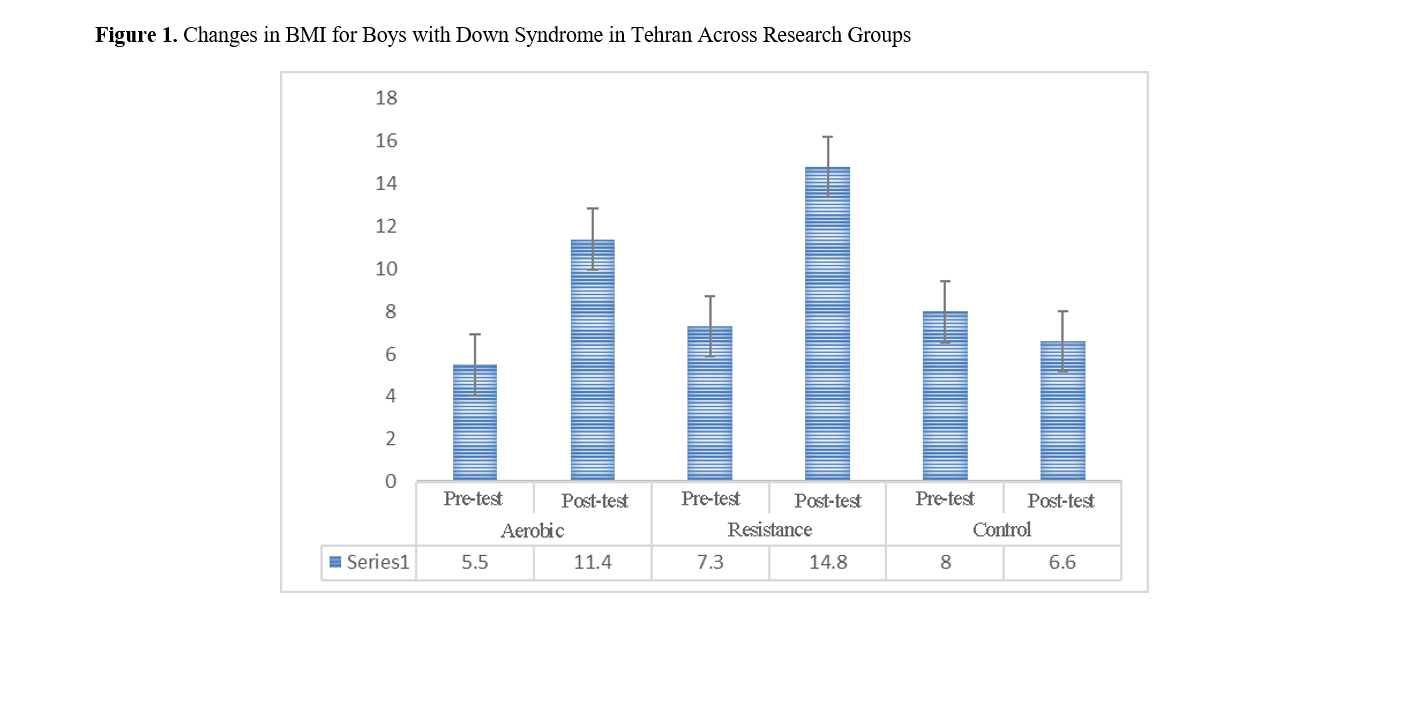
Findings: In the analysis of the interaction effect between group and time, although body mass index (BMI) decreased in both training groups, the difference was not statistically significant (p > .05). However, a significant difference was observed in the interaction effect between group and time for gross motor skills, fine motor skills, and upper limb coordination in both training groups (p < .05).
Conclusion: Aerobic and resistance training can be considered effective methods for improving BMI and perceptual-motor performance in boys with Down syndrome. The findings, in addition to confirming the importance of this therapeutic approach, may contribute to the development of comprehensive intervention programs aimed at enhancing the quality of life for individuals with Down syndrome.
Downloads
References
1. Antonarakis SE, Skotko BG, Rafii MS, Strydom A, Pape
SE, Bianchi DW, et al. Down syndrome. Nature Reviews Disease
Primers. 2020;6(1):9. [PMID: 32029743] [PMCID: PMC8428796]
[DOI]
2. Onnivello S, Pulina F, Locatelli C, Marcolin C,
Ramacieri G, Antonaros F, et al. Cognitive Profiles in Children and
Adolescents With Down Syndrome. Scientific Reports.
2022;12(1). [PMID: 35121796] [PMCID: PMC8816899] [DOI]
3. Østergaard A, et al. Acute lymphoblastic leukemia and
down syndrome: 6-mercaptopurine and methotrexate metabolites
during maintenance therapy. Leukemia. 2021;35(3). [PMID:
32623444] [DOI]
4. Anghel EE, Agheana V. Improving Language Disorders
in Children With Down Syndrome by Applying a Multimodal
Intervention Program Structured in Accordance With the Theory of
Multiple Intelligences. Review of Psychopedagogy. 2022. [DOI]
5. Fidler DJ, Most DE, Booth-LaForce C, Kelly JF.
Temperament and behaviour problems in young children with
Down syndrome at 12, 30, and 45 months. Down Syndrome
Research and Practice. 2006;10(1):23-9. [PMID: 16869370] [DOI]
6. González-Agüero A, Vicente-Rodríguez G, Moreno L,
Guerra-Balic M, Ara I, Casajus JJ. Health-related physical fitness
in children and adolescents with Down syndrome and response to
training. Scandinavian Journal of Medicine & Science in Sports.
2010;20(5):716-24. [PMID: 20456681] [DOI]
7. Rahmani P, Shahrokhi H. The study of static and
dynamic balance in mentally retarded female students with and
without Down Syndrome (DS). Journal of Exercise Science and
Medicine. 2011;2(2):97-113.
8. Esposito PE, MacDonald M, Hornyak JE, Ulrich DA.
Physical activity patterns of youth with Down syndrome.
Intellectual and Developmental Disabilities. 2012;50(2):109-19.
[PMID: 22642965] [DOI]
9. Rigoldi C, Galli M, Mainardi L, Crivellini M, Albertini
G. Postural control in children, teenagers and adults with Down
syndrome. Research in Developmental Disabilities.
2011;32(1):170-5. [PMID: 20933364] [DOI]
10. Agiovlasitis S, Mendonca GV, McCubbin JA, Fernhall
B. Prediction of energy expenditure during walking in adults with
Down syndrome. Journal of Applied Research in Intellectual
Disabilities. 2018;31:151-6. [PMID: 28815878] [DOI]
11. Ulrich DA, Burghardt AR, Lloyd M, Tiernan C, Hornyak
JE. Physical activity benefits of learning to ride a two-wheel
bicycle for children with Down syndrome: A randomized trial.
Physical Therapy. 2011;91(10):1463-77. [PMID: 21852519] [DOI]
12. Mohammadi F, Fatahi SM, Mahmoud, Varzeshi MJPDT.
The Impact of a Core Stability Exercise Program on Static and
Dynamic Balance of Children with Down Syndrome.
2015;3(5):51-8.
13. Boer PH. The effect of 8 weeks of freestyle swim training
on the functional fitness of adults with Down syndrome. Journal of
Intellectual Disability Research. 2020;64(10):770-81. [PMID:
32808345] [DOI]
14. Dijkhuizen A, Waninge A, Hermans S, van der Schans
CP, Krijnen WP. Progressive resistance training for persons with
intellectual disabilities and visual impairment. Journal of Applied
Research in Intellectual Disabilities. 2019;32(5):1194-202. [PMID:
31111635] [DOI]
15. Seron BB, Silva RAC, Greguol M. Effects of two
programs of exercise on body composition of adolescents with
Down syndrome. Revista Paulista de Pediatria. 2014;32:92-8.
[PMID: 24676196] [PMCID: PMC4182986] [DOI]
16. Shields N, Taylor NF, Fernhall B. A study protocol of a
randomised controlled trial to investigate if a community based
strength training programme improves work task performance in
young adults with Down syndrome. BMC Pediatrics. 2010;10:1-7.
[PMID: 20334692] [PMCID: PMC2858133] [DOI]
17. Samavati Sharif MA, Ramezani M, Siavoshy H. A
Comparative Study of Intense Continuous and Intermittent Aerobic
Training on Physiological Factors in Football Players. International
Journal of Sport Studies for Health. 2024;7(1):74-81. [DOI]
18. Burcu A, Tahir K, Yeliz K. Multi joint short term
resistance training strength zone evaluated on maximal strength,
maximal ısometric strength, peak isom reach, maximal isometric
endurance and muscular local endurance in resistance trained men.
Revista de Gestão e Secretariado. 2023;14(10):18789-801. [DOI]
19. Ordonez FJ, Rosety M, Rosety-Rodriguez M. Influence
of 12-week exercise training on fat mass percentage in adolescents
with Down syndrome. Medical Science Monitor.
2006;12(10):CR416-9.
20. Ahmadi M, Hojjati Z. The Impact of an AerobicResistance Exercise Program on Body Composition of Elementary
School Boys with Down Syndrome. The First National Conference
on Sports Science Developments in Health, Prevention, and
Championship. 2016.
21. Rimmer JH, Heller T, Wang E, Valerio I. Improvements
in physical fitness in adults with Down syndrome. American
Journal of Mental Retardation. 2004;109(2):165-74. [PMID:
15000673] [DOI]
22. Wuang YP, Wang CC, Huang MH, Su CY. Prospective
study of the effect of sensory integration, neurodevelopmental
treatment, and perceptual–motor therapy on the sensorimotor
performance in children with mild mental retardation. The
American Journal of Occupational Therapy. 2009;63(4):441-52.
[PMID: 19708473] [DOI]
23. Ahmadi Z, Zadeh Q, Esteghnaei SJFK. The
Effectiveness of Group Aerobic Sports Based on Sensory
Integration Theory on Gross and Fine Motor Skills of Children with
Down Syndrome. 2022;22(1):81-96.
Downloads
Additional Files
Publication Timeline
Issue
Section
License
Copyright (c) 2024 Farnaz Torabi, Reza Khodarahmi (Author)

This work is licensed under a Creative Commons Attribution-NonCommercial 4.0 International License.