Health Behaviors Based on an Active Lifestyle Among Generation Z: A Thematic Analysis
DOI:
https://doi.org/10.61838/kman.intjssh.8.2.8Keywords:
Health Behaviors, Active Lifestyle, Generation Z, Thematic AnalysisAbstract
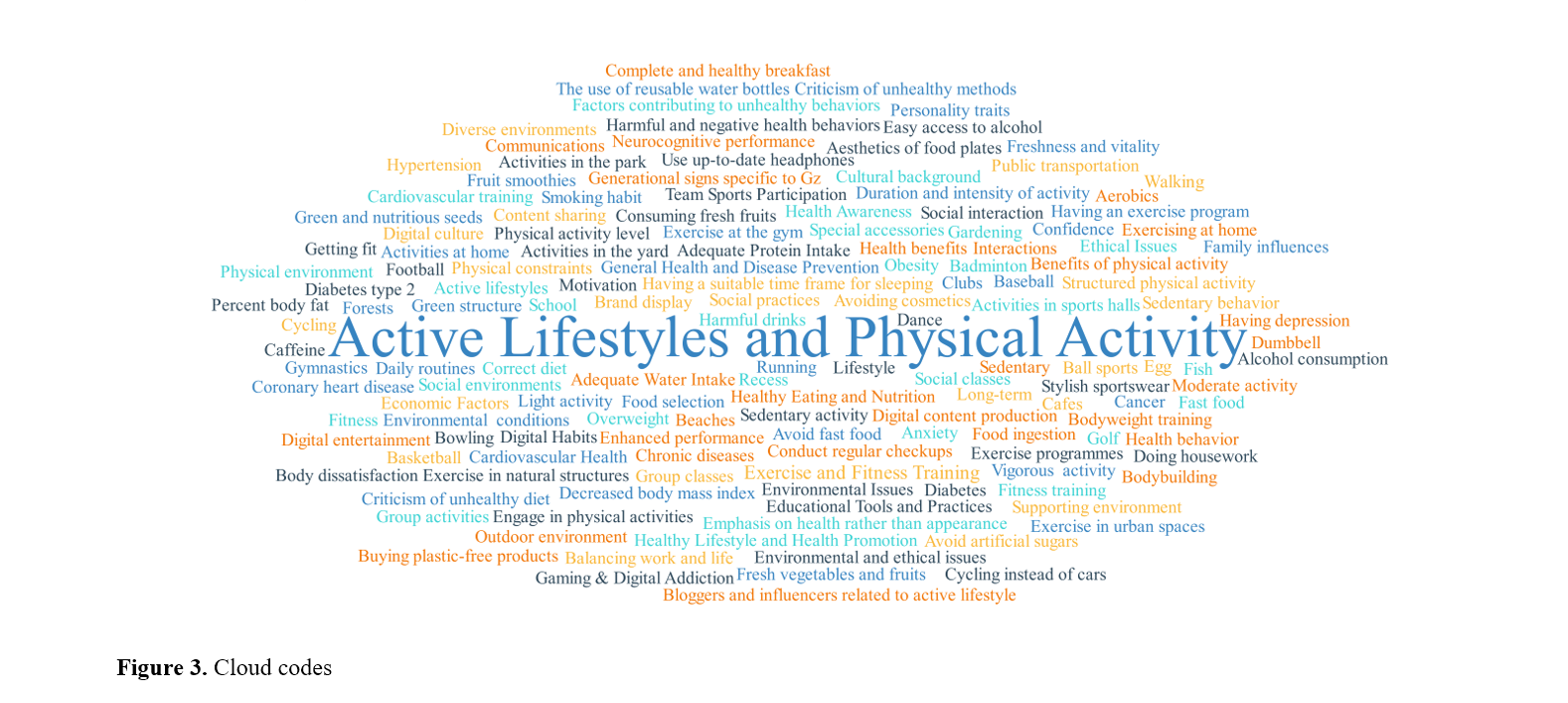
The aim of the present study was to identify health behaviors based on an active lifestyle among Generation Z. This study was classified as applied and qualitative research. The method used in this study was Brown and Clark's six-step thematic analysis. In order to achieve the desired goal, images and videos related to health behaviors, active lifestyle, and Generation Z that were available on the YouTube platform were extracted using Andy Search's artificial intelligence. Then, articles published in the Scopus citation database that were in this field were extracted, and finally the top ten articles were identified using RStudio software. All of these items were analyzed and coded using Maxqda 2020 software, and finally eight themes for health behaviors and active lifestyle among Generation Z were identified. These themes included unhealthy behaviors and barriers, environmental and ethical issues, generational signs specific to Generation Z, mental and social health issues, the role of the environment and society, sports behaviors and physical activity, healthy eating and diet, and the role of technology and digital in health. Overall, the results of this research indicate that to promote an active lifestyle among Generation Z, strategies must be adopted that are consistent with the digital, social, and motivational characteristics of this generation.
Downloads
References
1. Motomura M, Koohsari MJ, Lin C-Y, Ishii K, Shibata A, Nakaya T, et al. Associations of Public Open Space Attributes with Active and Sedentary Behaviors in Dense Urban Areas: A Systematic Review of Observational Studies. Health & Place. 2022;75:102816. [PMID: 35580456] [DOI]
2. Temba GS, Kullaya V, Pecht T, Mmbaga BT, Aschenbrenner AC, Ulas T, et al. Urban Living in Healthy Tanzanians Is Associated with an Inflammatory Status Driven by Dietary and Metabolic Changes. Nature immunology. 2021;22(3):287-300. [PMID: 33574617] [DOI]
3. Katzmarzyk PT, Friedenreich C, Shiroma EJ, Lee IM. Physical Inactivity and Non-Communicable Disease Burden in Low-Income, Middle-Income and High-Income Countries. British Journal of Sports Medicine. 2022;56(2):101-06. [PMID: 33782046] [PMCID: PMC8478970] [DOI]
4. Raffin J, de Souto Barreto P, Pavy Le Traon A, Vellas B, Aubertin-Leheudre M, Rolland Y. Sedentary Behavior and the Biological Hallmarks of Aging. Ageing Research Reviews. 2023;83:101807. [PMID: 36423885] [DOI]
5. Singh C, Bandre G, Gajbe U, Shrivastava S, Tiwade Y, Bankar N, et al. Sedentary Habits and Their Detrimental Impact on Global Health: A Viewpoint. National Journal of Community Medicine. 2024;15(02):154-60. [DOI]
6. Marquez DX, Aguiñaga S, Vásquez PM, Conroy DE, Erickson KI, Hillman C, et al. A Systematic Review of Physical Activity and Quality of Life and Well-Being. Transl Behav Med. 2020;10(5):1098-109. [PMID: 33044541] [PMCID: PMC7752999] [DOI]
7. Teraž K, Pišot S, Šimunic B, Pišot R. Does an Active Lifestyle Matter? A Longitudinal Study of Physical Activity and Health-Related Determinants in Older Adults. Front Public Health. 2022;10:975608. [PMID: 36072381] [PMCID: PMC9441629] [DOI]
8. Brandao-Rangel MAR, Brill B, de Souza Carvalho E, Melamed D, Moraes-Ferreira R, Silva-Reis A, et al. Physically Active Lifestyle Attenuates Impairments on Lung Function and Mechanics in Hypertensive Older Adults. Adv Respir Med. 2024;92(4):278-90. [PMID: 39051189] [PMCID: PMC11270291] [DOI]
9. Marshall S, McGill B, Young C, Clare P, Neill S, Thomas M, et al. Health Behaviour and Wellbeing Trends among Australian Adults before and During the Covid-19 Pandemic (2017-2022): An Interrupted Time-Series Analysis. Prev Med Rep. 2024;46:102861. [PMID: 39257878] [PMCID: PMC11386313] [DOI]
10. Haag D, Smeddinck JD, Vogelsang A, Blechert J. Contextual and Affective Precursors of Physical Activity Intention and Enactment Examined through Ecological Momentary Assessment. Psychology of Sport and Exercise. 2025;77:102796. [PMID: 39647677] [DOI]
11. Dogonchi M, Mohammadzadeh F, Moshki M. Investigating the Relationship between Health Locus of Control and Health Behaviors: A Systematic Review. The Open Public Health Journal. 2022;15. [DOI]
12. Zhang J, Zhang Y, Wu Z, Fu X. Enhancing Understanding of Healthy Aging Based on Time-Varying Dependencies among Multidimensional Health, Life Satisfaction, and Health Behaviors of Older Adults Aged 60 Years and Over. BMC Public Health. 2024;24(1):192. [PMID: 38229050] [PMCID: PMC10790531] [DOI]
13. Arulsamy K, McNamee P, Mendolia S. The Gendered Impact of Covid-19 on Health Behaviours and Mental Health: Evidence from the Uk. Social Science & Medicine. 2025;365:117565. [PMID: 39647181] [DOI]
14. Stenlund S, Koivumaa-Honkanen H, Sillanmäki L, Lagström H, Rautava P, Suominen S. Changed Health Behavior Improves Subjective Well-Being and Vice Versa in a Follow-up of 9 Years. Health and Quality of Life Outcomes. 2022;20(1):66. [PMID: 35449057] [PMCID: PMC9027415] [DOI]
15. Wintle J. Physical Education and Physical Activity Promotion: Lifestyle Sports as Meaningful Experiences. Education Sciences. 2022;12(3):181.
16. Ding D, Ramirez Varela A, Bauman AE, Ekelund U, Lee IM, Heath G, et al. Towards Better Evidence-Informed Global Action: Lessons Learnt from the Lancet Series and Recent Developments in Physical Activity and Public Health. British Journal of Sports Medicine. 2020;54(8):462-68. [PMID: 31562122] [PMCID: PMC7146932] [DOI]
17. Borodulin K, Anderssen S. Physical Activity: Associations with Health and Summary of Guidelines. Food Nutr Res. 2023;67. [PMID: 37441512] [PMCID: PMC10335097] [DOI]
18. de Almeida RS, Marques A. Active Lifestyle in Schizophrenia: How to Combine Exercise and Therapy in Practice? In: Carneiro L, Schuch F, editors. Combining Exercise and Psychotherapy to Treat Mental Health. Hershey, PA, USA: IGI Global; 2024[DOI]
19. Ameen N, Hosany S, Taheri B. Generation Z’s Psychology and New-Age Technologies: Implications for Future Research. Psychology & Marketing. 2023;40(10):2029-40. [DOI]
20. Zhang M, Li J, Li X. Can Esports Help with Hospitality Marketing for Generation Z? The Interaction of Esports, Novelty Seeking, and Subjective Knowledge. International Journal of Hospitality Management. 2025;124:103963. [DOI]
21. Xia Y, Deng Y, Tao X, Zhang S, Wang C. Digital Art Exhibitions and Psychological Well-Being in Chinese Generation Z: An Analysis Based on the S-O-R Framework. Humanities and Social Sciences Communications. 2024;11(1):266. [DOI]
22. Blandi L, Sabbatucci M, Dallagiacoma G, Alberti F, Bertuccio P, Odone A. Digital Information Approach through Social Media among Gen Z and Millennials: The Global Scenario During the Covid-19 Pandemic. Vaccines. 2022;10(11):1822. [PMID: 36366331] [PMCID: PMC9696549] [DOI]
23. Karagözoğlu M, İlhan N. The Effect of Health Literacy on Health Behaviors in a Sample of Turkish Adolescents. Journal of Pediatric Nursing. 2024;77:e187-e94. [PMID: 38604941] [DOI]
24. Chan CMJ, Müller-Riemenschneider F, Chia MYH, Hildon ZJ-L, Chong MF-F. Promoting Healthy Diet and Active Lifestyle (Pedal): A Protocol for the Development and Feasibility Study of a Multicomponent Intervention among Primary School Children in Singapore. Pilot and Feasibility Studies. 2024;10(1):52. [PMID: 38521958] [PMCID: PMC10960416] [DOI]
25. Bektas İ, Kudubeş AA, Ayar D, Bektas M. Predicting the Healthy Lifestyle Behaviors of Turkish Adolescents Based on Their Health Literacy and Self-Efficacy Levels. Journal of Pediatric Nursing. 2021;59:e20-e5. [PMID: 33589289] [DOI]
26. Joubert J, Davis SM, Donnan GA, Levi C, Gonzales G, Joubert L, et al. Icaruss: An Effective Model for Risk Factor Management in Stroke Survivors. International Journal of Stroke. 2020;15(4):438-53. [PMID: 30785379] [DOI]
27. Nascimento MC, Viana A, Dias DdS, Dos Santos F, Dal Corso S, Irigoyen MC, et al. Impact of an Active Lifestyle on Cardiovascular Autonomic Modulation and Oxidative Stress in Males with Overweight and Parental History of Hypertension. Journal of Human Hypertension. 2024;38(5):404-12. [PMID: 38291242] [DOI]
28. Mashud M, Arifin S, Warni H, Samodra T, Yosika GF, Basuki S, et al. Physical Fitness: Effects of Active Lifestyle Internalization through Physical Literacy Awarenes Based Project. Retos. 2023;51:1299-308. [DOI]
29. Ghodeshwar GK, Dube A, Khobragade D. Impact of Lifestyle Modifications on Cardiovascular Health: A Narrative Review. Cureus. 2023;15(7):e42616. [DOI]
30. Michaelsen MM, Esch T. Understanding Health Behavior Change by Motivation and Reward Mechanisms: A Review of the Literature. Frontiers in Behavioral Neuroscience. 2023;17:1151918. [PMID: 37405131] [PMCID: PMC10317209] [DOI]
31. Moran E, Walsh E, Sloan S. Promoting a Restorative Culture in Schools: Insights from School Leaders. International Journal of Educational Research Open. 2025;8:100397. [DOI]
32. Clarke V, Braun V. Thematic Analysis. The Journal of Positive Psychology. 2017;12(3):297-98. [DOI]
33. Herzog C, Handke C, Hitters E. Analyzing Talk and Text Ii: Thematic Analysis. In: Van den Bulck H, Puppis M, Donders K, Van Audenhove L, editors. The Palgrave Handbook of Methods for Media Policy Research. Cham: Springer International Publishing; 2019[DOI]
34. Cernasev A, Axon DR. Research and Scholarly Methods: Thematic Analysis. JACCP: JOURNAL OF THE AMERICAN COLLEGE OF CLINICAL PHARMACY. 2023;6(7):751-55. [DOI]
35. DeJonckheere M, Vaughn LM, James TG, Schondelmeyer AC. Qualitative Thematic Analysis in a Mixed Methods Study: Guidelines and Considerations for Integration. Journal of Mixed Methods Research. 2024;18(3):258-69. [DOI]
36. Campbell K, Orr E, Durepos P, Nguyen L, Li L, Whitmore C, et al. Reflexive Thematic Analysis for Applied Qualitative Health Research. Qualitative Report. 2021;26:2011-28. [PMID: PMC7042105] [DOI]
37. Braun V, Clarke V. Thematic analysis: A practical guide2021. [DOI]
38. de Beijer IAE, Bouwman E, Mulder RL, Steensma P, Brown MC, Araújo-Soares V, et al. Barriers, Facilitators, and Other Factors Associated with Health Behaviors in Childhood, Adolescent, and Young Adult Cancer Survivors: A Systematic Review. Cancer Medicine. 2024;13(12):e7361. [PMID: 39291862] [PMCID: PMC11192647] [DOI]
39. Zhong J, Liu W, Niu B, Lin X, Deng Y. Role of Built Environments on Physical Activity and Health Promotion: A Review and Policy Insights. Frontiers in Public Health. 2022;10:950348. [PMID: 35910910] [PMCID: PMC9326484] [DOI]
40. Carson V, Hunter S. Physical Activity Domains. The Routledge Handbook of Youth Physical Activity: Routledge; 2020[DOI]
41. Villafuerte Arias J, Coloma Guerrero C, Gómez Espinoza L, Enríquez Jácome MÁ, Chávez Arizala JF. Healthy Eating and Nutrition, a Review of the Theoretical Aspects of a Healthy Diet. AG Salud. 2025;3:112. [DOI]
42. Lohan A. Key Constituents of Healthy Diet for Growth, Vigor and Strength. Asian Journal of Research in Social Sciences and Humanities. 2021;11(10):139-45. [DOI]
43. Nielsen P, Sahay S. A Critical Review of the Role of Technology and Context in Digital Health Research. DIGITAL HEALTH. 2022;8:20552076221109554. [PMID: 35769359] [PMCID: PMC9234838] [DOI]
44. Williams CA, Wadey C, Pieles G, Stuart G, Taylor RS, Long L. Physical Activity Interventions for People with Congenital Heart Disease. Cochrane Database Syst Rev. 2020;10(10):Cd013400. [PMID: 33112424] [PMCID: PMC8490972] [DOI]
45. Gautam N, Dessie G, Rahman MM, Khanam R. Socioeconomic Status and Health Behavior in Children and Adolescents: A Systematic Literature Review. Frontiers in Public Health. 2023;11:1228632. [PMID: 37915814] [PMCID: PMC10616829] [DOI]
Downloads
Additional Files
Publication Timeline
Issue
Section
License
Copyright (c) 2025 Hamed Azimi Nojadeh (Author); Fatemeh Abdavi (Corresponding Author); Zühal Yurtsızoğlu (Author)

This work is licensed under a Creative Commons Attribution-NonCommercial 4.0 International License.