Interactive Effect of Dispositional Mindfulness and Type of Attention Instruction on Movement-Specific Reinvestment Components and Basketball Shooting Performance Under Psychological Pressure
DOI:
https://doi.org/10.61838/kman.intjssh.8.3.6Keywords:
Mindfulness, Attention, Psychological PressureAbstract
Objective: This study aimed to investigate the interactive effects of dispositional mindfulness and type of attention instruction on movement-specific reinvestment components and basketball shooting performance under psychological pressure.
Methods and Materials: A total of 80 Bachelor's degree students from the University of Babol, Iraq, were purposefully and conveniently selected and randomly divided into four groups of 20: 1) The high dispositional mindfulness with external focus group (HDMEAG), 2) The high dispositional mindfulness with internal focus group (HDMIAG), 3) The low dispositional mindfulness with external focus group (LDMEAG), 4) The low dispositional mindfulness with internal focus group (LDMIAG). Data were collected using the Brown and Ryan Mindfulness Scale, the movement-specific reinvestment Scale, and the Basketball Shooting Test (mid-range shot). Paired t-tests were used to examine within-group effects, and ANCOVA was used for between-group comparisons.
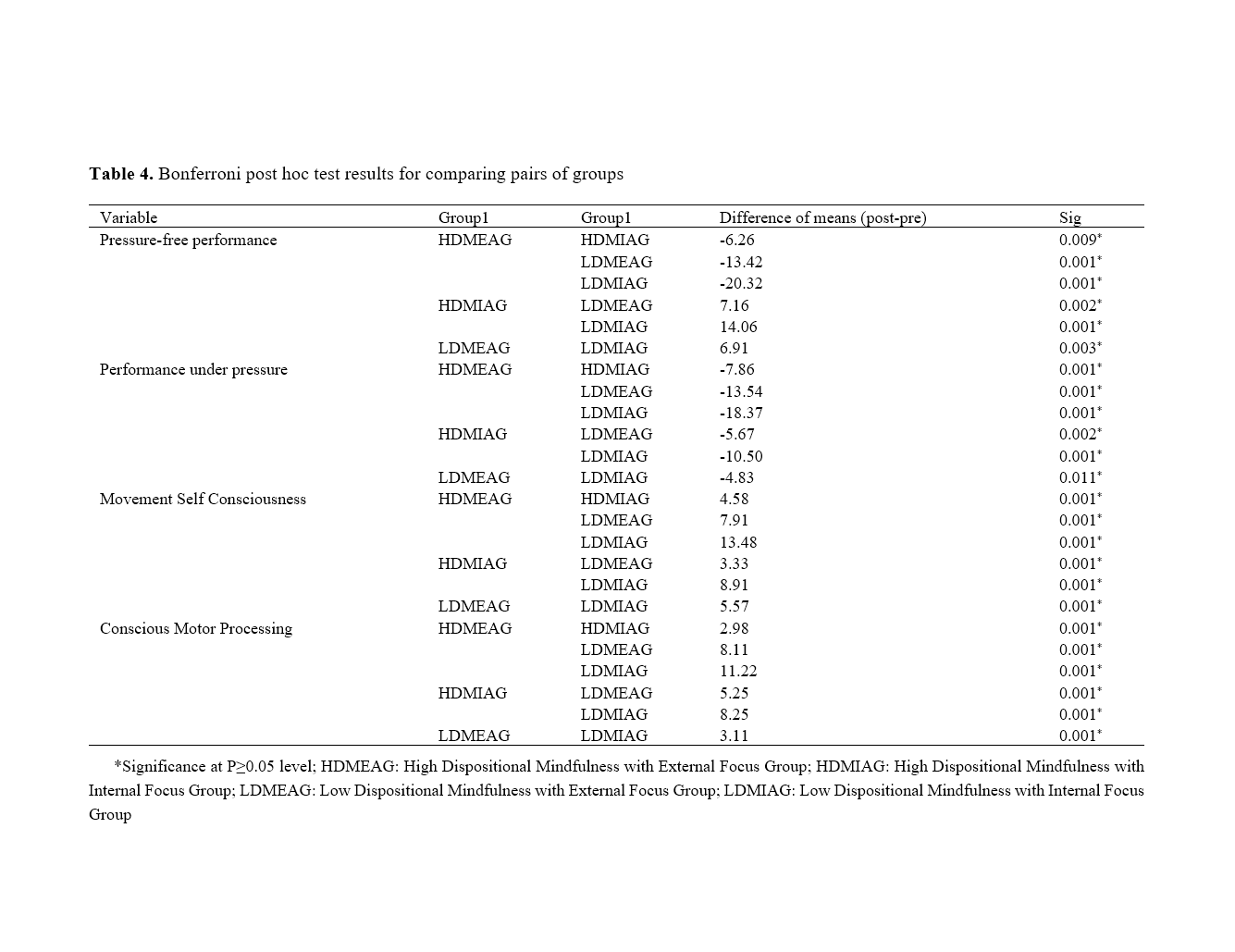
Findings: The results showed that both high and low dispositional mindfulness and internal and external attention improved movement self-consciousness, conscious motor processing, and basketball shooting performance (P≤ 0.05). The findings also indicated that the interaction between high dispositional mindfulness and external attention resulted in the best performance in basketball shooting, movement self-consciousness, and conscious motor processing compared to the other groups (P≤ 0.05).
Conclusion: Overall, the combination of high dispositional mindfulness and external attentional focus appears to be the most optimal state for enhanced athletic performance, whereas low dispositional mindfulness coupled with internal attentional focus may lead to performance decrements and heightened engagement in movement-specific reinvestment.
Downloads
References
1. Hanin Y, Khanin I, Chanin J. Emotions in sport human kinetics. Go to original source. 2000:26-39. [DOI]
2. Jones MV. Controlling emotions in sport. The sport psychologist. 2003;17(4):471-86. [DOI]
3. Verburgh L, Scherder EJ, van Lange PA, Oosterlaan J. Executive functioning in highly talented soccer players. PloS one. 2014;9(3):e91254. [DOI]
4. Kabat-Zinn J, editor Catalyzing movement towards a more contemplative/sacred-appreciating/non-dualistic society. Meeting of the working group; 1994.
5. Shapiro SL, Carlson LE, Astin JA, Freedman B. Mechanisms of mindfulness. Journal of clinical psychology. 2006;62(3):373-86. [DOI]
6. Brown KW, Ryan RM, Creswell JD. Mindfulness: Theoretical foundations and evidence for its salutary effects. Psychological inquiry. 2007;18(4):211-37. [DOI]
7. Brown KW, Ryan RM. The benefits of being present: mindfulness and its role in psychological well-being. Journal of personality and social psychology. 2003;84(4):822. [DOI]
8. Carmody J, Baer RA, LB Lykins E, Olendzki N. An empirical study of the mechanisms of mindfulness in a mindfulness‐based stress reduction program. Journal of clinical psychology. 2009;65(6):613-26. [DOI]
9. Birrer D, Röthlin P, Morgan G. Mindfulness to enhance athletic performance: Theoretical considerations and possible impact mechanisms. Mindfulness. 2012;3(3):235-46. [DOI]
10. Kee YH, Chatzisarantis NN, Kong PW, Chow JY, Chen LH. Mindfulness, movement control, and attentional focus strategies: effects of mindfulness on a postural balance task. Journal of Sport and Exercise Psychology. 2012;34(5):561-79. [DOI]
11. Chiu Y-H, Lu FJ, Gill DL, Lin T-W, Chang C-C, Wu S-C. Interaction of mindfulness disposition and instructional self-talk on motor performance: a laboratory exploration. PeerJ. 2019;7:e7034. [DOI]
12. Liu H-Y, Lu FJ, Hsu Y, Gill DL, Chiu Y-H, Peng Y-H. Interactive effects on motor performance of mindfulness, performance under pressure, self-talk, and motor task characteristics. Perceptual and motor skills. 2022;129(2):307-27. [DOI]
13. Schmidt RA, Lee TD. Motor learning and performance 6th edition with web study guide-loose-leaf edition: From principles to application: Human Kinetics Publishers; 2019.
14. Schmidt RA, Lee TD, Winstein C, Wulf G, Zelaznik HN. Motor control and learning: A behavioral emphasis: Human kinetics; 2018.
15. Badami R, VaezMousavi M, Wulf G, Namazizadeh M. Feedback about more accurate versus less accurate trials: Differential effects on self-confidence and activation. Research quarterly for exercise and sport. 2012;83(2):196-203. [DOI]
16. Anderson DI, Magill RA. Motor learning and control: concepts and applications. New York, NY: McGraw-Hill; 2021.
17. Wulf G, Lewthwaite R. Optimizing performance through intrinsic motivation and attention for learning: The OPTIMAL theory of motor learning. Psychonomic bulletin & review. 2016;23:1382-414. [DOI]
18. Wulf G, Prinz W. Directing attention to movement effects enhances learning: A review. Psychonomic bulletin & review. 2001;8(4):648-60. [DOI]
19. Zachry T, Wulf G, Mercer J, Bezodis N. Increased movement accuracy and reduced EMG activity as the result of adopting an external focus of attention. Brain research bulletin. 2005;67(4):304-9. [DOI]
20. Wulf G, Su J. An external focus of attention enhances golf shot accuracy in beginners and experts. Research quarterly for exercise and sport. 2007;78(4):384-9. [DOI]
21. Kinrade NP, Jackson RC, Ashford KJ. Reinvestment, task complexity and decision making under pressure in basketball. Psychology of Sport and Exercise. 2015;20:11-9. [DOI]
22. Orrell A, Masters R, Eves F. Reinvestment and movement disruption following stroke. Neurorehabilitation and Neural Repair. 2009;23(2):177-83. [DOI]
23. Malhotra N, Poolton JM, Wilson MR, Ngo K, Masters RS. Conscious monitoring and control (reinvestment) in surgical performance under pressure. Surgical endoscopy. 2012;26:2423-9. [DOI]
24. Otten M. Choking vs. clutch performance: A study of sport performance under pressure. Journal of sport and exercise psychology. 2009;31(5):583-601. [DOI]
25. Laborde S, Musculus L, Kalicinski M, Klämpfl MK, Kinrade NP, Lobinger BH. Reinvestment: Examining convergent, discriminant, and criterion validity using psychometric and behavioral measures. Personality and Individual Differences. 2015;78:77-87. [DOI]
26. Masters RS. Knowledge, knerves and know‐how: The role of explicit versus implicit knowledge in the breakdown of a complex motor skill under pressure. British journal of psychology. 1992;83(3):343-58. [DOI]
27. Masters RS, Maxwell JP. Implicit motor learning, reinvestment and movement disruption: What you don’t know won’t hurt you. Skill acquisition in sport: Routledge; 2004. p. 231-52[DOI]
28. Masters RS, Polman RC, Hammond N. ‘Reinvestment’: A dimension of personality implicated in skill breakdown under pressure. Personality and individual differences. 1993;14(5):655-66. [DOI]
29. Hill DM, Carvell S, Matthews N, Weston NJ, Thelwell RR. Exploring choking experiences in elite sport: The role of self-presentation. Psychology of Sport and Exercise. 2017;33:141-9. [DOI]
30. Beilock SL, Carr TH. On the fragility of skilled performance: What governs choking under pressure? Journal of experimental psychology: General. 2001;130(4):701. [DOI]
31. Reeves JL, Tenenbaum G, Lidor R. Choking in front of the Goal: The effects of self‐consciousness training. International Journal of Sport and Exercise Psychology. 2007;5(3):240-54. [DOI]
32. Eysenck MW, Calvo MG. Anxiety and performance: The processing efficiency theory. Cognition & emotion. 1992;6(6):409-34. [DOI]
33. Baumeister RF. Choking under pressure: self-consciousness and paradoxical effects of incentives on skillful performance. Journal of personality and social psychology. 1984;46(3):610. [DOI]
34. Nieuwenhuys A, Oudejans RR. Anxiety and perceptual-motor performance: toward an integrated model of concepts, mechanisms, and processes. Psychological research. 2012;76:747-59. [DOI]
35. Oudejans RR, Kuijpers W, Kooijman CC, Bakker FC. Thoughts and attention of athletes under pressure: skill-focus or performance worries? Anxiety, Stress, & Coping. 2011;24(1):59-73. [DOI]
36. Deng Y-Q, Li S, Tang Y-Y, Zhu L-H, Ryan R, Brown K. Psychometric properties of the Chinese translation of the mindful attention awareness scale (MAAS). Mindfulness. 2012;3:10-4. [DOI]
37. Masters R, Eves F, Maxwell J, editors. Development of a movement specific reinvestment scale. International Society of Sport Psychology (ISSP) World Congress; 2005: International Society of Sport Psychology (ISSP).
38. Soleimani Rad M, Tahmasebi Broojeni S, Mehrsafar AH. Psychometric Properties of Persian Version of Movement-and Decision-Specific Reinvestment Scales. Sport Psychology Studies. 2017;6(20):97-118.
39. Wakefield CJ, Smith D. Impact of differing frequencies of PETTLEP imagery on netball shooting performance. Journal of imagery research in sport and physical activity. 2009;4(1). [DOI]
40. Okazaki VHA, Rodacki ALF. Increased distance of shooting on basketball jump shot. Journal of sports science & medicine. 2012;11(2):231.
41. Fang B-B, Lu FJ, Gill DL, Chiu Y-H, Cheng Y-C, Hsieh M-H, et al. Interactive effects of dispositional mindfulness and PETTLEP imagery training on basketball shooting performance: A randomized controlled trial. Psychology of Sport and Exercise. 2023;65:102366. [DOI]
42. Gooding A, Gardner FL. An investigation of the relationship between mindfulness, preshot routine, and basketball free throw percentage. Journal of Clinical Sport Psychology. 2009;3(4):303-19. [DOI]
43. Josefsson T, Gustafsson H, Iversen Rostad T, Gardner FL, Ivarsson A. Mindfulness and shooting performance in biathlon. A prospective study. European journal of sport science. 2021;21(8):1176-82. [DOI]
44. Koop L, Jooste J. Mindfulness traits as potential inhibitor of irrational performance beliefs and intolerance of uncertainty amongst elite female basketball players. Apunts Sports Medicine. 2023;58(220):100428. [DOI]
45. Orn A. Effects of pressure and free throw routine on basketball kinematics and sport performance: Arizona State University; 2017.
46. Jackson RC, Ashford KJ, Norsworthy G. Attentional focus, dispositional reinvestment, and skilled motor performance under pressure. Journal of Sport and Exercise Psychology. 2006;28(1):49-68. [DOI]
47. Zhu F, Poolton J, Wilson M, Maxwell J, Masters R. Neural co-activation as a yardstick of implicit motor learning and the propensity for conscious control of movement. Biological psychology. 2011;87(1):66-73. [DOI]
48. Toner J, Moran A. Exploring the orthogonal relationship between controlled and automated processes in skilled action. Review of Philosophy and Psychology. 2021;12(3):577-93. [DOI]
49. Masters R, Maxwell J. The theory of reinvestment. International Review of Sport and Exercise Psychology. 2008;1(2):160-83. [DOI]
50. Iwatsuki T, Wright P. Relationships among movement reinvestment, decision-making reinvestment, and perceived choking. International Journal of Coaching Science. 2016;10(1):25-35.
51. Sparks KV, Kavussanu M, Masters RS, Ring C. The rowing-specific reinvestment scale. Journal of Sports Sciences. 2022;40(1):59-72. [DOI]
52. Sparks KV, Kavussanu M, Masters RS, Ring C. Mindfulness, reinvestment, and rowing under pressure: Evidence for moderated moderation of the anxiety-performance relationship. Psychology of Sport and Exercise. 2021;56:101998. [DOI]
53. Rad MS, Boroujeni ST, Jaberimoghaddam AA, Shahbazi M. Performance and decision making of a complex skill under monitoring and outcome pressure conditions: Which of them can reinvestment predict? Psychology of Sport and Exercise. 2022;59:102128. [DOI]
54. Kabat-Zinn J. Full Catastrophe Living: Using the Wisdom of Your Body and Mind to Face Stress, Pain, and Illness: Delta; 1990.
55. Birrer K, Morgan G. A review of the influence of mindfulness on athletic performance. Journal of Sport Psychology in Action. 2010;1(2):90-9.
56. Hanton S, Mellalieu S, Hall R. The effects of mindfulness on performance anxiety in athletes. Journal of Sports Sciences. 2014;32(11):1057-65.
57. Baumeister RF, Vohs KD, Tice DM. The strength model of self-control. Current directions in psychological science. 2007;16(6):351-5. [DOI]
58. Grossman P, Niemann L, Schmidt S, Walach H. Mindfulness-based stress reduction and health benefits: A meta-analysis. Journal of psychosomatic research. 2004;57(1):35-43. [DOI]
59. Naranjo JR, Schmidt S. Is it me or not me? Modulation of perceptual-motor awareness and visuomotor performance by mindfulness meditation. BMC neuroscience. 2012;13:1-17. [DOI]
60. Wulf G. Attentional focus and motor learning: a review of 15 years. International Review of sport and Exercise psychology. 2013;6(1):77-104. [DOI]
61. Liu X, Wu S, She W, Jiang W, Sun J. The effects of attentional focus on motor learning and retention. Journal of Motor Learning and Development. 2015;3(2):147-62.
62. Lohse KR, Sherwood DE, Healy AF. How changing the focus of attention affects performance, kinematics, and electromyography in dart throwing. Human movement science. 2010;29(4):542-55. [DOI]
63. Schücker L, Hagemann N, Strauss B, Völker K. The effect of attentional focus on running economy. Journal of sports sciences. 2009;27(12):1241-8. [DOI]
64. Hossner E-J, Ehrlenspiel F. Time-referenced effects of an internal vs. external focus of attention on muscular activity and compensatory variability. Frontiers in psychology. 2010;1:230. [DOI]
65. Kal E, Van der Kamp J, Houdijk H. External attentional focus enhances movement automatization: A comprehensive test of the constrained action hypothesis. Human movement science. 2013;32(4):527-39. [DOI]
66. Zhang Y, Xu L, Tu W, Qian X. The effects of mindfulness and attentional focus on athletic performance: A meta-analysis. Journal of Sports Sciences. 2016;34(12):1245-55. [DOI]
67. Roberts R, Woodman T. Personality and performance: Moving beyond the Big 5. Current opinion in psychology. 2017;16:104-8. [DOI]
68. Bühlmayer L, Birrer D, Röthlin P, Faude O, Donath L. Effects of mindfulness practice on performance-relevant parameters and performance outcomes in sports: A meta-analytical review. Sports medicine. 2017;47:2309-21. [DOI]
Downloads
Additional Files
Publication Timeline
Issue
Section
License
Copyright (c) 2025 Haidar Ghasem Kazem, Hasan Mohammadzadeh (Author); Jalal Dehghanizade (Corresponding Author)

This work is licensed under a Creative Commons Attribution-NonCommercial 4.0 International License.