Exploring the Effects of Physical Activity Levels and Sleep Quality on Cognitive Failure in Elderly: A Cross-Sectional Study
DOI:
https://doi.org/10.61838/kman.intjssh.8.4.6Keywords:
Cognitive Impairment, Older Adults, Physical Activity, Sleep Quality.Abstract
Abstract
Objectives: Aging is a natural stage of life characterized by physiological and cognitive changes that increase the risk of cognitive failure. Among modifiable lifestyle factors, physical activity and sleep quality play a crucial role in maintaining cognitive function in older adults. Therefore, the present study aimed to examine the effects of physical activity levels and sleep quality on cognitive failure in Iranian older adults.
Methods & Materials: To achieve the objectives of the study, a descriptive, cross-sectional study was conducted using a multistage cluster random sampling method. The study population consisted of adults aged 60 and older from five geographical regions of Iran. The data were collected using the Cognitive Failures Questionnaire (CFQ), Pittsburgh Sleep Quality Index (PSQI), and the CHAMPS Physical Activity Questionnaire for Older Adults. Finally, the data were analyzed using a two-way multivariate analysis of variance (MANOVA).
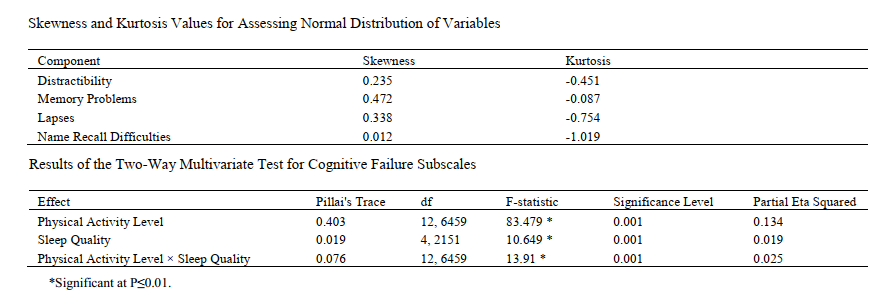
Results: The results of the two-way multivariate analysis of variance (MANOVA) revealed significant main effects for both physical activity level and sleep quality, as well as a significant interaction effect between physical activity level and sleep quality on the subscales of cognitive failure (p<.001). Follow-up tests of the interaction using a simple main effects test indicated that the effect of physical activity level on all subscales of cognitive failure depended on sleep quality. Specifically, in older adults with good sleep quality, the effect of physical activity on cognitive variables was significantly larger and more robust (partial eta squared ranging from .142 to .382). This suggests that under conditions of optimal sleep quality, individuals experience more pronounced benefits from physical activity. Conversely, while the effect of physical activity was also statistically significant in older adults with poor sleep quality (partial eta squared ranging from .060 to .111), the magnitude of this effect was diminished. This implies that even with suboptimal sleep, physical activity remains beneficial, although its impact is less pronounced than when sleep quality is also optimal.
Conclusion: The results revealed that the synergistic effect of physical activity and high-quality sleep is crucial for enhancing cognitive performance in the elderly. The beneficial effects of physical activity on cognitive performance were most pronounced when accompanied by optimal sleep quality. Consequently, it is recommended for health specialists and policymakers to prioritize integrated interventions that concurrently promote regular physical activity and offer strategies to improve sleep hygiene. Focusing on a single factor is unlikely to yield optimal results.
Downloads
References
1. Yazdanbakhsh K, Azarnia A. The Effectiveness of Cognitive Rehabilitation on Improving the Cognitive Abilities of the Elderly. Iranian Journal of Ageing. 2023;18(1):32-45. [DOI]
2. World Health O. Aging and health. 2021.
3. Petersen RC, Lopez O, Armstrong MJ, Getchius TS, Ganguli M, Gloss D, et al. Practice guideline update summary: Mild cognitive impairment: Report of the Guideline Development, Dissemination, and Implementation Subcommittee of the American Academy of Neurology. Neurology. 2018;90(3):126. [PMID: 29282327] [PMCID: PMC5772157] [DOI]
4. Prince M, Bryce R, Albanese E, Wimo A, Ribeiro W, Ferri CP. The global prevalence of dementia: a systematic review and meta-analysis. Alzheimer's & Dementia. 2013;9(1):63-75. [PMID: 23305823] [DOI]
5. Zarei S, Esmaeilpour-Bandboni M, Mansour-Ghanaei R, Alizadeh I. Investigation of Correlation between Communication Skills and Self-Reported Elder Mistreatment in Family Abuse. Avicenna Journal of Medicine. 2024;14(02):123-9. [PMID: 38957154] [PMCID: PMC11216802] [DOI]
6. Livingston G, Huntley J, Sommerlad A, Ames D, Ballard C, Banerjee S, et al. Dementia prevention, intervention, and care: 2020 report of the Lancet Commission. The Lancet. 2020;396(10248):413-46. [PMID: 32738937] [DOI]
7. Stillman CM, Cohen J, Lehman ME, Erickson KI. Mediators of physical activity on neurocognitive function: a review at multiple levels of analysis. Frontiers in Human Neuroscience. 2016;10:626. [PMID: 28018195] [PMCID: PMC5161022] [DOI]
8. Dinoff A, Herrmann N, Swardfager W, Liu CS, Sherman C, Chan S, et al. The effect of exercise training on resting concentrations of peripheral brain-derived neurotrophic factor (BDNF): a meta-analysis. PloS One. 2016;11(9):e0163037. [PMID: 27658238] [PMCID: PMC5033477] [DOI]
9. Kivimäki M, Singh-Manoux A, Pentti J, Sabia S, Nyberg ST, Alfredsson L, et al. Physical inactivity, cardiometabolic disease, and risk of dementia: an individual-participant meta-analysis. BMJ. 2019;365:l1495. [PMID: 30995986] [PMCID: PMC6468884] [DOI]
10. Erickson KI, Hillman C, Stillman CM, Ballard RM, Bloodgood B, Conroy DE, et al. Physical activity, cognition, and brain outcomes: a review of the 2018 physical activity guidelines. Medicine and Science in Sports and Exercise. 2019;51(6):1242. [PMID: 31095081] [PMCID: PMC6527141] [DOI]
11. Walker MP, Stickgold R. Sleep, memory, and plasticity. Annual Review of Psychology. 2006;57(1):139-66. [PMID: 16318592] [DOI]
12. Xie L, Kang H, Xu Q, Chen MJ, Liao Y, Thiyagarajan M, et al. Sleep drives metabolite clearance from the adult brain. Science. 2013;342(6156):373-7. [PMID: 24136970] [PMCID: PMC3880190] [DOI]
13. Irwin MR. Sleep and inflammation: partners in sickness and in health. Nature Reviews Immunology. 2019;19(11):702-15. [PMID: 31289370] [DOI]
14. Tononi G, Cirelli C. Sleep and the price of plasticity: from synaptic and cellular homeostasis to memory consolidation and integration. Neuron. 2014;81(1):12-34. [PMID: 24411729] [PMCID: PMC3921176] [DOI]
15. Diekelmann S, Born J. The memory function of sleep. Nature Reviews Neuroscience. 2010;11(2):114-26. [PMID: 20046194] [DOI]
16. Wilckens KA, Erickson KI, Wheeler ME. Physical activity and cognition: a mediating role of efficient sleep. Behavioral Sleep Medicine. 2018;16(6):569-86. [PMID: 27935322] [PMCID: PMC5466488] [DOI]
17. Bloomberg M, Brocklebank L, Hamer M, Steptoe A. Joint associations of physical activity and sleep duration with cognitive ageing: longitudinal analysis of an English cohort study. The Lancet Healthy Longevity. 2023;4(7):e345-e53. [PMID: 37421962] [DOI]
18. Kim K, Hwang G, Cho YH, Kim EJ, Woang JW, Hong CH, et al. Relationships of physical activity, depression, and sleep with cognitive function in community-dwelling older adults. International Journal of Environmental Research and Public Health. 2022;19(23):15655. [PMID: 36497729] [PMCID: PMC9737085] [DOI]
19. Kato K, Iwamoto K, Kawano N, Noda Y, Ozaki N, Noda A. Differential effects of physical activity and sleep duration on cognitive function in young adults. Journal of Sport and Health Science. 2018;7(2):227-36. [PMID: 30356485] [PMCID: PMC6180557] [DOI]
20. Seol J, Lee J, Park I, Tokuyama K, Fukusumi S, Kokubo T, et al. Bidirectional associations between physical activity and sleep in older adults: a multilevel analysis using polysomnography. Scientific Reports. 2022;12(1):15399. [PMID: 36100642] [PMCID: PMC9470065] [DOI]
21. Amiri S, Hasani J, Satkin M. Effect of exercise training on improving sleep disturbances: a systematic review and meta-analysis of randomized control trials. Sleep Medicine. 2021;84:205-18. [PMID: 34166987] [DOI]
22. Sanaeifar F, Pourranjbar S, Pourranjbar M, Ramezani S, Mehr SR, Wadan AHS, et al. Beneficial effects of physical exercise on cognitive-behavioral impairments and brain-derived neurotrophic factor alteration in the limbic system induced by neurodegeneration. Experimental Gerontology. 2024;195:112539. [PMID: 39116955] [DOI]
23. Tortora C, Di Crosta A, La Malva P, Prete G, Ceccato I, Mammarella N, et al. Virtual reality and cognitive rehabilitation for older adults with mild cognitive impairment: A systematic review. Ageing Research Reviews. 2024;93:102146. [PMID: 38036103] [DOI]
24. Tartibian B, Heidary D, Mehdipour A, Akbarizadeh S. The effect of exercise and physical activity on sleep quality and quality of life in Iranian Older Adults: A systematic review. Journal of Gerontology. 2021;6(1):18-31.
25. Miyazaki R, Ayabe M, Kumahara H, Morimura K, Inukai Y. Effects of light-to-moderate intensity aerobic exercise on objectively measured sleep parameters among community-dwelling older people. Archives of Gerontology and Geriatrics. 2021;94:104336. [PMID: 33493954] [DOI]
26. Zhao H, Lu C, Yi C. Physical activity and sleep quality association in different populations: a meta-analysis. International Journal of Environmental Research and Public Health. 2023;20(3):1864. [PMID: 36767229] [PMCID: PMC9914680] [DOI]
27. Xie Y, Liu S, Chen XJ, Yu HH, Yang Y, Wang W. Effects of exercise on sleep quality and insomnia in adults: a systematic review and meta-analysis of randomized controlled trials. Frontiers in Psychiatry. 2021;12:664499. [PMID: 34163383] [PMCID: PMC8215288] [DOI]
28. Guertin PA. Cardiovascular Diseases, Vital Organ Fibrosis, and Chronic Inflammation Associated with High-Intensity and/or High-Volume Exercise Training: Double-Edged Sword Effects of Vigorous Physical Activity in Elderly People and/or in Middle-Age Cancer-Therapy-Treated Patients. Journal of Functional Morphology and Kinesiology. 2025;10(1):33. [PMID: 39846674] [PMCID: PMC11755580] [DOI]
29. Chrysant SG. Effects of physical activity on sleep quality and wellbeing. Hospital Practice. 2024;52(1-2):13-8. [PMID: 38407170] [DOI]
30. Falck RS, Best JR, Davis JC, Liu-Ambrose T. The independent associations of physical activity and sleep with cognitive function in older adults. Journal of Alzheimer's Disease. 2018;63(4):1469-84. [PMID: 29782311] [DOI]
31. Ren Z, Long J, Deng W, Jing Y, Qiu J, Ren W, et al. Causal Relationship Between Sleep Traits and Hypothalamic-Pituitary-Target Gland Axis Function: A Mendelian Randomization Study. Nature and Science of Sleep. 2024:155-75. [PMID: 38379755] [PMCID: PMC10878316] [DOI]
32. Zhang D, Chen Y, Xie L, Zhao M. Introduction to the Special Issue on Wireless Sensing for Health Monitoring and Elderly Care. ACM New York, NY. 2025:1-. [DOI]
33. Štefan L, Vrgoč G, Rupčić T, Sporiš G, Sekulić D. Sleep duration and sleep quality are associated with physical activity in elderly people living in nursing homes. International Journal of Environmental Research and Public Health. 2018;15(11):2512. [PMID: 30423981] [PMCID: PMC6266288] [DOI]
34. Silva VP, Silva MP, Silva VLdS, Mantovani DB, Mittelmann JV, Oliveira JV. Effect of physical exercise on sleep quality in elderly adults: a systematic review with a meta-analysis of controlled and randomized studies. Journal of Ageing and Longevity. 2022;2(2):85-97. [DOI]
35. Solis-Navarro L, Masot O, Torres-Castro R, Otto-Yáñez M, Fernández-Jané C, Solà-Madurell M. Effects on sleep quality of physical exercise programs in older adults: a systematic review and meta-analysis. Clocks & Sleep. 2023;5(2):152-66. [PMID: 37092426] [PMCID: PMC10123754] [DOI]
36. Vanderlinden J, Boen F, Van Uffelen J. Effects of physical activity programs on sleep outcomes in older adults: a systematic review. International Journal of Behavioral Nutrition and Physical Activity. 2020;17:1-15. [PMID: 32024532] [PMCID: PMC7003368] [DOI]
37. Fank F, da Silva Pereira F, Dos Santos L, De Mello MT, Mazo GZ. Effects of exercise on sleep in older adults: an overview of systematic reviews and meta-analyses. Journal of Aging and Physical Activity. 2022;30(6):1101-17. [PMID: 35385825] [DOI]
38. Mahmoudzadeh H, Aghayari Hir T, Hatami D. Study and Analysis of the Elderly Population of Iran. Geographical Researches. 2022;37(1):111-25.
39. Mecacci L, Righi S. Cognitive failures, metacognitive beliefs and aging. Personality and Individual Differences. 2006;40(7):1453-9. [DOI]
40. Yazdi SM, Darvizeh Z, Sheikhi Z. A comparative study on cognitive failures and coping strategies in people with Major Depression Disorder (MDD), Generalized Anxiety Disorder (GAD), and comorbidity. Journal of Psychological Studies. 2015;11(3):7-28. [DOI]
41. Sahaf R, Delbari A, Fadaye Vatan R, Rassafiani M, Sabour M, Ansari G, et al. Validity and reliability of self-report physical activity instruments for Iranian older people. Iranian Journal of Ageing. 2014(3):206-17.
42. Mellow ML, Crozier AJ, Dumuid D, Wade AT, Goldsworthy MR, Dorrian J, et al. How are combinations of physical activity, sedentary behaviour and sleep related to cognitive function in older adults? A systematic review. Experimental Gerontology. 2022;159:111698. [PMID: 35026335] [DOI]
43. Gao X, Qiao Y, Chen Q, Wang C, Zhang P. Effects of different types of exercise on sleep quality based on Pittsburgh Sleep Quality Index in middle-aged and older adults: a network meta-analysis. Journal of Clinical Sleep Medicine. 2024;20(7):1193-204. [PMID: 38450497] [PMCID: PMC11217626] [DOI]
44. Hu W, Chu J, Chen X, Liu S, Sun N, Han Q, et al. The role of depression and physical activity in the association of sleep quality and duration with health-related quality of life among the elderly: a UK Biobank cross-sectional study. BMC Geriatrics. 2022;22(1):338. [PMID: 35436848] [PMCID: PMC9016983] [DOI]
45. Wang F, Boros S. The effect of physical activity on sleep quality: a systematic review. 2021.
46. Alhusami M, Jatan N, Dsouza S, Sultan MA. Association between physical activity and sleep quality among healthcare students. Frontiers in Sports and Active Living. 2024;6:1357043. [PMID: 38419911] [PMCID: PMC10899451] [DOI]
47. Kasmadi M, Suhadi S. The relationship between physical activity intensity, sleep quality and stress levels in adolescent physical fitness. Jurnal SPORTIF: Jurnal Penelitian Pembelajaran. 2024;10(1):15-30. [DOI]
Downloads
Additional Files
Publication Timeline
Issue
Section
License
Copyright (c) 2025 Farzaneh Hatami (Corresponding Author); Shafagh Abolghasemi Atani, Valerie Caron, Saheb Yousefi (Author)

This work is licensed under a Creative Commons Attribution-NonCommercial 4.0 International License.