The Effect of Two Weeks of L-Carnitine Supplementation on Muscle Damage Markers Following Intense Aerobic Activity in Female Karate Players
DOI:
https://doi.org/10.61838/kman.intjssh.8.3.10Keywords:
L-carnitine, Creatine kinase, Lactate dehydrogenaseAbstract
Background and Aim: This study investigated the effect of two weeks of L-carnitine supplementation on muscle damage markers, specifically creatine kinase (CK) and lactate dehydrogenase (LDH), following intense aerobic activity in female karate athletes.
Methods: This experimental study employed a repeated-measures design with a control group. Twenty-one female karate athletes from Mashhad were selected based on inclusion criteria and randomly assigned to either the L-carnitine or placebo group. For 14 days, the L-carnitine group received 2 grams of L-carnitine daily in capsule form, while the placebo group received 2 grams of starch capsules. On day 15, participants underwent a fasting blood draw before performing an endurance running test. Subsequent blood samples were collected at 5 minutes, 2 hours, and 24 hours post-endurance test. Data analysis was performed using repeated-measures ANOVA with SPSS version 24, with a significance level set at p<0.05.
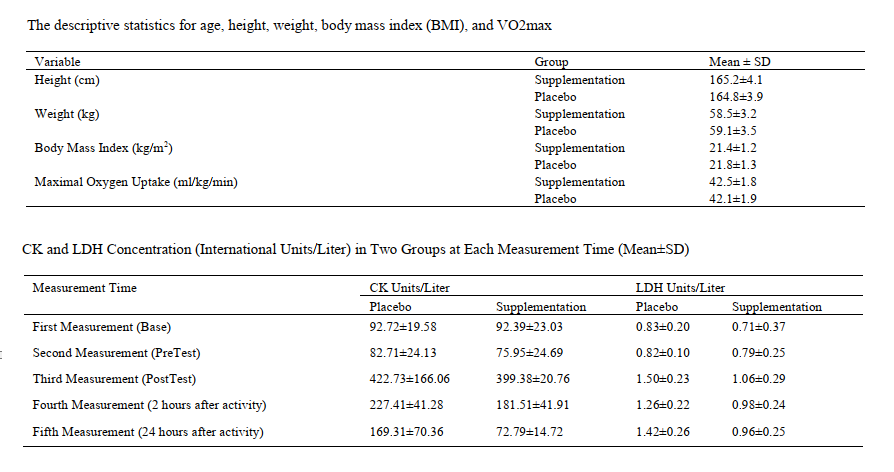
Findings: The results indicated a significant increase in CK and LDH levels immediately after activity compared to immediately before activity within the L-carnitine group (p<0.05). No other significant differences were observed in subsequent pairwise comparisons within this group. Conversely, the placebo group showed significant increases in CK and LDH levels immediately, 2 hours, and 24 hours after activity compared to two weeks before the activity (p<0.05). Furthermore, a significant difference was observed between the L-carnitine and placebo groups for CK and LDH levels immediately, 2 hours, and 24 hours after activity, with significantly higher values in the placebo group.
Conclusion: These findings suggest that two weeks of L-carnitine supplementation at a dose of 2 grams may potentially help prevent further muscle breakdown up to 24 hours following intense aerobic activity.
Downloads
References
1. Zhang D-M, Guo Z-X, Zhao Y-L, Wang Q-J, Gao Y-S, Yu T, et al. L-carnitine regulated Nrf2/Keap1 activation in vitro and in vivo and protected oxidized fish oil-induced inflammation response by inhibiting the NF-κB signaling pathway in Rhynchocypris lagowski Dybowski. Fish & shellfish immunology. 2019;93:1100-10. [DOI]
2. Pashayi P, Abbassi Daloii A, Barari AR, Mir Javadi SR. The Effect of Endurance Training and L-Carnitine Supplementation on Gene Expression of Hepatic Enzymes (AST, ALT, ALP) in Wistar Male Rats Toxicated by Boldenone. Journal of Advanced Biomedical Sciences. 2019;9(4):1710-8.
3. Khushboo M, Murthy MK, Devi MS, Sanjeev S, Ibrahim KS, Kumar NS, et al. Testicular toxicity and sperm quality following copper exposure in Wistar albino rats: ameliorative potentials of L-carnitine. Environmental Science and Pollution Research. 2018;25(2):1837-62. [PMID: 29103113] [DOI]
4. Bordoni L, Sawicka AK, Szarmach A, Winklewski PJ, Olek RA, Gabbianelli R. A pilot study on the effects of l-Carnitine and Trimethylamine-N-oxide on platelet mitochondrial DNA methylation and CVD biomarkers in aged women. International journal of molecular sciences. 2020;21(3):1047. [PMID: 32033285] [PMCID: PMC7037757] [DOI]
5. Tousson E, Keshta AT, Hussein Y, Fekry RM, Abo-Ghaneima WK. Renal protective effect of ginkgo biloba and L-carnitine extracts against pentylenetetrazol induced toxicity, oxidative stress, injury and proliferation alternation in epileptic rats. 2019. [DOI]
6. Fakourian A, Azarbayjani MA, Farzanegi P. The Effect of Aerobic Training and L-Carnitine on BCL2 and Mitochondrial Enzymes of Rat's Kidney. Iranian journal of diabetes and obesity. 2020. [DOI]
7. Gnoni A, Longo S, Gnoni GV, Giudetti AM. Carnitine in human muscle bioenergetics: can carnitine supplementation improve physical exercise? Molecules. 2020;25(1):182. [PMID: 31906370] [PMCID: PMC6982879] [DOI]
8. Lee B-J, Lin J-S, Lin Y-C, Lin P-T. Effects of L-carnitine supplementation on lipid profiles in patients with coronary artery disease. Lipids in health and disease. 2016;15:1-8. [PMID: 27317162] [PMCID: PMC4912751] [DOI]
9. Luz PLd, Favarato D, Faria-Neto Junior JR, Lemos P, Chagas ACP. High ratio of triglycerides to HDL-cholesterol predicts extensive coronary disease. Clinics. 2008;63:427-32. [PMID: 18719750] [PMCID: PMC2664115] [DOI]
10. Allen J, Sun Y, Woods JA. Exercise and the regulation of inflammatory responses. Progress in molecular biology and translational science. 2015;135:337-54. [PMID: 26477921] [DOI]
11. Asjodi F, Heidari N, Saydi A, Kordi N. Effects of Acute L-carnitine Supplementation with Incremental Training on Fat and Carbohydrate Metabolism in Overweight/Obese and Normal-Weight Young Men. Journal of Sport Physiology Special Groups. 2024;1(4):1-15.
12. Cha Y-S, Choi S-K, Suh H, Lee S-N, Cho D, Lim K. Effects of carnitine coingested caffeine on carnitine metabolism and endurance capacity in athletes. Journal of nutritional science and vitaminology. 2001;47(6):378-84. [PMID: 11922111] [DOI]
13. Ascensão A, Ferreira R, Magalhães J. Exercise-induced cardioprotection—biochemical, morphological and functional evidence in whole tissue and isolated mitochondria. International journal of cardiology. 2007;117(1):16-30. [PMID: 16860886] [DOI]
14. Chaabène H, Mkaouer B, Franchini E, Souissi N, Selmi MA, Nagra Y, et al. Physiological responses and performance analysis difference between official and simulated karate combat conditions. Asian journal of sports medicine. 2013;5(1):21. [PMID: 24868428] [PMCID: PMC4009084] [DOI]
15. Clarkson PM, Sayers SP. Gender differences in exercise-induced muscle damage. Gender differences in metabolism: CRC Press; 2020. p. 283-99
16. Wall BT, Stephens FB, Constantin‐Teodosiu D, Marimuthu K, Macdonald IA, Greenhaff PL. Chronic oral ingestion of L‐carnitine and carbohydrate increases muscle carnitine content and alters muscle fuel metabolism during exercise in humans. The Journal of physiology. 2011;589(4):963-73. [PMID: 21224234] [PMCID: PMC3060373] [DOI]
17. Bassett DR, Howley ET. Limiting factors for maximum oxygen uptake and determinants of endurance performance. Medicine and science in sports and exercise. 2000;32(1):70-84. [PMID: 10647532] [DOI]
18. Petersen EW, Ostrowski K, Ibfelt T, Richelle M, Offord E, Halkjær-Kristensen J, et al. Effect of vitamin supplementation on cytokine response and on muscle damage after strenuous exercise. American Journal of Physiology-Cell Physiology. 2001;280(6):C1570-C5. [PMID: 11350752] [DOI]
19. Tsakiris S, Parthimos T, Parthimos N, Tsakiris T, Schulpis KH. The beneficial effect of L-cysteine supplementation on DNA oxidation induced by forced training. Pharmacological research. 2006;53(4):386-90. [PMID: 16517176] [DOI]
20. Cunningham P, Geary M, Harper R, Pendleton A, Stover S. HIGH INTENSITY SPRINT TRAINING REDUCES LIPID PEROXIDATION IN FAST-TWITCH SKELETAL MUSCLE. Journal of Exercise Physiology Online. 2005;8(6).
21. Ghasemzadeh M, Hosseini E, Roudsari ZO, Zadkhak P. Intraplatelet reactive oxygen species (ROS) correlate with the shedding of adhesive receptors, microvesiculation and platelet adhesion to collagen during storage: does endogenous ROS generation downregulate platelet adhesive function? Thrombosis Research. 2018;163:153-61. [PMID: 29407628] [DOI]
22. Klaus V, Hartmann T, Gambini J, Graf P, Stahl W, Hartwig A, et al. 1, 4-Naphthoquinones as inducers of oxidative damage and stress signaling in HaCaT human keratinocytes. Archives of biochemistry and biophysics. 2010;496(2):93-100. [PMID: 20153715] [DOI]
23. Vavaev A, Buryachkovskaya L, Uchitel I, Tishchenko E, Maksimenko A. Effect of hydrogen peroxide and catalase derivatives on functional activity of platelets. Bulletin of experimental biology and medicine. 2012;152:307-12. [PMID: 22803073] [DOI]
Downloads
Additional Files
Publication Timeline
Issue
Section
License
Copyright (c) 2025 Saeed Ilbeigi (Corresponding Author); Zohreh Torab Beigi, Marziyeh Saghebjoo, Mozhgan Jafari (Author)

This work is licensed under a Creative Commons Attribution-NonCommercial 4.0 International License.