Innovative Strategies and Competitive Dynamics in Non-Profit Sports Clubs: From Transformation to Performance
DOI:
https://doi.org/10.61838/kman.intjssh.8.4.7Keywords:
Innovative behavior, environmental dynamics, competitive advantage, organizational performance, Nonprofit Sports Clubs.Abstract
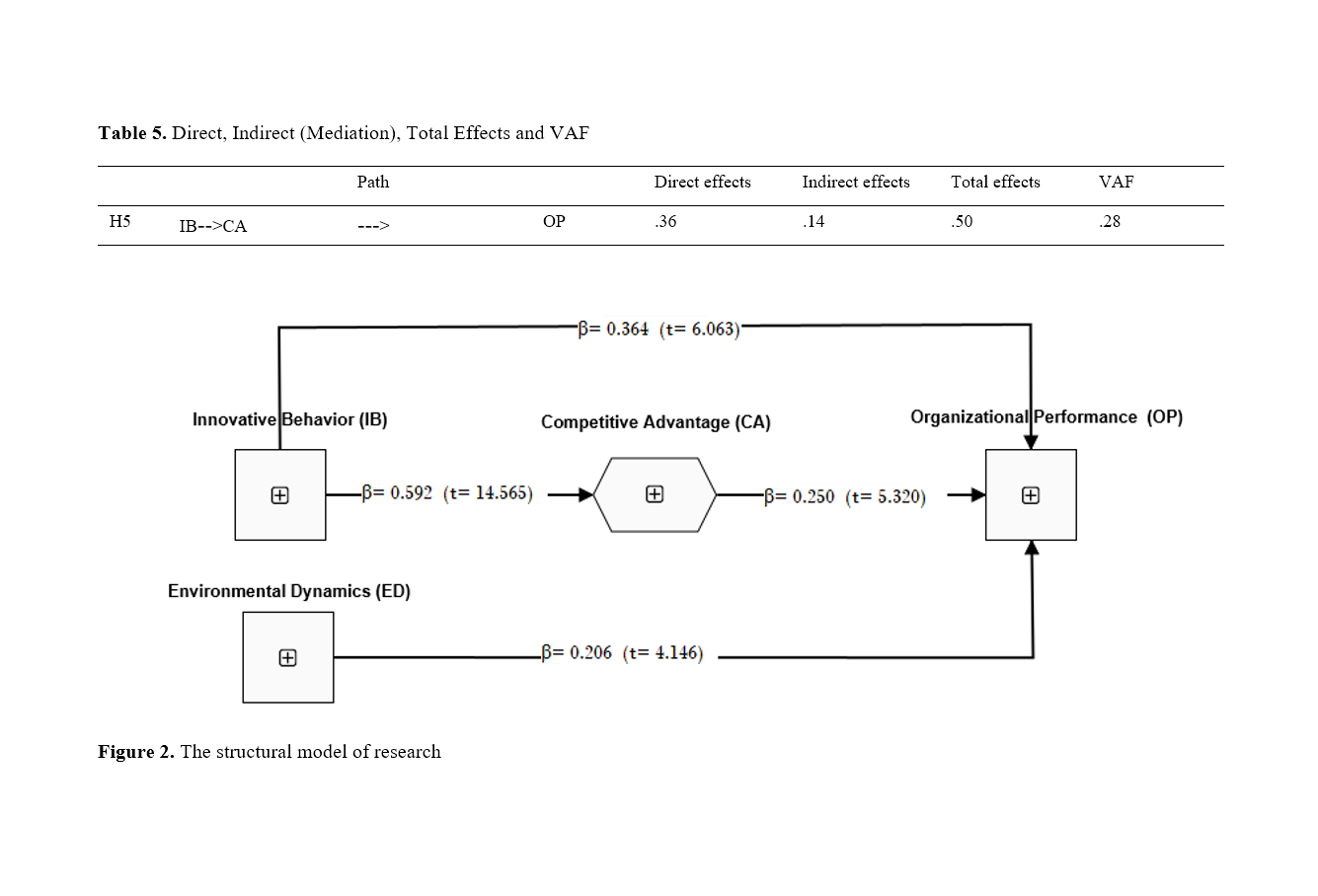
Objective: This paper examines the impact of IB, ED, and CA on OP in NPSOs. Given the increasing challenges such as economic and social changes and increasing competition, the present study identifies factors that can help improve the performance of these clubs.
Methods and Materials: In this research, we have proposed a theoretical model and empirically tested the model in a sample of 391 board members of NPSOs in Tehran province of Iran.
Findings: The findings support the proposed model, and the structural equation modeling (SEM-PLS) evaluation suggests that, IB has a positive and significant effect on OP and CA acts as a mediating variable in this relationship. Also, ED also has a positive effect on OP. Overall, the findings indicate that innovation and the ability to adapt to environmental changes can significantly contribute to improving OP.
Conclusion: This research adds to the richness of the sports management literature and recommends that NPSO managers focus on enhancing innovation and adaptation to environmental changes to gain sustainable CA.
Downloads
References
1. Aletaha SH, Shaemi Barzoki A, Safari A. Identifying the Challenges of Human Resource Management in Non-profit Organizations. Journal of Public Administration. 2022;14(4):580-601.
2. Nahrkhalaji SS, Shafiee S, Shafiee M, Hvam L, editors. Challenges of digital transformation: The case of the non-profit sector. 2018 IEEE international conference on industrial engineering and engineering management (IEEM); 2018: IEEE.
3. Sibisi N, Makka A. Financial challenges experienced by South African non-profit organisations regarding CSR implementation. Social Responsibility Journal. 2022;18(6):1089-105.
4. Vos S, Breesch D, Scheerder J. Undeclared work in non-profit sports clubs: A mixed method approach for assessing the size and motives. VOLUNTAS: International Journal of Voluntary and Nonprofit Organizations. 2012;23:846-69.
5. Ratten V. Social entrepreneurship and innovation in sports. International journal of social entrepreneurship and innovation. 2011;1(1):42-54.
6. Pashaie S, Golmohammadi H. Exploring the Influence of E-CRM on the innovation capabilities of sports venues: The moderating role of covid-19. Sports Marketing Studies. 2024;4(3):108-28.
7. Lin Z, Shin H. Structural relationship between organizational justice, organizational trust, and knowledge sharing and innovative behavior: Focus on professors from Chinese sport universities. Journal of Physical Education and Sport. 2021;21(2):882-93.
8. Mir Ameri H, Abbasi H, Jamshidi E. Investigating the Effect of Absorptive Capacity and Creativity on Experts’ Innovative Behavior in Ministry of Sport and Youth of Iran. Sport Management Journal. 2019;11(3):521-46.
9. Jogaratnam G. The effect of market orientation, entrepreneurial orientation and human capital on positional advantage: Evidence from the restaurant industry. International Journal of Hospitality Management. 2017;60:104-13.
10. Kasim A. Environmental management system (EMS) Postulating the value of its adoption to organizational learning in hotels. International Journal of Contemporary Hospitality Management. 2015;27(6):1233-53.
11. Tjønndal A. Sport innovation: Developing a typology. European Journal for Sport and Society. 2017;14(4):291-310.
12. Wemmer F, Emrich E, Koenigstorfer J. The impact of coopetition-based open innovation on performance in nonprofit sports clubs. European Sport Management Quarterly. 2016;16(3):341-63.
13. Behnam M, Delshab V, Tuan LT. Perceived service innovation in non-profit sports clubs: The antecedents and consequence. European Sport Management Quarterly. 2022;22(3):440-62.
14. Skinner J, Smith AC, Swanson S. Fostering innovative cultures in sport: leadership, innovation and change. 1, editor: Springer; 2018.
15. Hashemi A, Jassbi A, Bonyadi Naeini A, Daliri MR. Investigating the Relationship between Cognitive Decision-Making Style and Innovative Work Behavior. Transformation Management Journal. 2023;14(Autumn & Winter 2023):1-41.
16. Thurlings M, Evers AT, Vermeulen M. Toward a model of explaining teachers’ innovative behavior: A literature review. Review of educational research. 2015;85(3):430-71.
17. Winand M, Hoeber L. Innovation capability of non-profit sport organizations. Sport entrepreneurship and innovation. 2017;3(2):13-30.
18. Winand M, Rihoux B, Robinson L, Zintz T. Pathways to high performance: A qualitative comparative analysis of sport governing bodies. Nonprofit and Voluntary Sector Quarterly. 2013;42(4):739-62.
19. Hoeber L, Doherty A, Hoeber O, Wolfe R. The nature of innovation in community sport organizations. European Sport Management Quarterly. 2015;15(5):518-34.
20. Wemmer F, Koenigstorfer J. Open innovation in nonprofit sports clubs. VOLUNTAS: international journal of voluntary and nonprofit organizations. 2016;27:1923-49.
21. Delshab V, Winand M, Sadeghi Boroujerdi S, Hoeber L, Mahmoudian A. The impact of knowledge management on performance in nonprofit sports clubs: The mediating role of attitude toward innovation, open innovation, and innovativeness. European Sport Management Quarterly. 2022;22(2):139-60.
22. Ferreira J, Coelho A, Moutinho L. Dynamic capabilities, creativity and innovation capability and their impact on competitive advantage and firm performance: The moderating role of entrepreneurial orientation. Technovation. 2020;92:102061.
23. Elidemir S. Innovative Behaviors, Employee Creativity, and Sustainable Competitive Advantage: ModeratedMediation Evidence from Hotel Industry. 2020.
24. Koentjoro S, Gunawan S. Managing knowledge, dynamic capabilities, innovative performance, and creating sustainable competitive advantage in family companies: A case study of a family company in Indonesia. Journal of Open Innovation: Technology, Market, and Complexity. 2020;6(3):90.
25. Nosratpanah R, Barani S, Ashrafzadeh A, Atashi G. The Effect of Dynamic Service Innovation Capabilities on Firm Performance: The Moderating Role of Perceived Environmental Dynamism and the Mediating Role of Service Innovation and Competitive Advantage. Journal of Business Management. 2024;16(1):137-66.
26. Tu Y, Wu W. How does green innovation improve enterprises’ competitive advantage? The role of organizational learning. Sustainable Production and Consumption. 2021;26:504-16.
27. Abou-Moghli A, Al Abdallah G, Al Muala A. Impact of innovation on realizing competitive advantage in banking sector in Jordan. American Academic & Scholarly Research Journal. 2012;4(5).
28. Farida I, Setiawan D. Business strategies and competitive advantage: the role of performance and innovation. Journal of Open Innovation: Technology, Market, and Complexity. 2022;8(3):163.
29. Rossi L, Breuer C, Feiler S. Determinants of non-profit sports clubs’ perceived competition from commercial sports providers. Sport management review. 2020;23(4):736-49.
30. Rossi L, Feiler S, Dallmeyer S, Breuer C. Organizational capacity building in non-profit sport clubs: exploring the role of competition as a capacity building stimulus. European Sport Management Quarterly. 2024;24(4):857-75.
31. Baron RA, Tang J. The role of entrepreneurs in firm-level innovation: Joint effects of positive affect, creativity, and environmental dynamism. Journal of business venturing. 2011;26(1):49-60.
32. Pérez-Luño A, Gopalakrishnan S, Cabrera RV. Innovation and performance: The role of environmental dynamism on the success of innovation choices. IEEE Transactions on Engineering Management. 2014;61(3):499-510.
33. Adibpour MR, Daneshvar Deylami MR, Dehghanan H. The Impact of Person–Invironment Fit, on Innovative Work Behavior and Job Performance by Mediating Role of Innovation Trust. Public Organizations Management. 2016;4(3):105-18.
34. Jiao H, Alon I, Cui Y. Environmental dynamism, innovation, and dynamic capabilities: the case of China. Journal of Enterprising Communities: People and Places in the Global Economy. 2011;5(2):131-44.
35. Dess GG, Beard DW. Dimensions of organizational task environments. Administrative science quarterly. 1984;29(1):52-73.
36. Çakmak Z. Adapting to environmental change: The importance of organizational agility in the business landscape. Florya Chronicles of Political Economy. 2023;9(1):67-87.
37. Moradi M, mostahfezian m, Ghasemi H, zahedi h. A Model for Organizational Dynamism in the Ministry of Sports and Youth of the Islamic Republic of Iran. Strategic Studies on Youth and Sports. 2023;22(60):33-46.
38. Barney J. Firm Resources and Sustained Competitive Advantage. Journal of Management. 1991;17(1):99-120.
39. Rudsaz H, seyed naghavi ma, Abdoli Masinan F. The Effect of Open Innovation on Competitive Advantage Considering the Mediation Role of Knowledge Management. Industrial Management Studies. 2020;18(59):117-50.
40. Nasifoglu Elidemir S, Ozturen A, Bayighomog SW. Innovative behaviors, employee creativity, and sustainable competitive advantage: A moderated mediation. Sustainability. 2020;12(8):3295.
41. Modiri M, Kashef SM, Behnam M. The mediating role of shared leadership on the relationship between organizational capacity types with technical and administrative innovation in sport organizations. Organizational Behavior Management in Sport Studies. 2023;10(4):97-108.
42. Vos S, Breesch D, Késenne S, Lagae W, Van Hoecke J, Vanreusel B, et al. The value of human resources in non-public sports providers: The importance of volunteers in non-profit sports clubs versus professionals in for-profit fitness and health clubs. International Journal of Sport Management and Marketing 2. 2012;11(1-2):3-25.
43. Skinner J, Zakus DH, Cowell J. Development through sport: Building social capital in disadvantaged communities. Sport management review. 2008;11(3):253-75.
44. Siegfried J, Zimbalist A. The Economic Impact of Sports Facilities, Teams and Mega-Events. Australian Economic Review. 2006;39(4).
45. Robertson J, Eime R, Westerbeek H. Community sports clubs: are they only about playing sport, or do they have broader health promotion and social responsibilities? Annals of Leisure Research. 2019;22(2):215-32.
46. He Z-L, Wong P-K. Exploration vs. exploitation: An empirical test of the ambidexterity hypothesis. Organization science. 2004;15(4):481-94.
47. Jansen JJ, Van Den Bosch FA, Volberda HW. Exploratory innovation, exploitative innovation, and performance: Effects of organizational antecedents and environmental moderators. Management science. 2006;52(11):1661-74.
48. Dehghani Soltani M, Mesbahi M, Agheli Gouki F. The Effect of Innovation Behavior on Organizational Performance with clarifying role of Intellectual Capital, Opportunism and Competitive Advantage in Hotel Industry. Journal of Tourism and Development. 2020;9(3):263-78.
49. Simon A, Honore Petnji Yaya L. Improving innovation and customer satisfaction through systems integration. Industrial Management & Data Systems. 2012;112(7):1026-43.
50. Ramezanlo K, Benar N, Saeedi F. Creating a Competitive Advantage in Sports Businesses: The Role of Input Sources, Market Position and Creativity. Research in Sport Management and Motor Behavior,. 2022;12(23):123-44.
51. Malek Mahmoudi V, Mandalizadeh Z, Zohra Vandian K. The Effect of Innovation Capability on Innovative Performance of Sport Clubs. New approaches in sports management. 2022;9(35):29-44.
52. Chen J-S, Tsou H-T. Performance effects of IT capability, service process innovation, and the mediating role of customer service. Journal of Engineering and Technology Management. 2012;29(1):71-94.
53. Malekzadeh K, Haji Hosseini R, Radfar R, Malekzadeh K. Effective factors in creating innovation capabilities (a case study of an aviation industry research center in Iran). Innovation management. 2014;3(1):75-100.
54. Escamilla-Fajardo P, Núñez-Pomar J, Parra-Camacho D. Does the organizational climate predict the innovation in sports clubs? Journal of Entrepreneurship and Public Policy. 2019;8(1):103-21.
55. Shanker R, Bhanugopan R, Van der Heijden BI, Farrell M. Organizational climate for innovation and organizational performance: The mediating effect of innovative work behavior. Journal of vocational behavior. 2017;100:67-77.
56. Tsai S-P. Driving holistic innovation to heighten hotel customer loyalty. Current Issues in Tourism. 2017;20(15):1604-19.
57. Sok P, O'cass A. Achieving service quality through service innovation exploration–exploitation: the critical role of employee empowerment and slack resources. Journal of Services Marketing. 2015;29(2):137-49.
58. Escamilla-Fajardo P, Núñez-Pomar JM, Gómez-Tafalla AM. Exploring environmental and entrepreneurial antecedents of social performance in Spanish sports clubs: A symmetric and asymmetric approach. Sustainability. 2020;12(10):4234.
59. Laalkazemian E, Jafari Titkanloo S. The effect of strategic change with organizational learning and environmental dynamics on organizational performance. Journal of Strategic Management Studies. 2022;13(50):175-99.
60. Tidd J. Innovation management in context: environment, organization and performance. International journal of management reviews. 2001;3(3):169-83.
61. Boeker W, Goodstein J. Organizational performance and adaptation: Effects of environment and performance on changes in board composition. Academy of Management journal. 1991;34(4):805-26.
62. Pashaie S, Golmohammadi H, Hoseini MD. Social Customer Relationship Management Capabilities in Sports Facilities. Journal of New Studies in Sport Management. 2023;4(4).
63. Chiu C-N, Yang C-L. Competitive advantage and simultaneous mutual influences between information technology adoption and service innovation: Moderating effects of environmental factors. Structural Change and Economic Dynamics. 2019;49:192-205.
64. Ekmekçi YAD. Factors influencing competitive advantage of sports clubs in Turkey. Trakya Üniversitesi Sosyal Bilimler Dergisi. 2019;21:79-91.
65. Fahy J, Farrelly F, Quester P. Competitive advantage through sponsorship: A conceptual model and research propositions. European journal of Marketing. 2004;38(8):1013-30.
66. Obeidat U, Obeidat B, Alrowwad A, Alshurideh M, Masadeh R, Abuhashesh M. The effect of intellectual capital on competitive advantage: The mediating role of innovation. Management Science Letters. 2021;11(4):1331-44.
67. Burnside LM. Strategies to Attract and Retain Customers for US Private Country Clubs. United States: Walden University; 2018.
68. Al-alak BA, Tarabieh SA. Gaining competitive advantage and organizational performance through customer orientation, innovation differentiation and market differentiation. International journal of economics and management sciences. 2011;1(5):80-91.
69. Fatoki O. Innovative behavior and firm competitive advantage: The moderating effect of environmental dynamism. Foundations of Management. 2021;13(1):159-70.
70. Li X. Innovative Management and Economic Analysis of Business Models in Sports Enterprises: Enhancing Competitiveness Through Strategic Practices. Revista de Psicología del Deporte (Journal of Sport Psychology). 2024;33(3):93-104.
71. Olan F, Liu S, Neaga I, Chen H, Nakpodia F. How cultural impact on knowledge sharing contributes to organizational performance: Using the fsQCA approach. Journal of Business Research. 2019;94:313-9.
72. Chelladurai P. Managing organizations for sport and physical activity: A systems perspective. Edition t, editor. New York: Routledge; 2014.
73. Escamilla-Fajardo P, Núñez-Pomar JM, Prado-Gascó V. Economic performance in Spanish sports clubs: Entrepreneurial orientation of professional and non-professional teams analysed through fsQCA. European Journal of International Management. 2021;15(2-3):214-30.
74. Li S, Ragu-Nathan B, Ragu-Nathan T, Rao SS. The impact of supply chain management practices on competitive advantage and organizational performance. Omega. 2006;34(2):107-24.
75. Saeidi SP, Sofian S, Saeidi P, Saeidi SP, Saaeidi SA. How does corporate social responsibility contribute to firm financial performance? The mediating role of competitive advantage, reputation, and customer satisfaction. Journal of business research. 2015;68(2):341-50.
76. Hull CE, Lio BH. Innovation in non-profit and for-profit organizations: Visionary, strategic, and financial considerations. Journal of change management. 2006;6(1):53-65.
77. Winand M, Anagnostopoulos C. Get ready to innovate! Staff’s disposition to implement service innovation in non-profit sport organisations. International journal of sport policy and politics. 2017;9(4):579-95.
78. Weerawardena J, Mort GS. Competitive strategy in socially entrepreneurial nonprofit organizations: Innovation and differentiation. Journal of Public Policy & Marketing. 2012;31(1):91-101.
79. Kanovska L, Doubravsky K. Does Provision of Smart Services Depend on Cooperation Flexibility, Innovation Flexibility, Innovation Performance or Business Performance in SMEs? Periodica Polytechnica Social and Management Sciences. 2021;29(1):64-9.
80. Ortíz JIB, Henao SJC, Henao Colorado LC, Valencia-Arias A. Creating Value in Non-Profit Sports Organizations: An Analysis of the DART Model and Its Performance Implications. European Journal of Investigation in Health, Psychology and Education. 2023;13(9):1676-93.
81. Harrison JS, Bosse DA, Phillips RA. Managing for stakeholders, stakeholder utility functions, and competitive advantage. Strategic management journal. 2010;31(1):58-74.
82. Sawaean F, Ali K. The impact of entrepreneurial leadership and learning orientation on organizational performance of SMEs: The mediating role of innovation capacity. Management science letters. 2020;10(2):369-80.
83. Khan MS, Saengon P, Charoenpoom S, Soonthornpipit H, Chongcharoen D. The impact of organizational learning culture, workforce diversity and knowledge management on innovation and organization performance: A structural equation modeling approach. Human Systems Management. 2021;40(1):103-15.
84. Cochran WG. Sampling techniques. Johan Wiley & Sons Inc. 1977:428
85. Comrey AL, Lee HB. A first course in factor analysis. New Jersey: Lawrence Elbraum Associates Inc1992.
86. Scott SG, Bruce RA. Determinants of innovative behavior: A path model of individual innovation in the workplace. Academy of management journal. 1994;37(3):580-607.
87. Mafini C, Pooe DRI. Performance measurement in a South African government social services department: A balanced scorecard approach. Mediterranean Journal of Social Sciences. 2013;4(14):23-36.
88. Azeem M, Ahmed M, Haider S, Sajjad M. Expanding competitive advantage through organizational culture, knowledge sharing and organizational innovation. Technology in Society. 2021;66:101635.
89. Surty S, Scheepers CB. Moderating effect of environmental dynamism on leadership practices and employees’ response to change in South Africa. Management Research Review. 2020;43(7):787-810.
90. Sarstedt M, Ringle CM, Hair JF. Partial least squares structural equation modeling. Handbook of market research: Springer; 2021. p. 587-632.
91. Fornell C, Larcker DF. Evaluating structural equation models with unobservable variables and measurement error. Journal of marketing research. 1981;18(1):39-50.
92. Preacher KJ, Hayes AF. Asymptotic and resampling strategies for assessing and comparing indirect effects in multiple mediator models. Behavior research methods. 2008;40(3):879-91.
93. Henseler J, Dijkstra TK, Sarstedt M, Ringle CM, Diamantopoulos A, Straub DW, et al. Common beliefs and reality about PLS: Comments on Rönkkö and Evermann (2013). Organizational research methods. 2014;17(2):182-209.
94. Chin WW. The partial least squares approach to structural equation modeling. Modern methods for business research/Lawrence Erlbaum Associates. 1998.
95. Purwanto A, Sudargini Y. Partial least squares structural squation modeling (PLS-SEM) analysis for social and management research: a literature review. Journal of Industrial Engineering & Management Research. 2021;2(4):114-23.
96. Yount WR. Research design and statistical analysis for Christian ministry: W.R. Yount; 2006.
97. Pallant J. SPSS survival manual: A step by step guide to data analysis using IBM SPSS: Routledge; 2020.
98. Yamin S. Smartpls 3, amos & stata: Olah data statistik (mudah & praktis): Dewangga Energi Internasional Publishing; 2021.
99. Schermelleh-Engel K, Moosbrugger H, Müller H. Evaluating the fit of structural equation models: Tests of significance and descriptive goodness-of-fit measures. Methods of psychological research online. 2003;8(2):23-74.
100. Hair Jr JF, Hult GTM, Ringle CM, Sarstedt M, Danks NP, Ray S. Partial least squares structural equation modeling (PLS-SEM) using R: A workbook: Springer Nature; 2021.
101. Sundbo J, Orfila-Sintes F, Sørensen F. The innovative behaviour of tourism firms—Comparative studies of Denmark and Spain. Research policy. 2007;36(1):88-106.
102. Orfila-Sintes F, Mattsson J. Innovation behavior in the hotel industry. Omega. 2009;37(2):380-94.
103. Alwi Mahmudin AMAM, Rajak BF. The Relationship Between Innovative Behavior and Business Intelligence System Adoption as Mediated by Competitive Intelligence and Moderated by Innovative Dynamism. International Journal of Academic Research in Accounting Finance and Management Sciences. 2023;13(3):156–71.
Downloads
Additional Files
Publication Timeline
Issue
Section
License
Copyright (c) 2025 Jerónimo García-Fernández, Javad Karimi, Sajjad Pashaei (Author); Hamed Golmohammadi (Corresponding Author); Monika Piątkowska (Author)

This work is licensed under a Creative Commons Attribution-NonCommercial 4.0 International License.