Validity of a Modified Special Judo Fitness Test: A Novel Approach Using Dummies to Improve the Test’s Ergometric Properties
DOI:
https://doi.org/10.61838/kman.intjssh.4403Keywords:
Combat sport, dummies, performance, evaluation, judo.Abstract
Objective: To examine the criterion validity of a modified Special Judo Fitness Test (SJFT) using dummies compared with the original version.
Methods and Materials: Forty-seven judo players (22 women and 25 men) participated. The criterion validity between the original and the modified SJFT was examined using the intraclass correlation coefficient (ICC). Linear mixed models employed the two SJFTs as within-subject repeated fixed effects and subject identification as a random effect. Student´s t tests for independent samples were used to compare the two SJFTs’ parameters between the novice and advanced groups; Hedges’ g was used to interpret effect sizes.
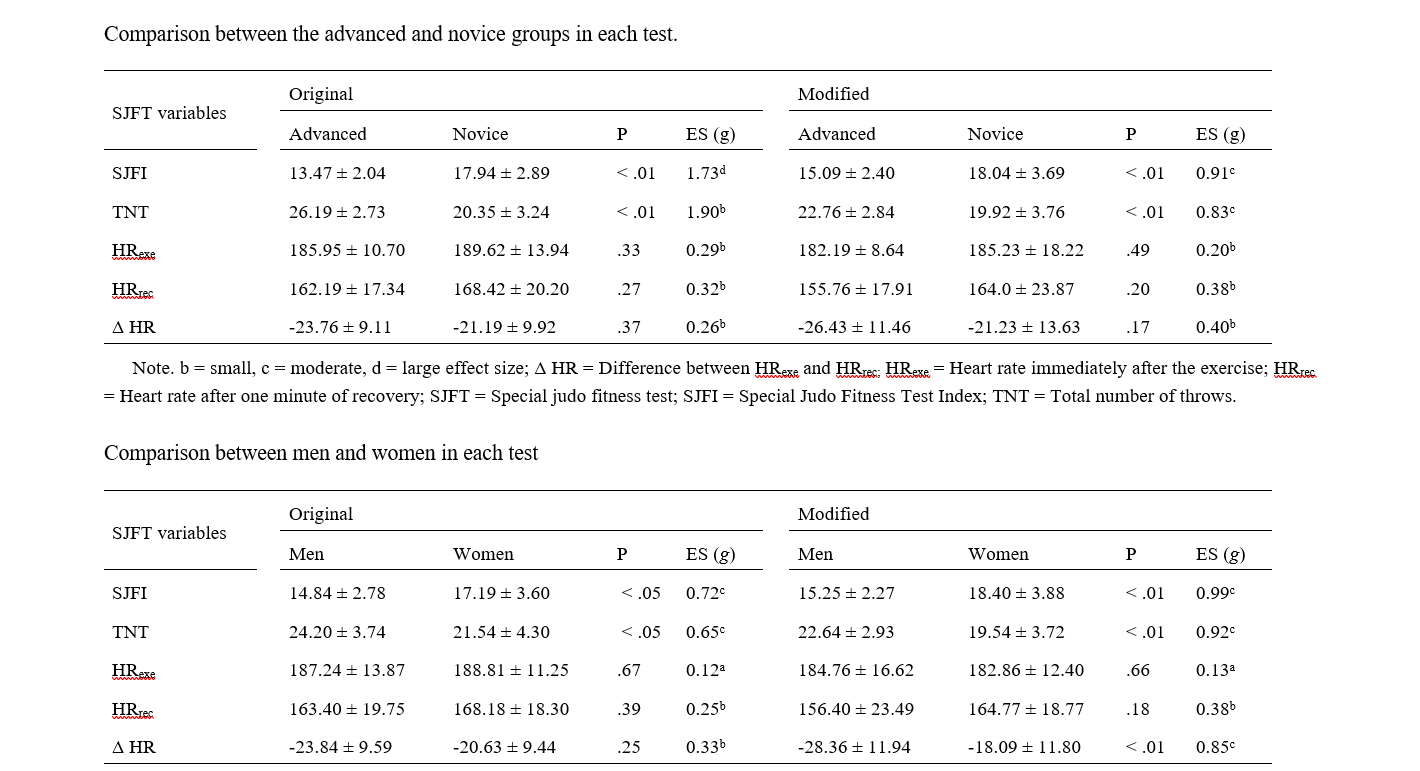
Findings: A strong consistency was observed between the two versions (ICC [95% CI] = 0.913 [0.843–0.951], p < 0.001). Both tests demonstrated specificity, differentiating novice from advanced judokas and men from women. However, systematic mean differences were observed between the original and modified tests, and agreement across parameters was lacking.
Conclusion: Preliminary evidence indicates that the modified SJFT may be a useful alternative for assessing judo-specific performance, but it should not be considered interchangeable with the original test. Further studies, particularly those examining test–retest reliability and ecological validity, are needed before recommending its widespread application.
Downloads
References
1. Farzaneh Hezari A. Relationship between aerobic and anaerobic power, and Special Judo Fitness Test (SJFT) in elite Iranian male judokas. Apunt Med l'Esport. 2014;49(181):25-9. [DOI]
2. Franchini E, Sterkowicz S, Szmatlan-Gabrys U, Gabrys T, Garnys M. Energy system contributions to the special judo fitness test. International Journal of Sports Physiology and Performance. 2011;6(3):334-43. [PMID: 21911859] [DOI]
3. Torres-Luque G, Hernández-García R, Escobar-Molina R, Garatachea N, Nikolaidis P. Physical and Physiological Characteristics of Judo Athletes: An Update. Sports. 2016;4(1):20. [PMID: 29910268] [PMCID: PMC5968945] [DOI]
4. Kons RL. Relationship between physical fitness, attacks and effectiveness in short- and long-duration judo matches. Int J Perform Anal Sport. 2018;18(6):1024-36. [DOI]
5. Courel-Ibnez J, Franchini E, Escobar-Molina R. Is the Special Judo Fitness Test Index discriminative during formative stages? Age and competitive level differences in U13 and U15 children. Ido Movement for Culture. 2018;18(3):37-41. [DOI]
6. Franchini E, Vecchio F, Sterkowicz S. A special judo fitness test classificatory table. Arch Budo. 2009;5:127-9.
7. Sterkowicz S. Levels of Anaerobic and Aerobic Capacity Indices and Results for the Special Fitness Test in Judo Competitors. J Hum Kinet. 1999;2(1):115-35.
8. Sterkowicz S, Franchini E. Specific fitness of elite and novice judoists. Journal of Human Kinetics. 2001;6(1):81-98.
9. Franchini E. Physical Fitness and Anthropometrical Differences Between Elite and Non-Elite Judo Players. Biol Sport. 2005;22(4):315-28.
10. Agostinho MF, Junior JAO, Stankovic N, Escobar-Molina R, Franchini E. Comparison of special judo fitness test and dynamic and isometric judo chin-up tests' performance and classificatory tables' development for cadet and junior athletes. Journal of Exercise Rehabilitation. 2018;14(2):244-52. [PMID: 29740559] [PMCID: PMC5931161] [DOI]
11. Sterkowicz-Przybycień K. Establishing Normative data for the Special Judo Fitness Test in Female Athletes Using Systematic Review and Meta-analysis. J Strength Cond Res. 2014;28(12):3585-93. [PMID: 24910957] [DOI]
12. Arazi H. Correlation of anthropometric and bio-motor attributes with Special Judo Fitness Test in senior male judokas. Ido Mov Cult. 2017;17(4):19-24.
13. Casals C. Special Judo Fitness Test Level and Anthropometric Profile of Elite Spanish Judo Athletes. J Strength Cond Res. 2017;31(5):1229-35. [PMID: 26562711] [DOI]
14. Ceylan B. Anthropometric profile, Wingate performance and Special Judo Fitness Levels of Turkish Olympic Judo Athletes. Ido Mov Cult. 2018;18(3):15-20.
15. Blach W, Ambroży T, Obmiński Z, Malliaronopoulos N, Migasiewicz J, Ozimek M, et al. A Novel Approach to Safe Special Fitness Testing in Judo Players. Research Square. 2021:1-13. [DOI]
16. Marković M. Reliability of the two new specific wrestling tests: Performance, metabolic and cardiac indicators. Arch Budo. 2017;13:409-20.
17. Hopkins WG. Progressive statistics for studies in sports medicine and exercise science. Med Sci Sports Exerc. 2009;41(1):3-12. [PMID: 19092709] [DOI]
18. Garbouj H, Selmi MA, Haj Sassi R, Haj Yahmed M, Chamari K, Chaouachi A. Do maximal aerobic power and blood lactate concentration affect Specif ic Judo Fitness Test performance in female judo athletes? Biology of Sport. 2016;33(4):367-72. [PMID: 28090141] [PMCID: PMC5143773] [DOI]
19. Sterkowicz S. The effects of training and creatine malate supplementation during preparation period on physical capacity and special fitness in judo contestants. J Int Soc Sports Nutr. 2012;9(1):1-8. [PMID: 22943072] [PMCID: PMC3447702] [DOI]
20. Karimi M. Validity of Special Judo Fitness Test in Iranian Male Wrestlers. International Journal of Wrestling Science. 2016;6(1):34-8. [DOI]
21. Buchheit M. Monitoring training status with HR measures : Do all roads lead to Rome? Front Physiol. 2014;5:73. [DOI]
22. Courel-Ibáñez J. Fitness testing in padel: Performance differences according to players' competitive level. Sci Sport. 2020;35(1):e11-e9. [DOI]
23. Araújo M. Contrasts in intermittent endurance performance and heart rate response between female and male soccer players of different playing levels. Biology of sport. 2019;36(4):323-31. [PMID: 31938003 ] [PMCID: PMC6945050] [DOI]
24. Daanen HAM. A Systematic Review on Heart-Rate Recovery to Monitor Changes in Training Status in Athletes. In: Lamberts RP, editor. 2012. p. 251-60.
25. Sterkowicz-Przybycień K. Meta-Analysis to Determine Normative Values for the Special Judo Fitness Test in Male Athletes: 20+ Years of Sport-Specific Data and the Lasting Legacy of Stanisław Sterkowicz. Sports. 2019;7(8):194. [PMID: 31426342] [PMCID: PMC6723689] [DOI]
26. Helm N. Validation of a new judo-specific ergometer system in male elite and sub-elite athletes. J Sport Sci Med. 2018;17(3):465-74.
27. Bosquet L, Gamelin F, Xavier, Berthoin S. Is aerobic endurance a determinant of cardiac autonomic regulation? European Journal of Applied Physiology. 2007;100(3):363-9. [PMID: 17440748] [DOI]
Downloads
Additional Files
Publication Timeline
- Submitted
- Revised
- Accepted