Ramadan Fasting: Physical and Performance Maintained, Health Challenged in Elite Adolescent Football
DOI:
https://doi.org/10.61838/kman.intjssh.4834Keywords:
ramadan fasting, young athletes, performance, elite adolescentsAbstract
Objective: Adolescent Muslim athletes participating in elite sports during Ramadan Fasting (RF) face unique physiological and developmental challenges. This prospective cohort study aimed to observe the changes in body composition, hydration status, physiological performance, and hematological profiles in 20 elite Malaysian adolescent footballers (17.8 ± 0.8 years).
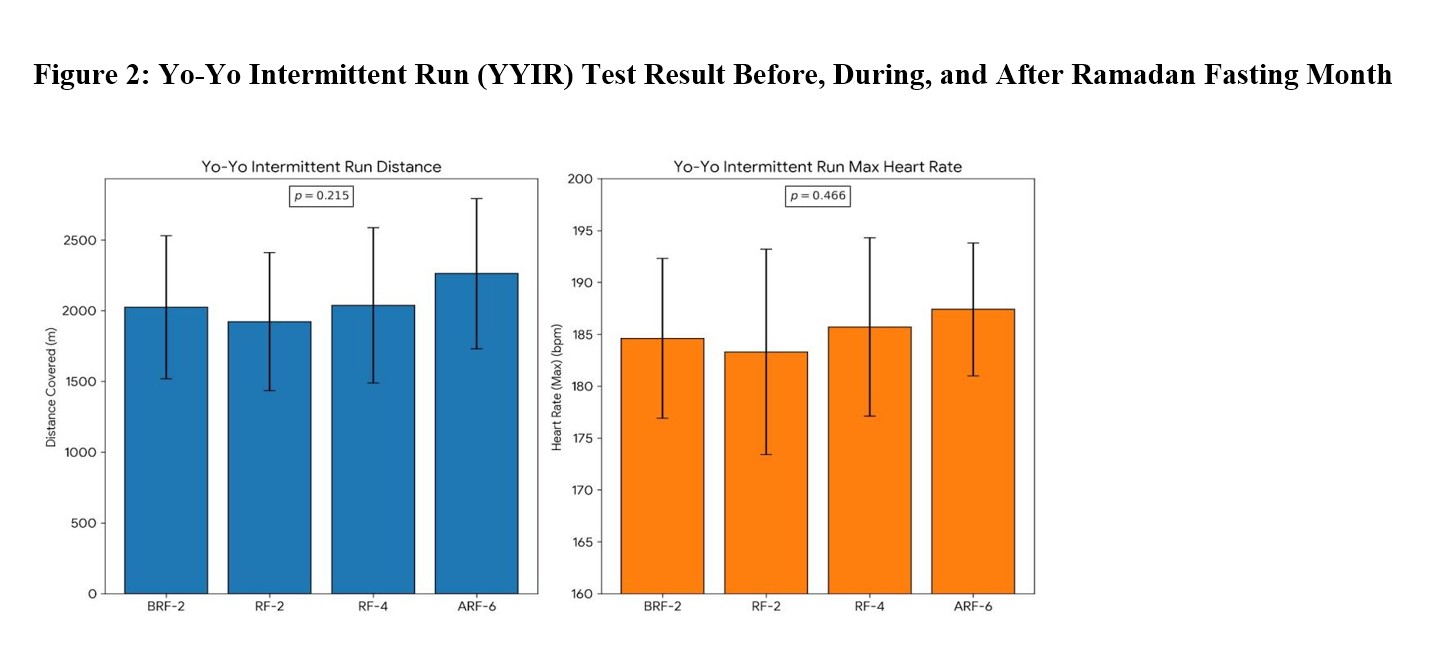
Methods: Measurements were taken at four phases (two weeks before Ramadan, BRF-2; mid, 2nd weeks of Ramadan, RF-2; late, 4th weeks of Ramadan, RF-4; and two weeks after Ramadan, ARF-6) using dual-time-point (morning/evening) blood and urine sampling, bioelectrical impedance, skinfolds, and the Yo-Yo Intermittent Run (YYIR) test.
Results: Results showed that energy balance, body composition, and aerobic performance (YYIR distance and HRmax) were successfully maintained throughout RF (p>0.05). However, significant dynamic fluid shifts were observed: morning measurements showed hemodilution, while late-afternoon Urine Specific Gravity was significantly higher in RF-4, indicating daily hemoconcentration and dehydration stress. Furthermore, while red blood cells (RBC) and haemoglobin (HB) showed transient morning reductions during RF, the most critical finding was the delayed post-fasting reduction in Mean Cell Volume (MCV) and persistent low Hematocrit (HCT) at ARF-6.
Conclusions: These findings suggest that elite performance is preserved through strong physiological adaptation and effective energy intake, but the RF period induced a subclinical iron deficiency stress that manifested as microcytosis post-Ramadan. Coaches and medical staff must implement rigorous post-Ramadan nutritional and detailed hematological screening to safeguard the long-term health of adolescent footballers.
Downloads
References
1. Ali Z, Abizari AR. Ramadan fasting alters food patterns, dietary diversity and body weight among Ghanaian adolescents. Nutr J. 2018;17(1):75. [PMID: 30098591] [PMCID: PMC6086999] [DOI]
2. Aloui A, Chtourou H, Masmoudi L, Chaouachi A, Chamari K, Souissi N. Effects of Ramadan fasting on male judokas' performances in specific and non-specific judo tasks. Biol Rhythm Res. 2013;44(5):645-54. [DOI]
3. Shatila H, Baroudi M, El Sayed Ahmad R, Chehab R, Forman MR, Abbas N, et al. Impact of Ramadan Fasting on Dietary Intakes Among Healthy Adults: A Year-Round Comparative Study. Front Nutr. 2021;8:689788. [PMID: 34422880] [PMCID: PMC8375294] [DOI]
4. Haouari M, Haouari-Oukerro F, Sfaxi A, Ben Rayana MC, Kâabachi N, Mbazâa A. How Ramadan fasting affects caloric consumption, body weight, and circadian evolution of cortisol serum levels in young, healthy male volunteers. Horm Metab Res. 2008;40(8):575-7. [PMID: 18393168] [DOI]
5. Shirreffs SM, Maughan RJ. Water and salt balance in young male football players in training during the holy month of Ramadan. J Sports Sci. 2008;26(Suppl 3):S47-S54. [PMID: 19085452] [DOI]
6. Akgül S, Derman O, Kanbur N. Fasting during Ramadan: A Religious Factor as a Possible Trigger or Exacerbator for Eating Disorders in Adolescents. Int J Eat Disord. 2014;47(6):663-7. [PMID: 24474707] [DOI]
7. Attarzadeh Hosseini SR, Hejazi K. The effects of ramadan fasting and physical activity on blood hematological-biochemical parameters. Iran J Basic Med Sci. 2013;16(7):845-9.
8. Chaouachi A, Coutts AJ, Chamari K, Wong del P M, Chaouachi M, Chtara M, et al. Effect of Ramadan intermittent fasting on aerobic and anaerobic performance and perception of fatigue in male elite judo athletes. J Strength Cond Res. 2009;23(9):2702-9. [PMID: 19910805] [DOI]
9. Chaouachi A, Leiper JB, Souissi N, Coutts AJ, Chamari K. Effects of Ramadan intermittent fasting on sports performance and training: a review. Int J Sports Physiol Perform. 2009;4(4):419-34. [PMID: 20029094] [DOI]
10. Maughan RJ, Bartagi Z, Dvorak J, Zerguini Y. Dietary intake and body composition of football players during the holy month of Ramadan. J Sports Sci. 2008;26(Suppl 3):S29-S38. [PMID: 19085450] [DOI]
11. Trabelsi K, el Abed K, Trepanowski JF, Stannard SR, Ghlissi Z, Ghozzi H, et al. Effects of Ramadan Fasting on Biochemical and Anthropometric Parameters in Physically Active Men. Asian J Sports Med. 2011;2(3):34775. [DOI]
12. Ziaee V, Razaei M, Ahmadinejad Z, Shaikh H, Yousefi R, Yarmohammadi L, et al. The changes of metabolic profile and weight during Ramadan fasting. Singapore Med J. 2006;47(5):409-14.
13. Aziz AR, Wahid MF, Png W, Jesuvadian CV. Effects of Ramadan fasting on 60 min of endurance running performance in moderately trained men. Br J Sports Med. 2010;44(7):516-21. [PMID: 20519256] [DOI]
14. Karli U, Guvenc A, Aslan A, Hazir T, Acikada C. Influence of Ramadan Fasting on Anaerobic Performance and Recovery Following Short time High Intensity Exercise. J Sports Sci Med. 2007;6(4):490-7.
15. Kok Wei G, Tan Yi Wey A, Boon Suen A, Che Muhamed AM, Singh R. Influence of Sahour Meal on Exercise Performance and Physiological Responses in Well-trained Muslim Runners during Ramadan. J Nutr Fasting Health. 2013;1(1):28-37.
16. Memari AH, Kordi R, Panahi N, Nikookar LR, Abdollahi M, Akbarnejad A. Effect of ramadan fasting on body composition and physical performance in female athletes. Asian J Sports Med. 2011;2(3):161-6. [DOI]
17. Özbay S, Ulupınar S, Gençoğlu C, Ouergui I, Öget F, Yılmaz HH, et al. Effects of Ramadan intermittent fasting on performance, physiological responses, and bioenergetic pathway contributions during repeated sprint exercise. Front Nutr. 2024;11:1322128. [PMID: 38406182] [PMCID: PMC10884246] [DOI]
18. Tayebi SM, Niaki AG, Hanachi P, Ghorban-alizadeh F, editors. The Effect of Ramadan Fasting and Weight-Lifting Training on Plasma Volume, Glucose and Lipids Profile of Male Weight Lifters. Proceedings of the 5th International Conference on Sports and Exercise Science; 2010 2010 Nov 29-30.
19. Bouhlel E, Salhi Z, Bouhlel H, et al. Effect of Ramadan fasting on fuel oxidation during exercise in trained male rugby players. Clin J Sport Med. 2006;16(6):493-9. [PMID: 17296516] [DOI]
20. Güvenç A. Effects of ramadan fasting on body composition, aerobic performance and lactate, heart rate and perceptual responses in young soccer players. J Hum Kinet. 2011;29:79-91. [PMID: 23486092] [PMCID: PMC3588618] [DOI]
21. Kirkendall DT, Leiper JB, Bartagi Z, Dvorak J, Zerguini Y. The influence of Ramadan on physical performance measures in young Muslim footballers. J Sports Sci. 2008;26(Suppl 3):S15-S27. [PMID: 19085449] [DOI]
22. Zerguini Y, Kirkendall D, Junge A, Dvorak J. Impact of Ramadan on physical performance in professional soccer players. Br J Sports Med. 2007;41(6):398-400. [PMID: 17224435] [PMCID: PMC2465333] [DOI]
23. el Ati J, Beji C, Danguir J. Increased fat oxidation during Ramadan fasting in healthy women: an adaptative mechanism for body-weight maintenance. Am J Clin Nutr. 1995;62(2):302-7. [PMID: 7625336] [DOI]
24. Hallak MH, Nomani MZ. Body weight loss and changes in blood lipid levels in normal men on hypocaloric diets during Ramadan fasting. Am J Clin Nutr. 1988;48(5):1197-210. [PMID: 3189206] [DOI]
25. Ramadan J, Telahoun G, Al-Zaid NS, Barac-Nieto M. Responses to exercise, fluid, and energy balances during Ramadan in sedentary and active males. Nutrition. 1999;15(10):735-9. [PMID: 10501284] [DOI]
26. Yucel A, Degirmenci B, Acar M, Albayrak R, Haktanir A. The effect of fasting month of Ramadan on the abdominal fat distribution: assessment by computed tomography. Tohoku J Exp Med. 2004;204(3):179-87. [PMID: 15502416] [DOI]
27. Frost G, Pirani S. Meal frequency and nutritional intake during Ramadan: a pilot study. Hum Nutr Appl Nutr. 1987;41(1):47-50.
28. Al-Hourani HM, Atoum MF. Body composition, nutrient intake and physical activity patterns in young women during Ramadan. Singapore Med J. 2007;48(10):906-10.
29. Beltaifa L, Bouguerra R, Ben Slama C, Jabrane H, El-Khadhi A, Ben Rayana MC, et al. Food intake, and anthropometrical and biological parameters in adult Tunisians during fasting at Ramadan. East Mediterr Health J. 2002;8(4-5):603-11. [DOI]
30. Waterhouse J. Effects of Ramadan on physical performance: chronobiological considerations. Br J Sports Med. 2010;44(7):509-15. [PMID: 20484313] [DOI]
31. Attarzadeh Hosseini SR, Sardar MA, Hejazi K, Farahati S. The effect of ramadan fasting and physical activity on body composition, serum osmolarity levels and some parameters of electrolytes in females. Int J Endocrinol Metab. 2013;11(2):88-94. [PMID: 23825979] [PMCID: PMC3693661] [DOI]
32. Leiper JB, Watson P, Evans G, Dvorak J, Zerguini Y. Intensity of a training session during Ramadan in fasting and non-fasting Tunisian youth football players. J Sports Sci. 2008;26(Suppl 3):S71-S9. [PMID: 19085454] [DOI]
33. Meckel Y, Ismaeel A, Eliakim A. The effect of the Ramadan fast on physical performance and dietary habits in adolescent soccer players. Eur J Appl Physiol. 2008;102(6):651-7. [PMID: 18071743] [DOI]
34. Ramadan J. Does fasting during Ramadan alter body composition, blood constituents and physical performance? Med Princ Pract. 2002;11(Suppl 2):41-6. [PMID: 12444309] [DOI]
35. Lessan N, Ali T. Energy Metabolism and Intermittent Fasting: The Ramadan Perspective. Nutrients. 2019;11(5):1079. [PMID: 31137899] [PMCID: PMC6566767] [DOI]
36. Sweileh N, Schnitzler A, Hunter GR, Davis B. Body composition and energy metabolism in resting and exercising Muslims during Ramadan fast. J Sports Med Phys Fitness. 1992;32(2):156-63.
37. Wilson D, Drust B, Reilly T. Is diurnal lifestyle altered during Ramadan in professional Muslim athletes? Biol Rhythm Res. 2009;40(5):385-97. [DOI]
38. Adeva-Andany MM, Pérez-Felpete N, Fernández-Fernández C, Donapetry-García C, Pazos-García C. Liver glucose metabolism in humans. Biosci Rep. 2016;36(6):e00366. [PMID: 27707936] [PMCID: PMC5293555] [DOI]
Downloads
Publication Timeline
- Submitted
- Revised
- Accepted