The Effect of Micro-Dose Neuromuscular Training on Landing Mechanics, Knee Valgus Angle, and Jump Performance in Male Handball Players
Keywords:
micro-dose neuromuscular training; dynamic knee valgus; landing mechanics; jump performance; handballAbstract
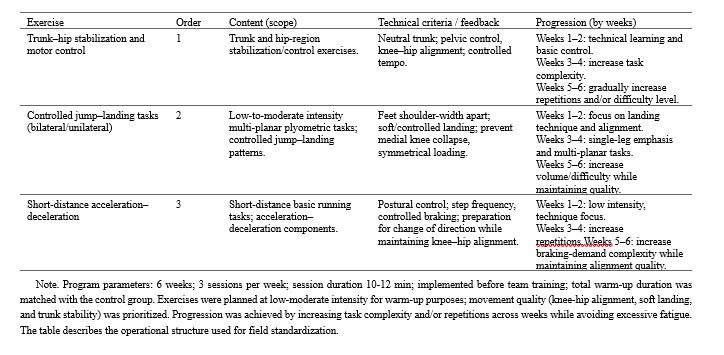
This study examined the effects of a 6-week micro-dose neuromuscular training (NMT) program integrated into the warm-up during the in-season period on frontal-plane knee valgus angle during landing and on jump performance in male handball players. Competitive male handball players competing at the Regional League level in Ankara were randomly assigned to an experimental group (n = 15) or a control group (n = 15). The experimental group performed a 10-12 min micro-dose NMT warm-up three times per week for 6 weeks in place of part of the routine warm-up, whereas the control group maintained the routine warm-up and training content. The program included trunk-hip stabilization and motor control, controlled bilateral and unilateral jump-landing tasks, and short-distance acceleration-deceleration drills. Knee valgus angle was assessed with two-dimensional frontal-plane video analysis during a 30-cm drop-jump task, and jump performance was assessed using squat jump, countermovement jump, and drop-jump height. In the experimental group, knee valgus angle decreased significantly and all jump outcomes improved, whereas no significant changes were observed in the control group. In the post-test comparison, knee valgus angle was lower in the experimental group than in the control group, while between-group differences in jump outcomes remained close to the threshold of statistical significance. Micro-dose NMT integrated into the warm-up may therefore improve landing mechanics and may represent a feasible in-season strategy for supporting jump performance in male handball players.
Downloads