









Identifying Cultural Patterns in Parenting Beliefs Through Clustering Algorithms
|
Objective: The present study aimed to identify latent cultural patterns in parenting beliefs by applying clustering algorithms to multidimensional data on parental attitudes and cultural orientations. Methods and Materials: This study employed a quantitative, cross-sectional design with a data-driven analytical approach. The sample consisted of 412 parents from Georgia, selected through stratified random sampling to ensure representation across demographic strata. Data were collected using standardized instruments assessing parenting beliefs, including dimensions such as parental authority, autonomy support, emotional socialization, and behavioral control, alongside cultural orientation constructs such as collectivism, individualism, power distance, and uncertainty avoidance. After data preprocessing, clustering analyses were conducted using K-means and hierarchical methods. The optimal number of clusters was determined using the Elbow method, Silhouette coefficient, and Davies–Bouldin index. Principal component analysis (PCA) was also employed to enhance interpretability and visualize cluster separation. Statistical preprocessing and descriptive analyses were performed using IBM SPSS, while machine learning analyses were implemented in Python. Findings: Clustering results revealed a statistically meaningful three-cluster solution with acceptable validity indices (Silhouette = 0.53; Davies–Bouldin = 0.81), indicating moderate-to-strong separation between clusters. The first cluster demonstrated significantly higher levels of parental authority, behavioral control, and collectivist orientation, reflecting a traditional-authoritarian profile. The second cluster exhibited significantly higher autonomy support, emotional socialization, and individualism, representing an autonomy-supportive profile. The third cluster showed moderate levels across all variables, indicating a hybrid or integrative parenting belief pattern. Principal component analysis confirmed clear spatial differentiation among clusters, supporting the robustness and interpretability of the classification model. Conclusion: The findings demonstrate that parenting beliefs are structured into distinct cultural profiles that reflect varying combinations of authority, autonomy, and cultural orientation. The identification of traditional, autonomy-supportive, and hybrid parenting patterns highlights the complexity and heterogeneity of parenting beliefs within a single cultural context. These results underscore the value of machine learning approaches in uncovering latent cultural structures and provide a foundation for culturally informed research and intervention in family and developmental studies. |
Machine Learning-Based Classification of Cultural Beliefs and Mental Health Attitudes
|
Objective: The present study aimed to classify cultural beliefs and mental health attitudes using machine learning techniques and to identify the most influential psychosocial predictors within an Armenian population. Methods and Materials: This cross-sectional, descriptive–analytical study was conducted on a sample of 412 adults from Armenia selected through stratified random sampling. Data were collected using standardized instruments assessing cultural beliefs (including individualism, collectivism, traditionalism, and authority orientation) and mental health attitudes (including stigma, help-seeking attitudes, emotional openness, and beliefs about mental illness), along with a demographic questionnaire. Data preprocessing included normalization, missing data imputation, and categorical encoding. Feature selection was performed using correlation-based filtering and recursive feature elimination. Supervised machine learning models, including Support Vector Machine, Random Forest, and Gradient Boosting, were implemented to classify participants based on their psychosocial profiles. Model evaluation was conducted using 10-fold cross-validation, with performance assessed via accuracy, precision, recall, F1-score, and AUC-ROC metrics. Findings: Inferential results indicated significant associations between cultural belief dimensions and mental health attitudes, with collectivism, traditionalism, and authority orientation positively predicting mental health stigma, while individualism significantly predicted help-seeking attitudes and emotional openness. Machine learning analyses revealed that the Gradient Boosting model demonstrated superior classification performance (accuracy = 0.902, AUC = 0.947) compared to Random Forest and Support Vector Machine models. Feature importance analysis showed that mental health stigma, help-seeking attitudes, and collectivism were the most influential predictors in distinguishing participant profiles. Correlation patterns further confirmed that higher stigma was significantly associated with lower help-seeking and emotional openness, while culturally embedded belief systems significantly shaped mental health perceptions. Conclusion: The findings demonstrate that cultural beliefs play a critical role in shaping mental health attitudes and that machine learning techniques provide a robust framework for accurately classifying these complex relationships. The prominence of stigma-related constructs highlights the need for culturally sensitive interventions aimed at reducing stigma and promoting adaptive help-seeking behaviors. Integrating computational approaches with cultural psychology offers valuable insights for targeted mental health strategies and policy development. |
Predicting Family Stability Using Socioeconomic and Cultural Variables via Machine Learning
|
Objective: The present study aimed to predict family stability based on socioeconomic and cultural variables using advanced machine learning models. Methods and Materials: This study employed a cross-sectional predictive-correlational design involving 428 participants from diverse urban and semi-urban regions of Ecuador selected through multistage cluster sampling. Data were collected using standardized instruments, including the Family Adaptability and Cohesion Evaluation Scale IV (FACES IV) to measure family stability and its subcomponents, alongside structured measures of socioeconomic status and culturally adapted scales assessing collectivism, traditionalism, gender role beliefs, and intergenerational norms. Data preprocessing included handling missing values, normalization, and categorical encoding. Machine learning algorithms, including Random Forest, Support Vector Machines, Gradient Boosting, and Artificial Neural Networks, were implemented using Python-based analytical frameworks. Model performance was evaluated through 10-fold cross-validation, with accuracy, precision, recall, F1-score, and AUC-ROC as key performance indicators. Feature importance analysis was conducted to identify the most influential predictors of family stability. Findings: The results indicated that Gradient Boosting achieved the highest predictive performance (AUC = 0.93; accuracy = 0.88), followed by Artificial Neural Networks (AUC = 0.92), Random Forest (AUC = 0.91), and Support Vector Machines (AUC = 0.88). Communication quality emerged as the strongest predictor of family stability, followed by socioeconomic status, family cohesion, and cultural collectivism. Significant positive associations were observed between family stability and communication (r = 0.67), socioeconomic status (r = 0.48), and collectivism (r = 0.42), indicating the combined influence of relational, structural, and cultural dimensions in shaping family outcomes. Conclusion: The findings demonstrate that family stability is a multidimensional construct influenced by the interaction of socioeconomic conditions, cultural values, and relational processes, with machine learning models providing robust predictive capabilities. The prominence of communication quality highlights the critical role of intra-family dynamics, while the contribution of socioeconomic and cultural variables underscores the need for integrative and context-sensitive approaches in both research and intervention. |
A Predictive Study of Family Adaptability Based on Cultural and Economic Indicators
|
Objective: The present study aimed to predict family adaptability based on cultural orientation and economic indicators using both statistical and machine learning approaches in a Canadian population. Methods and Materials: This study employed a quantitative, cross-sectional, descriptive–correlational design. The statistical population consisted of married adults residing in Canada in 2025, from which 486 participants were selected using a stratified random sampling method based on the Krejcie and Morgan table. Data were collected using standardized instruments, including the Family Adaptability subscale of the Family Adaptability and Cohesion Evaluation Scales IV (FACES IV), a Cultural Orientation Scale assessing individualism, collectivism, traditionalism, and acculturation, and a socioeconomic questionnaire measuring income index, financial stability, and economic pressure. The reliability and validity of all instruments were confirmed in prior research and re-evaluated in the present study. Data analysis was conducted using IBM SPSS Statistics (version 27) for descriptive statistics, Pearson correlations, and multiple regression analysis. Additionally, machine learning models including Random Forest, Support Vector Machine, and Gradient Boosting were implemented in Python using Scikit-learn to enhance predictive accuracy. Findings: The results revealed that collectivism (β = 0.31, p < 0.001), financial stability (β = 0.36, p < 0.001), acculturation (β = 0.18, p < 0.001), and individualism (β = 0.12, p = 0.007) were significant positive predictors of family adaptability, whereas economic pressure (β = -0.29, p < 0.001) was a significant negative predictor. The regression model explained 46% of the variance in family adaptability (R² = 0.46, p < 0.001). Machine learning results indicated that the Gradient Boosting model achieved the highest predictive performance (R² = 0.74), followed by Random Forest (R² = 0.71) and Support Vector Machine (R² = 0.66). Feature importance analysis identified financial stability and economic pressure as the most influential predictors. Conclusion: The findings demonstrate that both cultural and economic factors play a critical and complementary role in shaping family adaptability, with economic conditions exerting particularly strong effects. The integration of machine learning approaches provided enhanced predictive accuracy and revealed complex relationships among variables, highlighting the importance of multidimensional and data-driven approaches in family research. These results underscore the need for interventions and policies that simultaneously address financial stability and cultural integration to promote adaptive family functioning. |
Cross-Cultural Prediction of Norm Internalization Using Conformity Pressure, Moral Disengagement, and Social Learning
|
Objective: The present study aimed to predict norm internalization across culturally diverse individuals based on conformity pressure, moral disengagement, and social learning using an integrated statistical and machine learning approach. Methods and Materials: This study employed a descriptive–correlational design with a predictive modeling framework. The sample consisted of 512 participants from Canada, selected through stratified random sampling to ensure cultural diversity. Data were collected using standardized instruments measuring norm internalization, conformity pressure, moral disengagement, and social learning. Demographic variables were also assessed to control for potential confounding effects. Data analysis was conducted using both classical statistical techniques, including Pearson correlation and multiple regression analysis, and advanced machine learning models such as Random Forest, Support Vector Machine, and Gradient Boosting. Model performance was evaluated using cross-validation procedures and metrics including R², RMSE, and MAE. Findings: The results indicated that conformity pressure (β = 0.24, p < 0.001) and social learning (β = 0.31, p < 0.001) significantly and positively predicted norm internalization, while moral disengagement (β = -0.38, p < 0.001) was a significant negative predictor. The regression model explained a substantial proportion of variance in norm internalization (R² = 0.41). Machine learning analyses revealed that the Gradient Boosting model achieved the highest predictive performance (R² = 0.47), outperforming Random Forest and Support Vector Machine models. Feature importance analysis consistently identified moral disengagement as the most influential predictor, followed by social learning and conformity pressure. Conclusion: The findings demonstrate that norm internalization is a multifaceted process influenced by the interaction of social influence and cognitive moral mechanisms. Social learning and conformity pressure facilitate the internalization of norms, whereas moral disengagement undermines it. The integration of machine learning methods enhances predictive accuracy and reveals complex non-linear relationships among variables. These results highlight the importance of addressing both social and cognitive dimensions in interventions aimed at promoting ethical behavior and strengthening social cohesion in culturally diverse contexts. |
Modeling Substance Use Risk via Family Monitoring, Sensation Seeking, and Peer Deviance
Objective: The present study aimed to model substance use risk among adolescents by examining the predictive roles of family monitoring, sensation seeking, and peer deviance within an integrated analytical framework.
Methods and Materials: This study employed a quantitative, cross-sectional, correlational design among 472 high school students from urban regions of Ontario, Canada, selected through multistage cluster sampling. Data were collected using standardized self-report instruments, including the Substance Use Risk Profile Scale, the Parental Monitoring Scale, the Brief Sensation Seeking Scale, and a modified Peer Deviance Scale. All instruments demonstrated acceptable validity and reliability in previous research and within the current sample. Data analysis was conducted using IBM SPSS version 27 and AMOS version 24. Descriptive statistics and Pearson correlation coefficients were calculated, followed by multiple regression analysis to examine predictive relationships. Structural equation modeling was used to test the hypothesized model and evaluate direct and indirect effects. Model fit was assessed using standard indices including χ²/df, CFI, TLI, GFI, and RMSEA.
Findings: The results indicated significant relationships among all study variables. Family monitoring was negatively associated with substance use risk (β = -0.31, p < 0.001), while sensation seeking (β = 0.36, p < 0.001) and peer deviance (β = 0.43, p < 0.001) showed positive and significant predictive effects, with peer deviance emerging as the strongest predictor. The overall regression model was significant (F(3, 468) = 132.74, p < 0.001), explaining 46% of the variance in substance use risk. Structural equation modeling demonstrated good model fit (χ²/df = 2.41, CFI = 0.95, TLI = 0.94, GFI = 0.93, RMSEA = 0.055). Indirect effects revealed that family monitoring reduced substance use risk through peer deviance, and sensation seeking partially mediated the relationship between peer deviance and substance use risk.
Conclusion: The findings highlight the multidimensional nature of adolescent substance use risk, emphasizing the combined influence of familial, personality, and peer-related factors. Family monitoring serves as a protective factor, whereas sensation seeking and peer deviance function as significant risk enhancers. Integrative models that consider both individual dispositions and social contexts provide a more comprehensive understanding of substance use risk. These results underscore the importance of developing prevention and intervention strategies that simultaneously target family dynamics, personality traits, and peer environments to effectively reduce substance use risk among adolescents.
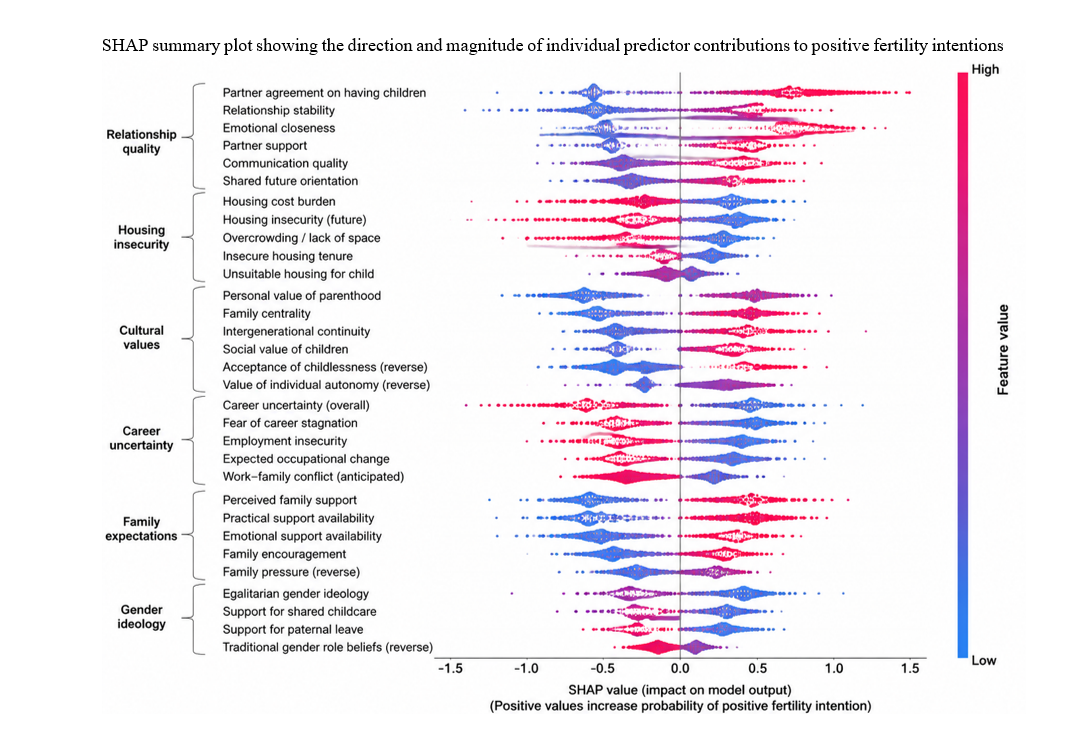
Predicting Fertility Intentions Using Cultural Norms, Economic Security, and Relationship Satisfaction via a Machine Learning Approach
Objective: The present study aimed to predict fertility intentions based on cultural norms, economic security, and relationship satisfaction using advanced machine learning techniques.
Methods and Materials: This study employed a cross-sectional, predictive-correlational design conducted on 512 adults of reproductive age in South Africa selected through stratified random sampling. Data were collected using standardized instruments including the Cultural Values Scale, Economic Stability Index, Dyadic Adjustment Scale, and a Fertility Intention Scale, all of which demonstrated acceptable validity and reliability in previous studies. Data were analyzed using IBM SPSS-27 for descriptive and correlational analyses, followed by machine learning modeling in Python using Random Forest, Support Vector Machine, Gradient Boosting, and Artificial Neural Network algorithms. Data preprocessing included normalization, missing data imputation, and categorical encoding. Model performance was evaluated using 10-fold cross-validation and metrics including accuracy, precision, recall, F1-score, and area under the ROC curve.
Findings: The results indicated significant positive relationships between cultural norms, economic security, relationship satisfaction, and fertility intentions (p < .01). Among predictors, economic security demonstrated the strongest predictive power, followed by relationship satisfaction and cultural norms. Machine learning results showed that the Artificial Neural Network achieved the highest performance (accuracy = 0.868, AUC = 0.926), followed by Gradient Boosting (accuracy = 0.856, AUC = 0.914) and Random Forest (accuracy = 0.842, AUC = 0.901), while Support Vector Machine showed comparatively lower performance (accuracy = 0.801, AUC = 0.862). Feature importance analysis confirmed the dominant role of economic security across all models.
Conclusion: The superior performance of machine learning models demonstrates their effectiveness in capturing complex, nonlinear relationships among predictors, offering a powerful approach for understanding and predicting reproductive decision-making.
Machine Learning-Based Identification of Cultural Determinants of Decision-Making: The Role of Risk Perception, Uncertainty Avoidance, and Norm Compliance
|
Objective: The present study aimed to identify and model the cultural determinants of decision-making using machine learning techniques, with a specific focus on the predictive roles of risk perception, uncertainty avoidance, and norm compliance. Methods and Materials: This study employed a descriptive–correlational design with a machine learning predictive framework. The sample consisted of 412 adult participants from Portugal selected through stratified random sampling to ensure demographic diversity. Data were collected using standardized instruments measuring risk perception, uncertainty avoidance, norm compliance, and decision-making quality. After preprocessing procedures including normalization and handling of missing values, data were analyzed using both traditional statistical methods and advanced machine learning algorithms. Supervised learning models, including Logistic Regression, Support Vector Machine, Random Forest, and Gradient Boosting, were applied to predict decision-making outcomes. Model performance was evaluated using k-fold cross-validation and metrics such as accuracy, precision, recall, F1-score, and area under the ROC curve. Feature importance analysis was conducted to determine the relative contribution of predictors. Findings: The results indicated that all three cultural variables significantly predicted decision-making quality, with norm compliance emerging as the strongest predictor, followed by risk perception and uncertainty avoidance. Ensemble models demonstrated superior predictive performance, with Gradient Boosting achieving the highest accuracy and classification efficiency compared to other models. Feature importance analysis confirmed the dominant role of norm compliance in influencing decision-making outcomes. Additionally, significant positive relationships were observed among all study variables, indicating that higher levels of cultural alignment correspond to improved decision-making quality. Conclusion: The findings highlight the critical role of cultural determinants in shaping decision-making processes and demonstrate the effectiveness of machine learning approaches in modeling complex behavioral patterns. Integrating cultural variables into predictive frameworks enhances both theoretical understanding and practical applications of decision-making research. |
About the Journal
JPRFC publishes four issues per year, with occasional special issues coming in addition.
- E-ISSN: 3041-8550
- Director in Charge: M.B. Jafari
- Editor-in-chief: Dr. Mehdi Rostami
- Owner: KMAN Research Institute
- Publisher: KMAN Publication Inc. (KMANPUB)
- Email: jprfc@kmanpub.com
- Open Access: YES
JPRFC covers a wide range of topics related to family and culture, such as psychology, sociology, anthropology, and more. The journal provides an advantageous resource for professionals and scholars in these fields, as it offers a platform for publishing cutting-edge research and innovative ideas. The journal is committed to publishing articles that make significant contributions to the fields of family and culture, and that have practical implications for professionals working in these areas. Overall, JPRCF and Culture is an excellent addition to the academic community. With its emphasis on quality research, meticulous peer-review process, and commitment to open access, the journal is well-positioned to serve as a leading resource for professionals and scholars in the fields of family and culture.
About the Publisher
Publisher: KMAN Publication Inc.
Publisher Office: Unit 5‑10825 Yonge St, Richmond Hill, Ontario, Canada, L4C 3E3
https://journals.kmanpub.com
Email: kmanpu@kmanpub.com
Telegram: +1 (647) 656‑4401 | WhatsApp: +1 (437) 429‑3507
Germany Office: Dratelnstrasse, Wohnung A60, 21119 Hamburg, Germany (+4915207720487)
Current Issue