The Relationship Between Participation in Martial Arts Sports and Aggression Levels Among Students
Abstract
Objective: This study examines the relationship between sports participation and aggression, with a specific focus on martial arts disciplines (taekwondo and karate), as well as gender differences.
Methods: The sample consisted of 63 licensed martial arts athletes (33 female, 30 male), each with a minimum of five years of experience in their respective sports. The primary aim was to investigate how discipline, gender, and years of experience impact various dimensions of aggression. Data were collected using the 30-item “Aggression Inventory,” developed by İpek İlter (Kiper) in 1984, whose validity and reliability were confirmed for this study. A demographic questionnaire was also administered to gather information on gender, sport discipline, years of engagement in sports, and parental background (education and occupation). Descriptive statistics, independent samples t-tests, and one-way analysis of variance (ANOVA) were used to analyze the data via the SPSS software package.
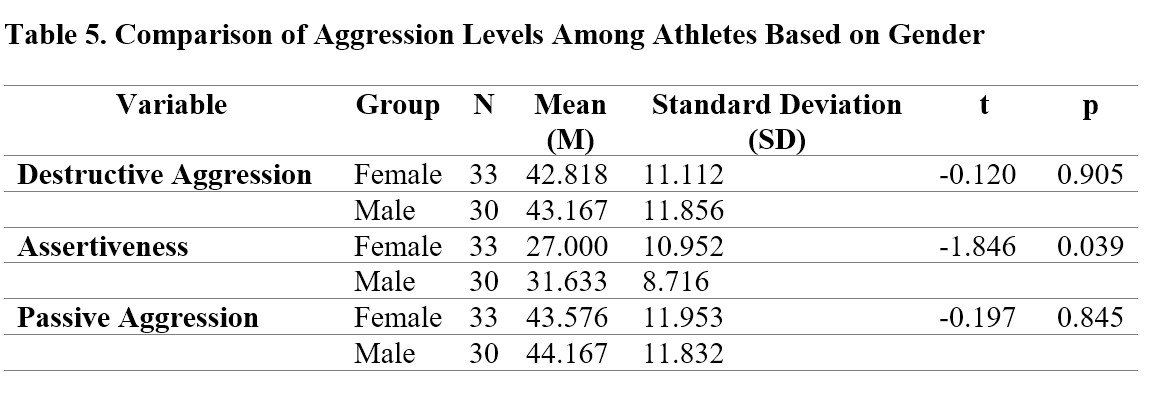
Results: The findings revealed no statistically significant differences in aggression levels based on the number of years of experience in sports. However, karate athletes exhibited significantly higher levels of destructive and passive aggression than taekwondo athletes, suggesting that the nature or culture of specific martial arts disciplines may differentially affect aggression levels. Additionally, gender differences were found only in assertiveness, with male athletes scoring significantly higher than female athletes. When it came to destructive or passive aggression, there were no discernible gender differences. These findings imply that gender and athletic discipline may have an impact on some aspects of aggression.
Conclusion: This study highlights how essential it is to contain behavioral and psychological knowledge in training programs for the purpose of better control and possibly lessening athletes' tendency for aggression. A more comprehensive and informed approach to athlete improvement and coaching can emerge from an understanding of the complex connection between sport, gender, and aggression.
Downloads