Quantitative Risk Assessment of Outdoor Fitness Equipment Safety in Rainy Conditions Using the L-Type Matrix Method
DOI:
https://doi.org/10.61838/kman.intjssh.4622Keywords:
Outdoor Fitness Equipment, Slip and Fall Risk, L-Type Matrix, Risk Assessment, Public Space Safety, Rainy WeatherAbstract
Objective: To address a critical gap in proactive risk management for public recreational infrastructure, this study quantitatively assesses the safety risks posed by rainy weather on outdoor fitness equipment using the L-type matrix method.
Methods: A mixed-method approach, which combines quantitative and qualitative data, was employed. A total of 240 participants from two similar outdoor fitness parks evaluated the usability of eight different equipment pieces (B1-B8) on a 0-2 scale (0=Unusable, 1=Cautious Use, 2=Usable) under wet conditions. Quantitative data were analyzed using descriptive statistics, the L-Type Matrix Risk Analysis—where probability (O) was calculated as O = 2 - Usability Score to accurately reflect accident likelihood—and one/two-way analysis of variance tests. Qualitative data from the focus group interviews were analyzed through content analysis.
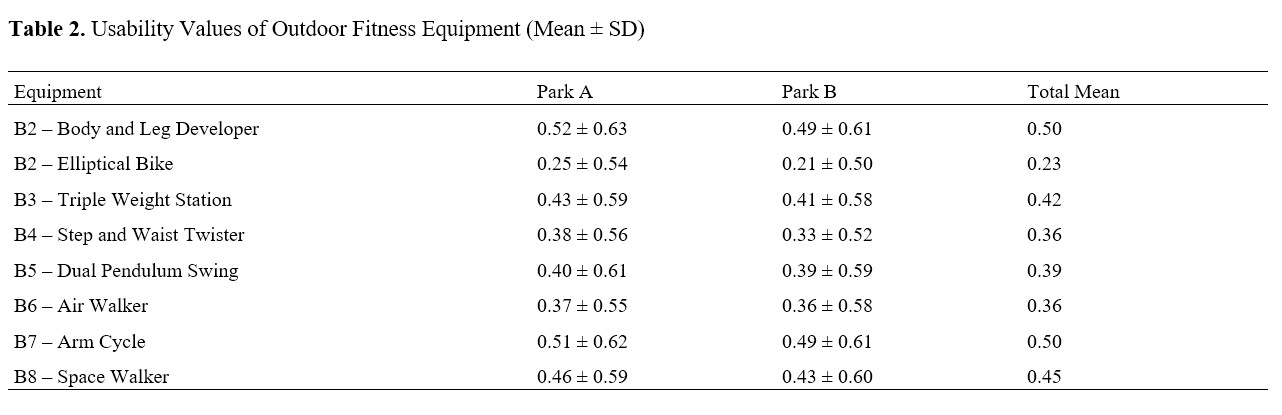
Findings: The L-Type Matrix analysis revealed that seven out of the eight equipment pieces posed a "high risk," and one (B2 - Elliptical Bike) posed a "very high risk." The elliptical bike (B2) had the lowest usability score (0.23), correlating with the highest accident probability. No significant differences were found based on gender or age (p > 0.05), confirming that environmental factors are the primary risk determinants, not user demographics. Qualitative findings strongly supported these results, with 81% of participants reporting significant safety concerns regarding surface slipperiness and 68% highlighting water accumulation and corrosion issues.
Conclusion: This study provides quantitative evidence that rainy conditions create serious safety hazards in outdoor fitness areas. The findings underscore the necessity of integrating environmental safety parameters—such as non-slip and permeable surfaces, effective drainage, corrosion-resistant materials, and clear warning systems—as a core component of the design, planning, and maintenance of public exercise infrastructure. The application of the L-type matrix method demonstrates its utility as a practical tool for proactive risk assessment in this context.
Downloads
References
1. Ding D, Lawson KD, Kolbe-Alexander TL, Finkelstein EA, Katzmarzyk PT, van Mechelen W, et al. The economic burden of physical inactivity: a global analysis of major non-communicable diseases. The Lancet. 2016;388(10051):1311-24. [PMID: 27475266] [DOI]
2. Kohl HW, Craig CL, Lambert EV, Inoue S, Alkandari JR, Leetongin G, et al. The pandemic of physical inactivity: global action for public health. The Lancet. 2012;380(9838):294-305. [PMID: 22818941] [DOI]
3. World Health O. Guidelines on physical activity and sedentary behaviour. Geneva: WHO Press; 2020.
4. Carmona-Torres JM, Cobo-Cuenca AI, Recio-Andrade B. Outdoor fitness parks and health: a public health perspective. International Journal of Environmental Research and Public Health. 2019;16(14):2508.
5. Cohen DA, Han B, Derose KP, Williamson S, Marsh T, McKenzie TL. Physical activity in parks: a review of the evidence. American Journal of Preventive Medicine. 2013;45(5):590-7. [PMID: 24139772] [PMCID: PMC4091686] [DOI]
6. Dadvand P, Nieuwenhuijsen M, Esnaola M. Green spaces and cognitive development in primary schoolchildren. Proceedings of the National Academy of Sciences of the USA. 2015;112(26):7937-42. [PMID: 26080420] [PMCID: PMC4491800] [DOI]
7. Marselle MR, Stadler J, Korn H, Irvine KN, Bonn A. Biodiversity and health in the face of climate change. Cham: Springer; 2019. [DOI]
8. Leavell MA, Leiferman JA, Gascon M, Braddick F, Gonzalez JC, Litt JS. Nature-based social prescribing in urban settings to improve social connectedness and mental well-being: a systematic review. Current Environmental Health Reports. 2019;6(4):297-308. [PMID: 31713144] [DOI]
9. Lourenço P, Bastos T, Pizarro A, Corredeira R. The long-term effects of a 24-week outdoor exercise program in persons with schizophrenia: results of a 12-week follow-up period. Schizophrenia Research. 2025;278:47-56. [PMID: 40112445] [DOI]
10. Maddison R, Jiang Y, Vander Hoorn S, Rush E. Outdoor exercise equipment in parks: a systematic review. Health Promotion Journal of Australia. 2019;30(2):216-25.
11. Xie L, Wu L, Zou Y. The impact of meteorological conditions on outdoor sport participation and safety: a systematic review. Journal of Sports Sciences. 2021;39(18):2069-81.
12. Hillsdon M, Coombes E, Griew P, Jones A. The effect of rainfall on the use of urban outdoor physical activity environments: an observational study. Preventive Medicine. 2022;154:106888.
13. Lin D, Lu R, Xia W, Zhen M. Personalized thermal comfort assessment during outdoor exercise: effects of exercise intensity and seasonal variation using electrodermal activity. Journal of Building Engineering. 2025;114:114207. [DOI]
14. Feng Y, Wang L, Zhang Y, Li Q. A quantitative analysis of slip-and-fall accidents associated with rainfall and surface water accumulation in public spaces. Safety Science. 2023;157:105943.
15. Kim SH. Risk factors for severe injury following indoor and outdoor falls in geriatric patients. Archives of Gerontology and Geriatrics. 2016;62:75-82. [PMID: 26553485] [DOI]
16. Kaewcham S, Tongtako W. Effects of 8-week surf skateboard training on physical fitness in young people. Sports Medicine and Health Science. 2024. [PMID: 41496811] [PMCID: PMC12766291] [DOI]
17. Sun Y, Chen J, Yuan Y, Liu S. Environmental elements of residential open spaces for grandparent–child rearing based on a field survey in Tianjin, China. Journal of Urban Management. 2025;14(1):216-31. [DOI]
18. Midgett JD, Middelberg LK. Pediatric injuries from consumer products and strategies for prevention. Pediatric Clinics of North America. 2025. [PMID: 41193141] [DOI]
19. Ruiz-González A, Pérez-Ordóñez JL, Martínez-Suárez MJ. Seasonal variation in environmental impacts and user safety of outdoor exercise areas: a longitudinal study. Urban Forestry & Urban Greening. 2024;95:128295. [DOI]
20. Schneider S, Niederberger M, Kurowski L, Bade L. How can outdoor sports protect themselves against climate change-related health risks? A prevention model based on an expert Delphi study. Journal of Science and Medicine in Sport. 2024;27(1):37-44. [PMID: 38007294] [DOI]
21. Gürcanlı GE, Müngen U. Risk assessment methods in occupational safety: L-type matrix and Fine–Kinney comparison. Journal of Safety Research. 2009;40(3):251-9.
22. Kahraman C. Multi-criteria decision making methods and applications. Berlin: Springer; 2016.
23. Uca S, Alizadehebadi F. Risk analysis in boxing sport using L-type matrix method. Physical Education and Sport Sciences Journal. 2021;15(3):201-14. [DOI]
24. Rivera Domínguez C, Ramírez Guadian JE, Guerrero Lona J, Pozos Mares JI. Hazard identification for risk assessment using the PRA technique in the automotive industry. Safety Science. 2023;160:106041. [DOI]
25. Zhang X, Mohandes SR. Occupational health and safety in green building construction projects: a holistic Z-numbers-based risk management framework. Journal of Cleaner Production. 2020;275:122788. [DOI]
26. Yin X, Thai BN, Tan YQ, Salinas SV, Yu LE, Seow WJ. When and where to exercise: assessment of personal exposure to urban tropical ambient airborne pollutants in Singapore. Science of the Total Environment. 2024;906:167086. [PMID: 37716686] [DOI]
27. Jiang SH, Liu X, Ma G, Rezania M. Stability analysis of heterogeneous infinite slopes under rainfall infiltration using an improved Green–Ampt model. Canadian Geotechnical Journal. 2023;61(8):1560-73. [DOI]
28. Lian J, Wu J, Luo Q, Wang L, Liu F, Huang D. Shallow stability of soil slopes with frame protection considering rainwater seepage. Transportation Geotechnics. 2023;42:101076. [DOI]
29. Lysdal FG, Grønlykke TB, Kersting UG. Spraino: a novel low-friction device for prevention of lateral ankle sprain injuries in indoor sports. Medical Novel Technology and Devices. 2022;16:100141. [DOI]
30. Long J, Xiong Y, Fu H, Tian L. Flexural performance of UHPC–NC composite beams under different interface treatments. Journal of Building Engineering. 2025;111:113566. [DOI]
31. Yu Z, Zhang H, Yang Y, Wang B, Guo Z. Slippery liquid-infused porous surfaces (SLIPS) for anti-icing. Materials Today. 2025;88:906-32.
32. Liu R, Shen W. Data acquisition of exercise and fitness pressure measurement based on artificial intelligence technology. SLAS Technology. 2025;33:100328. [PMID: 40619065] [DOI]
Downloads
Publication Timeline
- Submitted
- Revised
- Accepted