Generative Artificial Intelligence and Large Language Models in Didactics of Sports Sciences and Physical Education: A Comprehensive Review of Pedagogical Applications, Teaching Innovations, and Research Implications
DOI:
https://doi.org/10.61838/kman.intjssh.4891Keywords:
Artificial Intelligence; Constructivism; Differentiated Instruction; Education Technology; Large Language Models; Learning Technology; Pedagogy; Physical Education; Sports Didactics; Sports SciencesAbstract
Objective: The global burden of physical inactivity contributes to 5.3 million deaths annually, exceeding smoking-related mortality in certain regions and contributing substantially to the 1.5 billion individuals worldwide living with chronic diseases. Physical education (PE) represents a critical intervention point, yet persistent challenges limit effectiveness including inadequate instructional time (80 minutes weekly versus recommended 150 minutes), insufficient specialized teacher preparation (42% of elementary PE teachers lack specialized training), and limited capacity for differentiated instruction in heterogeneous student populations. The emergence of Generative Artificial Intelligence (Gen AI), particularly Large Language Models (LLMs) such as ChatGPT (launched November 2022, achieving 100 million users within two months), presents unprecedented opportunities for transforming pedagogical practices in sports sciences and PE contexts while simultaneously introducing critical challenges regarding academic integrity, cognitive development, and the preservation of embodied learning central to movement education. This comprehensive review aimed to: (i) systematically examine current applications and pedagogical affordances of Gen AI and LLMs in sports sciences and PE didactics; (ii) analyze alignment with established pedagogical principles including constructivism, social constructivism, situated learning theory, and Universal Design for Learning; (iii) critically evaluate potential benefits and risks from a didactics perspective including impacts on teacher development, student learning outcomes, curriculum design, and assessment practices; and (iv) propose evidence-informed frameworks for pedagogically sound integration emphasizing human-AI collaboration rather than replacement of essential teaching functions.
Methods: A systematic literature search was conducted following adapted PRISMA guidelines across seven databases (PubMed/MEDLINE, Web of Science, Scopus, IEEE Xplore, ERIC, SPORTDiscus, Google Scholar) covering January 2022 to November 2025. Search terms combined Gen AI/LLM terminology with pedagogical concepts in sports sciences contexts using Boolean operators. Inclusion criteria focused on peer-reviewed articles examining pedagogical applications, teaching innovations, learning outcomes, and didactic research methodologies. From 1,247 initial records, 858 titles and abstracts were screened after duplicate removal (n=389), with 247 undergoing full-text review. Final analysis included 78 studies meeting inclusion criteria. Data extraction utilized standardized forms capturing study characteristics, methodological approaches, AI technology examined, pedagogical context, theoretical framework, key findings, and practice implications. Thematic analysis employed a pedagogically-oriented framework organizing findings into four domains aligned with core didactic functions: teaching support, learning enhancement, assessment innovation, and didactic research.
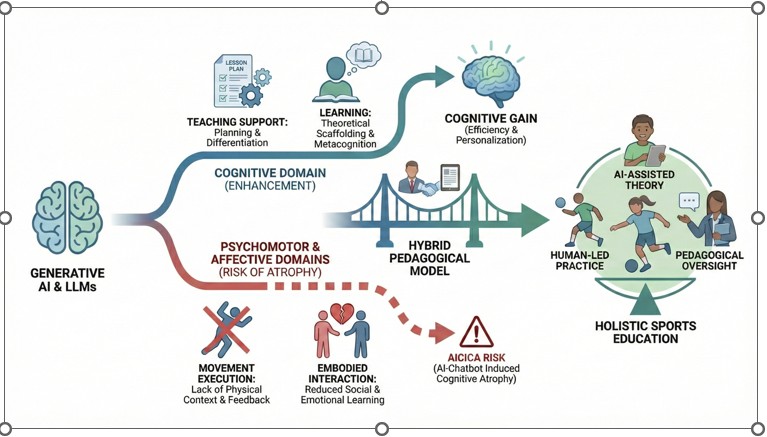
Results: Analysis of 78 studies (67% published 2023-2024) revealed significant pedagogical applications across four domains with concurrent identification of critical challenges. Teaching Support domain demonstrated lesson planning time reductions of 35% to 45%, with AI-assisted lesson plan quality rated 7.3 out of 10 (SD=1.2) for curriculum alignment compared to 7.8 out of 10 (SD=0.9) for manually created plans. Educators reported 67% satisfaction with differentiated instruction materials generated through Gen AI platforms. Learning Enhancement domain revealed improved conceptual understanding when engaging with AI tutors for anatomy and biomechanics concepts, with students valuing immediate availability and scaffolded explanations. Assessment Innovation applications showed AI-generated feedback demonstrated substantial agreement with expert teacher feedback for student assignments. Didactic Research efficiency gains included literature synthesis completion substantially faster than traditional methods and qualitative coding demonstrating substantial agreement between AI and expert human coders. However, critical challenges emerged including academic integrity violations in 23% to 43% of student work, factual inaccuracies in AI-generated specialized content, cognitive atrophy concerns (AI-Chatbot Induced Cognitive Atrophy, AICICA), reduced emphasis on embodied learning in PE contexts, and equity issues affecting students with limited digital literacy or technology access.
Conclusion: Gen AI and LLMs represent transformative tools for sports sciences and PE didactics when implemented within robust pedagogical frameworks that preserve the essential embodied, social, and affective dimensions of movement education. Evidence supports specific applications including administrative efficiency, differentiated cognitive content delivery, formative assessment support, and research methodology enhancement, while simultaneously demanding critical attention to academic integrity, accuracy verification, equity considerations, and prevention of cognitive atrophy through over-reliance. A hybrid pedagogical model is recommended integrating Gen AI for cognitive content delivery, theoretical knowledge construction, and administrative tasks while rigorously preserving face-to-face instruction, kinesthetic learning experiences, immediate physical feedback, and human mentorship central to sports education. Successful integration requires comprehensive teacher professional development focusing on pedagogical decision-making rather than technical operation, explicit policies balancing academic integrity with beneficial use, critical AI literacy curriculum specific to sports sciences contexts, and ongoing empirical evaluation of long-term learning outcomes. The field requires a paradigm shift from technology-driven adoption to pedagogy-informed integration, ensuring Gen AI serves educational goals rather than dictating them.
Downloads
References
1. Lee IM, Shiroma EJ, Lobelo F, Puska P, Blair SN, Katzmarzyk PT. Effect of physical inactivity on major non-communicable diseases world wide: an analysis of burden of disease and life expectancy. Lancet. 2012;380(9838):219-29. [PMID: 22818936] [PMCID: PMC3645500] [DOI]
2. Guthold R, Stevens GA, Riley LM, Bull FC. Worldwide trends in insufficient physical activity from 2001 to 2016: a pooled analysis of 358 population-based surveys with 1.9 million par ticipants. Lancet Glob Health. 2018;6(10):e1077-e86. [PMID: 30193830] [PMCID: PMC8160759] [DOI]
3. World Health O. Global Action Plan on Physical Activity 2018-2030: More Active People for a Healthier World. Geneva: WHO; 2018 2018.
4. Centers for Disease C, Prevention. Comprehensive School Physical Activity Programs: A Guide for Schools. Atlanta, GA: US Department of Health and Human Services; 2013 2013.
5. McKenzie TL, Lounsbery MAF. Physical education teacher effectiveness in a public health context. Research Quarterly for Exercise and Sport. 2013;84(4):419-30. [PMID: 24592772] [DOI]
6. Sallis JF, McKenzie TL, Beets MW, Beighle A, Erwin H, Lee S. Physical education's role in public health. Research Quarterly for Exercise and Sport. 2012;83(2):125-35. [PMID: 22808697] [PMCID: PMC6036633] [DOI]
7. Dergaa I, Chamari K, Zmijewski P, Ben Saad H. From human writing to artificial intelligence generated text: Examinin g the prospects and potential threats of ChatGPT in academic writing. Biology of Sport. 2023;40(2):615-22. [PMID: 37077800] [PMCID: PMC10108763] [DOI]
8. OpenAi. GPT-4 Technical Report. 2023.
9. Bubeck S, Chandrasekaran V, Eldan R. Sparks of artificial general intelligence: Early experiments with GPT- 4. 2023.
10. Rahman MM, Watanobe Y. ChatGPT for education and research: Opportunities, threats, and strate gies. Applied Sciences. 2023;13(9):5783. [DOI]
11. Chen X, Zou D, Xie H, Cheng G, Liu C. Two decades of artificial intelligence in education. Educational Technology & Society. 2022;25(1):28-47.
12. Bala K, Colvin A, Christiansen MH, et al. Generative Artificial Intelligence for Education and Pedagogy. Ithaca, NY: Cornell University Committee Report; 2023 2023.
13. Pratschke BM. Generative AI and Education: Digital Pedagogies, Teaching Innovation a nd Learning Design. Cham: Springer; 2024 2024. [DOI]
14. Dergaa I, Ben Saad H, El Omri A, Glenn JM, Clark CCT, Washif JA. Using artificial intelligence for exercise prescription in personalise d health promotion: A critical evaluation of OpenAI GPT-4 model. Biology of Sport. 2024;41(2):221-41. [PMID: 38524814] [PMCID: PMC10955739] [DOI]
15. Dergaa I, Fekih-Romdhane F, Hallit S, Loch AA, Glenn JM, Fessi MS. ChatGPT is not ready yet for use in providing mental health assessment and interventions. Frontiers in Psychiatry. 2024;14:Article 1277756. [PMID: 38239905] [PMCID: PMC10794665] [DOI]
16. Dhahbi W, Jebabli N, Boujabli M, Souaifi M, Dergaa I, Ben Ezzdine L. Machine learning and deep learning applications in sports biomechanica l analysis. ISBS Proceedings Archive. 2025;43(1):Article 18.
17. Hamdaoui T, Ghennam N, Bouchouareb R, Ghouili H. Exploring the integration and implications of artificial intelligence chatbots in sports science research. Tunis Journal of Sports Science and Medicine. 2024;2(3):6-16. [DOI]
18. Methnani J, Latiri I, Dergaa I, Chamari K, Ben Saad H. ChatGPT for Sample-Size Calculation in Sports Medicine and Exercise Sc iences: A Cautionary Note. International Journal of Sports Physiology and Performance. 2023;18(10):1219-23. [PMID: 37536678] [DOI]
19. Souaifi M, Dhahbi W, Jebabli N, Ceylan HI, Boujabli M, Muntean RI. Artificial intelligence in sports biomechanics: A scoping review on we arable technology, motion analysis, and injury prevention. Bioengineering. 2025;12(8):Article 887. [PMID: 40868401] [PMCID: PMC12383302] [DOI]
20. Washif JA, Pagaduan J, James C, Dergaa I, Beaven CM. Artificial intelligence in sport: Exploring the potential of using Cha tGPT in resistance training prescription. Biology of Sport. 2024;41(2):209-20. [PMID: 38524820] [PMCID: PMC10955742] [DOI]
21. Piaget J. The Psychology of Intelligence. London: Routledge & Kegan Paul; 1950 1950.
22. Vygotsky LS. Mind in Society: The Development of Higher Psychological Processes. Cambridge, MA: Harvard University Press; 1978 1978.
23. Lave J, Wenger E. Situated Learning: Legitimate Peripheral Participation. Cambridge: Cambridge University Press; 1991 1991. [DOI]
24. Rose DH, Meyer A. Teaching Every Student in the Digital Age: Universal Design for Learni ng. Alexandria, VA: ASCD; 2002 2002.
25. Whitehead M. Physical Literacy: Throughout the Lifecourse. London: Routledge; 2010 2010. [DOI]
26. Kirk D. Physical Education Futures. London: Routledge; 2010 2010. [DOI]
27. Schmidt RA, Lee TD. Motor Control and Learning: A Behavioral Emphasis. 5th ed. Champaign, IL: Human Kinetics; 2011 2011.
28. Trendowski J. Five ways to use generative artificial intelligence in physical educat ion. Strategies. 2024;38(1):11-6. [DOI]
29. Stokel-Walker C. ChatGPT listed as author on research papers: many scientists disapprov e. Nature. 2023;613(7945):620-1. [PMID: 36653617] [DOI]
30. Dergaa I, Ben Saad H, Glenn JM, Amamou B, Ben Aissa M, Guelmami N. From tools to threats: A reflection on the impact of artificial-intell igence chatbots on cognitive health. Frontiers in Psychology. 2024;15:Article 1259845. [PMID: 38629037] [PMCID: PMC11020077] [DOI]
31. Bai L, Liu X, Su J. ChatGPT: The cognitive effects on learning and memory. Computers and Education: Artificial Intelligence. 2023;4:Article 100134. [DOI]
32. Dergaa I, Ben Saad H. Artificial Intelligence and promoting open access in academic publishi ng. Tunisian Medicine. 2023;101(6):533-6.
33. Dergaa I, Chamari K, Glenn JM, Ben Aissa M, Guelmami N, Ben Saad H. Towards responsible research: Examining the need for preprint policy r eassessment in the era of artificial intelligence. EXCLI Journal. 2023;22:686-9.
34. Ben Saad H, Dergaa I, Ghouili H, Ceylan HI, Chamari K, Dhahbi W. The assisted Technology dilemma: a reflection on AI chatbots use and r isks while reshaping the peer review process in scientific research. AI & SOCIETY. 2025:1-8. [DOI]
35. Warschauer M. Technology and Social Inclusion: Rethinking the Digital Divide. Cambridge, MA: MIT Press; 2003 2003. [DOI]
36. Moher D, Liberati A, Tetzlaff J, Altman DG. Preferred reporting items for systematic reviews and meta-analyses: th e PRISMA statement. PLoS Medicine. 2009;6(7):Article e1000097. [PMID: 19621072] [PMCID: PMC2707599] [DOI]
37. Hong QN, Fàbregues S. The Mixed Methods Appraisal Tool (MMAT) version 2018 for information p rofessionals and researchers. Education for Information. 2018;34(4):285-91. [DOI]
38. Braun V, Clarke V. Using thematic analysis in psychology. Qualitative Research in Psychology. 2006;3(2):77-101. [DOI]
39. Miles MB, Huberman AM, Saldaña J. Qualitative Data Analysis: A Methods Sourcebook. 4th ed. Thousand Oaks, CA: SAGE Publications; 2020 2020.
40. Adamopoulou E, Moussiades L. Chatbots: History, technology, and applications. Machine Learning with Applications. 2020;2:100006. [DOI]
41. Cabero-Almenara J, Guillen-Gamez FD, Ruiz-Palmero J, Palacios-Rodriguez A. The impact of pedagogical beliefs on the adoption of generative AI in higher education. Frontiers in Artificial Intelligence. 2024;7:Article 1497705. [PMID: 39484153] [PMCID: PMC11524896] [DOI]
42. Dis EAM, Bollen J, Zuidema W, Rooij R, Bockting CL. ChatGPT: five priorities for research. Nature. 2023;614(7947):224-6. [PMID: 36737653] [PMCID: PMC11137200] [DOI]
43. Dwivedi YK, Kshetri N, Hughes L HL, et al. Opinion Paper: "So what if ChatGPT wrote it?" Multidisciplinary perspe ctives on opportunities, challenges and implications of generative con versational AI for research, practice and policy. International Journal of Information Management. 2023;71:Article 102642. [DOI]
44. Farrokhnia M, Banihashem SK, Noroozi O, Wals A. A SWOT analysis of ChatGPT: Implications for educational practice and research. Innovations in Education and Teaching International. 2024;61(3):460-74. [DOI]
45. Kasneci E, Sessler K, Küchemann S. ChatGPT for good? On opportunities and challenges of large language mo dels for education. Learning and Individual Differences. 2023;103:102274. [DOI]
46. Pataranutaporn P, Danry V, Leong J, et al. AI-generated characters for supporting personalized learning and well- being. Nature Machine Intelligence. 2021;3(12):1013-22. [DOI]
47. Sweller J, Ayres P, Kalyuga S. Cognitive Load Theory. New York2011 2011. [DOI]
48. Deci EL, Ryan RM. Self-determination theory: A macrotheory of human motivation, developm ent, and health. Canadian Psychology. 2008;49(3):182-5. [DOI]
49. Black P, Wiliam D. Assessment and classroom learning. Assessment in Education. 1998;5(1). [DOI]
50. Boud D, Molloy E. Feedback in Higher and Professional Education: Understanding it and Do ing it Well. London: Routledge; 2013 2013. [PMID: 22491961] [DOI]
51. Hattie J, Timperley H. The power of feedback. Review of Educational Research. 2007;77(1):81-112. [DOI]
52. Cao Z, Hidalgo G, Simon T, Wei SE, Sheikh Y. OpenPose: realtime multi-person 2D pose estimation using part affinity fields. IEEE Transactions on Pattern Analysis and Machine Intelligence. 2021;43(1):172-86. [PMID: 31331883] [DOI]
53. Parmar P, Morris BT, editors. What and how well you performed? A multitask learning approach to acti on quality assessment20192019. [DOI]
54. Zhu G, Xie X, Liu X, Jiang Y, Wang J. Computer vision in sports: a survey. Visual Computer. 2023;39(7):2811-29.
55. Cooper H. Research Synthesis and Meta-Analysis: A Step-by-Step Approach. 5th ed. Thousand Oaks, CA: SAGE Publications; 2017 2017. [DOI]
56. Creswell JW, Plano Clark VL. Designing and Conducting Mixed Methods Research. 3rd ed. Thousand Oaks, CA: SAGE Publications; 2018 2018.
57. Creswell JW, Poth CN. Qualitative Inquiry and Research Design: Choosing Among Five Approache s. 4th ed. Thousand Oaks, CA: SAGE Publications; 2018 2018.
58. Graham ID, Logan J, Harrison MB, et al. Lost in knowledge translation: time for a map? Journal of Continuing Education in the Health Professions. 2006;26(1):13-24. [PMID: 16557505] [DOI]
59. Lincoln YS, Guba EG. Naturalistic Inquiry. Newbury Park, CA: SAGE Publications; 1985 1985. [DOI]
60. Onwuegbuzie AJ, Leech NL. On becoming a pragmatic researcher: The importance of combining quanti tative and qualitative research methodologies. International Journal of Social Research Methodology. 2005;8(5):375-87. [PMID: PMC7673071] [DOI]
61. Patton MQ. Qualitative Research & Evaluation Methods. 4th ed. Thousand Oaks, CA: SAGE Publications; 2015 2015.
62. Popay J, Roberts H, Sowden A, et al. Guidance on the Conduct of Narrative Synthesis in Systematic Reviews. Lancaster: Lancaster University; 2006 2006.
63. Saldaña J. The Coding Manual for Qualitative Researchers. 4th ed. Thousand Oaks, CA: SAGE Publications; 2021 2021.
64. Teddlie C, Tashakkori A, Thousand Oaks CA. Foundations of Mixed Methods Research: Integrating Quantitative and Qu alitative Approaches in the Social and Behavioral Sciences. SAGE Publications2009 2009.
65. Thomas J, Harden A. Methods for the thematic synthesis of qualitative research in systemat ic reviews. BMC Medical Research Methodology. 2008;8:45. [PMID: 18616818] [PMCID: PMC2478656] [DOI]
66. Lavis JN, Robertson D, Woodside JM, McLeod CB, Abelson J. How can research organizations more effectively transfer research know ledge to decision makers? Milbank Quarterly. 2003;81(2):221-48. [PMID: 12841049] [PMCID: PMC2690219] [DOI]
67. Straus SE, Tetroe J, Graham I. Defining knowledge translation. CMAJ. 2009;181(3–4):165-8. [PMID: 19620273] [PMCID: PMC2717660] [DOI]
68. Wulf G, Lewthwaite R. Optimizing performance through intrinsic motivation and attention for learning: The OPTIMAL theory of motor learning. Psychonomic Bulletin & Review. 2016;23(5):1382-414. [PMID: 26833314] [DOI]
69. Fitts PM, Posner MI. Human Performance. Belmont, CA: Brooks/Cole; 1967 1967.
70. Tomlinson CA. How to Differentiate Instruction in Mixed-Ability Classrooms. 2nd ed. Alexandria, VA: ASCD; 2001 2001.
71. Selwyn N. Education and Technology: Key Issues and Debates. 2nd ed. London: Bloomsbury; 2017 2017. [DOI]
72. Clark A, Chalmers DJ. The extended mind. Analysis. 1998;58(1):7-19. [DOI]
73. Oecd. Students, Computers and Learning: Making the Connection. Paris: OECD Publishing; 2015 2015.
74. Metzler MW. Instructional Models in Physical Education. 3rd ed. Scottsdale, AZ: Holcomb Hathaway; 2017 2017. [DOI]
75. Bloom BS. Taxonomy of Educational Objectives, Handbook I: The Cognitive Domain. New York: David McKay Co Inc; 1956 1956.
76. Mayer RE. Multimedia Learning. 2021. [PMID: 34181062] [PMCID: PMC8763738] [DOI]
Downloads
Publication Timeline
- Submitted
- Revised
- Accepted