Effects of a 14-Week Rehabilitation Program Based on a Customized Multimodal Protocol in Individuals with Chronic Non-Specific LBP
DOI:
https://doi.org/10.61838/kman.intjssh.5071Keywords:
Chronic non - specific low back pain, physical therapy, Aquatic movements, Flexion based exercises, Extension oriented exercises, Rehabilitation.Abstract
Objective: To evaluate the effectiveness of a 14-week multimodal rehabilitation program compared with flexion-based and extension-oriented exercise protocols on pain-related disability and lumbar range of motion in adults with chronic non-specific low back pain.
Methods and Materials: In a single-center, assessor-blinded, parallel-group randomized controlled trial, 180 adults with CLBP (≥4 months; 45–72 years) were allocated (n=60/group) to: (1) multimodal comprehensive program (specialized therapeutic exercise + aquatic movements + physiotherapy modalities + massage; 90–100 min/session, 3×/week), (2) flexion-based protocol (45–60 min/session, 3×/week), or (3) extension-oriented protocol (45–60 min/session, 3×/week). Outcomes were assessed at baseline, post-intervention, and 1-month follow-up. Primary outcome was disability/pain impact using the Quebec Back Pain Disability Scale (QBPDS). Lumbar range of motion (LROM) was measured via field tests (trunk flexion, lateral flexion right/left, and supine hip/knee flexion). Analyses used repeated-measures MANOVA/ANOVA (time×group), Tukey post-hoc tests, and paired t-tests (α≤0.05).
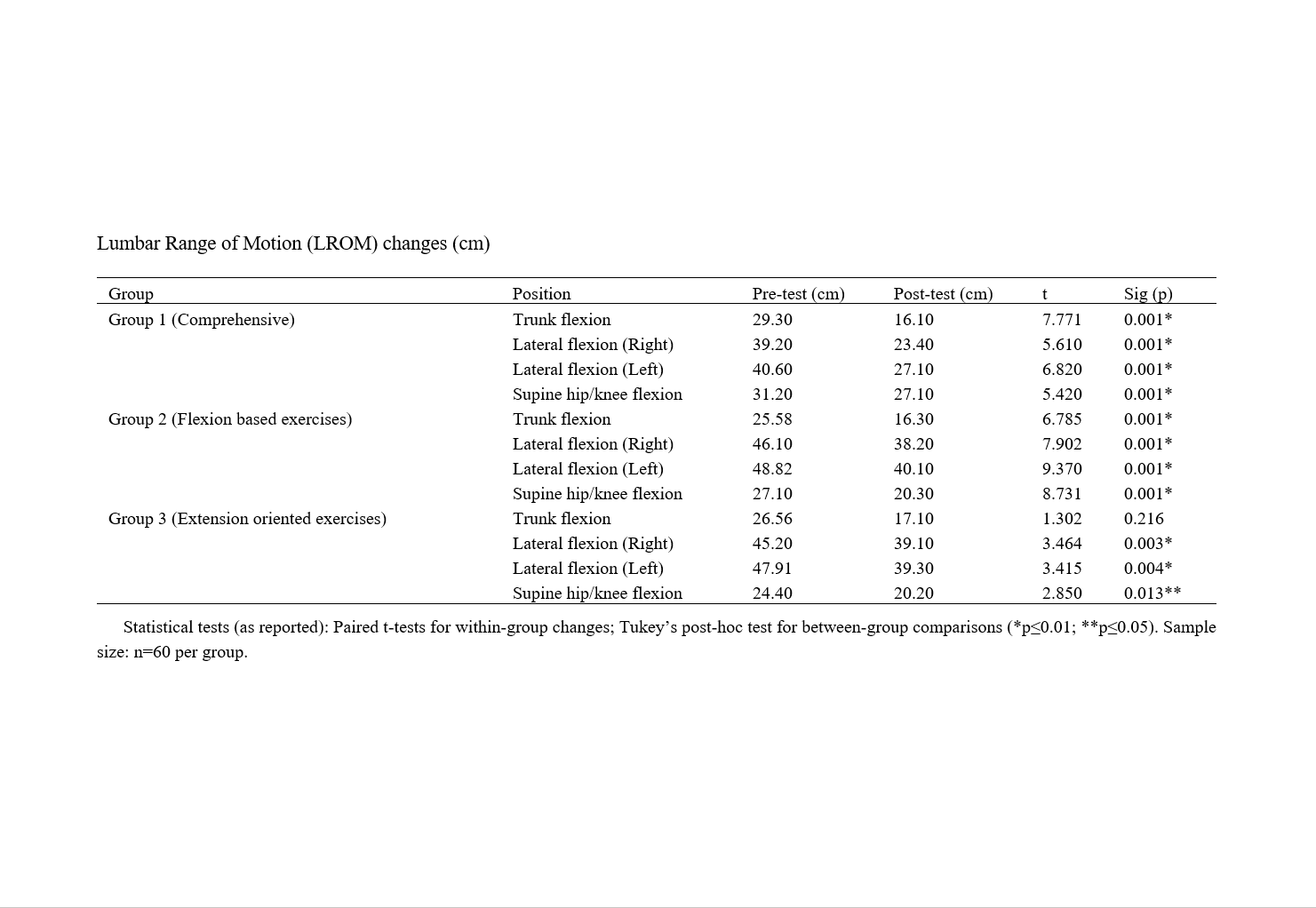
Findings: QBPDS improved within all groups (Group 1: t=15.705, p=0.001; Group 2: t=9.410, p=0.001; Group 3: t=6.930, p=0.001). Group 1 showed the greatest reduction (54.70→16.10; follow-up 21.20) versus Group 2 (53.12→29.12; follow-up 40.80) and Group 3 (55.70→31.70; follow-up 42.10), with between-group differences favoring Group 1 (Tukey p≤0.01). LROM improved significantly in Group 1 across all tests (e.g., trunk flexion t=7.771, p=0.001) and in Group 2 (all p=0.001), while Group 3 showed no trunk-flexion change (t=1.302, p=0.216). Gender effects were non-significant (p>0.05).
Conclusion: A 14-week customized multimodal rehabilitation program produced greater and more sustained improvements in disability/pain and lumbar mobility than either flexion-based or extension-oriented exercise alone in adults with chronic non-specific LBP.
Downloads
References
1. Foster NE, Anema JR, Cherkin D, Chou R, Cohen SP, Gross DP, et al. Prevention and treatment of low back pain: evidence, challenges, and promising directions. The Lancet. 2018;391(10137):2368-83. [PMID: 29573872] [PMCID: PMC11557401] [DOI]
2. Stevans JM, Delitto A, Khoja SS, Patterson CG, Smith CN, Schneider MJ, et al. Risk factors associated with transition from acute to chronic low back pain in US patients seeking primary care. JAMA network open. 2021;4(2):e2037371-e. [PMID: 33591367] [PMCID: PMC7887659] [DOI]
3. Meucci RD, Fassa AG, Faria NMX. Prevalence of chronic low back pain: systematic review. Revista de saude publica. 2015;49:73. [PMID: 26487293] [PMCID: PMC4603263] [DOI]
4. Hayden JA, Van Tulder MW, Tomlinson G. Systematic review: strategies for using exercise therapy to improve outcomes in chronic low back pain. Annals of internal medicine. 2005;142(9):776-85. [PMID: 15867410] [PMCID: PMC10493154] [DOI]
5. Van Tulder M, Malmivaara A, Esmail R, Koes B. Exercise therapy for low back pain: a systematic review within the framework of the cochrane collaboration back review group. Spine. 2000;25(21):2784-96. [PMID: 11064524] [DOI]
6. Moldovan M. Therapeutic considerations and recovery in low back pain: Williams vs McKenzie. Timisoara Physical Education and Rehabilitation Journal. 2012;5(9):2012. [DOI]
7. Ghiasi F, Mehraeen M. The effect of William's exercise on non-specific and chronic referral low back pain. Journal of Kermanshah University of Medical Sciences. 2009;12(4).
8. Namnaqani FI, Mashabi AS, Yaseen KM, Alshehri MA. The effectiveness of McKenzie method compared to manual therapy for treating chronic low back pain: a systematic review. Journal of musculoskeletal & neuronal interactions. 2019;19(4):492.
9. PIELE D, RUSU L, CALINA ML, MARIN M. EFFICIENCY OF WILLIAM'S VERSUS McKENZIE'S THERAPY FOR PATIENTS DIAGNOSED WITH LOW BACK PAIN. Discobolul-Physical Education, Sport & Kinetotherapy Journal. 2024;63(1).
10. Jenkins HJ, Corrêa L, Brown BT, Ferreira GE, Nim C, Aspinall SL, et al. Long-term effectiveness of non-surgical interventions for chronic low back pain: a systematic review and meta-analysis. The Lancet Rheumatology. 2025. [PMID: 40449512] [DOI]
11. Elmahdy HH, Zaky NA, Elalfy AT, Aly MG. Mckenzie versus William’s Exercise for Non-Specific Low Back Pain in Adolescents: A Comparative Study. The Egyptian Journal of Hospital Medicine. 2022;89(1):4747-53. [DOI]
12. NICE G. Low back pain and sciatica in over 16s: assessment and management. National Institute for Health and Care Excellence (UK) London; 2016.
13. Qaseem A, McLean RM, O'Gurek D, Batur P, Lin K, Kansagara DL, et al. Nonpharmacologic and pharmacologic management of acute pain from non–low back, musculoskeletal injuries in adults: a clinical guideline from the American College of Physicians and American Academy of Family Physicians. Annals of internal medicine. 2020;173(9):739-48. [PMID: 32805126] [DOI]
14. Oliveira CB, Maher CG, Pinto RZ, Traeger AC, Lin C-WC, Chenot J-F, et al. Clinical practice guidelines for the management of non-specific low back pain in primary care: an updated overview. European Spine Journal. 2018;27(11):2791-803. [PMID: 29971708] [DOI]
15. Andronis L, Kinghorn P, Qiao S, Whitehurst DG, Durrell S, McLeod H. Cost-effectiveness of non-invasive and non-pharmacological interventions for low back pain: a systematic literature review. Applied health economics and health policy. 2017;15(2):173-201. [PMID: 27550240] [PMCID: PMC9639433] [DOI]
16. Ma J, Zhang T, He Y, Li X, Chen H, Zhao Q. Effect of aquatic physical therapy on chronic low back pain: a systematic review and meta-analysis. BMC musculoskeletal disorders. 2022;23(1):1050. [PMID: 36460993] [PMCID: PMC9717486] [DOI]
17. Dundar U, Solak O, Yigit I, Evcik D, Kavuncu V. Clinical effectiveness of aquatic exercise to treat chronic low back pain: a randomized controlled trial. LWW; 2009. [PMID: 19525833] [DOI]
18. Barker P. Psychiatric and mental health nursing: The craft of caring: CRC Press; 2008.
19. Danneels L, Vanderstraeten G, Cambier D, Witvrouw E, Bourgois J, Dankaerts W, et al. Effects of three different training modalities on the cross sectional area of the lumbar multifidus muscle in patients with chronic low back pain. British journal of sports medicine. 2001;35(3):186-91. [PMID: 11375879] [PMCID: PMC1724339] [DOI]
20. Farrell J, Koury M, Taylor C. Therapeutic exercise for back pain. Physical therapy of the low back 3rd ed Philadelphia, PA: Churchill Livingstone. 2000:327-3.
21. Rainville J, Hartigan C, Martinez E, Limke J, Jouve C, Finno M. Exercise as a treatment for chronic low back pain. The Spine Journal. 2004;4(1):106-15. [PMID: 14749199] [DOI]
Downloads
Publication Timeline
- Submitted
- Revised
- Accepted