Field-Based Evaluation of a Three-Camera Video-Based System for Three-Dimensional Kinematic Analysis of Powerlifting Movements
Keywords:
Powerlifting, Kinematics, Motion Analysis, Biomechanical Phenomena, Markerless Motion Capture, Resistance ExerciseAbstract
Objective: Three-dimensional (3D) kinematic assessment is important for quantifying movement mechanics during resistance exercise; however, laboratory-based motion-capture systems are often costly, technically demanding, and difficult to implement in field settings. Low-cost multi-camera video-based systems may offer a practical alternative, but their measurement agreement during complex multi-joint resistance exercises remains insufficiently established. This study aimed to evaluate the agreement between a three-camera video-based 3D kinematic analysis system and an expert manual video-digitization reference method during squat, bench press, and deadlift exercises performed under field-based conditions.
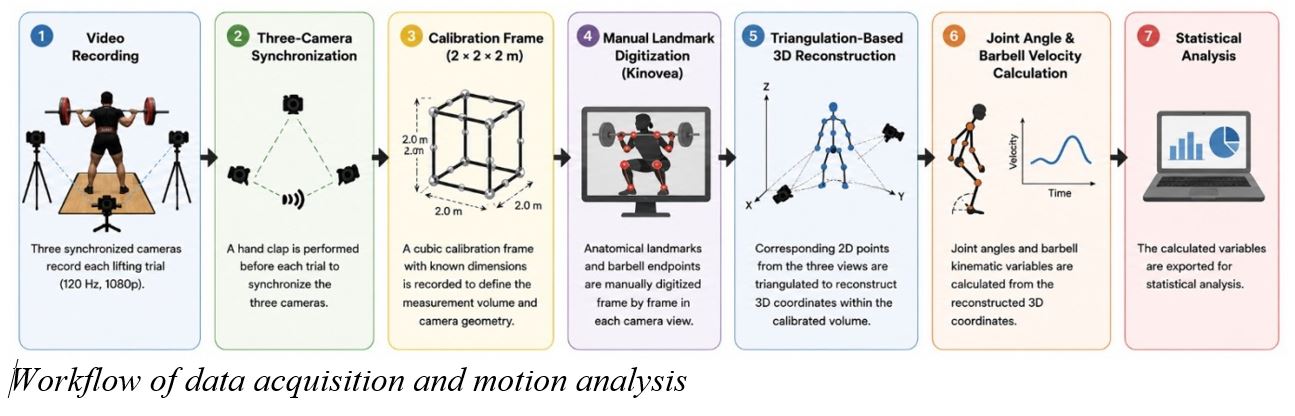
Methods and Materials: This cross-sectional agreement study included 42 male university powerlifters who performed competition-standard squat, bench press, and deadlift trials. Movements were recorded using three synchronized digital video cameras operating at 120 Hz and analyzed with Kinovea software. The proposed system was compared with an expert manual video-digitization reference method performed by blinded analysts. Selected joint angles and mean concentric barbell velocity were analyzed. Agreement between methods was assessed using Pearson correlation coefficients, intraclass correlation coefficients (ICC), root mean square error (RMSE), paired-samples t-tests, and Bland–Altman analysis.
Findings: Strong correlations were observed across all measured variables (r = 0.946–0.982, p ≤ 0.001), and agreement was excellent based on ICC values ranging from 0.944 to 0.981. RMSE values were low, ranging from 1.63° to 1.91° for joint-angle measures and from 0.015 to 0.016 m·s⁻¹ for barbell velocity. Paired-samples comparisons showed no statistically significant differences between the proposed system and the expert manual reference method for seven of the eight variables. Although the bench press elbow angle showed a statistically significant difference, the magnitude of this difference was less than 1° and was not considered practically meaningful. Bland–Altman analysis indicated minimal systematic bias and narrow limits of agreement across the measured variables.
Conclusion: The proposed three-camera video-based system demonstrated high agreement with an expert manual video-digitization reference method for selected 3D kinematic variables during squat, bench press, and deadlift exercises under standardized field-based conditions. Although these findings should not be interpreted as validation against laboratory-grade optical motion-capture systems, the system may provide a practical option for field-based biomechanical assessment when laboratory motion-capture facilities are unavailable.
Downloads
References
1. Khuyagbaatar B, Tumurbaatar M, Tsenkherjav K, Purevsuren T, Shambaljamts T, Kim K, et al. Kinematic Comparison Of Snatch And Clean Lifts In Weightlifters Using Wearable Inertial Measurement Unit Sensors. Physical Activity and Health. 2024;8:1-9. [DOI]
2. Rodal M, Franco-García JM, Carlos‐Vivas J, José F, Gosálvez AP, Charneco-Salguero G, et al. Spatio-Temporal And Mechanical Analysis Of Bench Press Phases: Barbell Kinematics And Dynamics Across Different Load Intensities. Applied Sciences. 2024;14:11783-. [DOI]
3. Sandau I, Langen G, Nitzsche N. Variability Of Time Series Barbell Kinematics In Elite Male Weightlifters. Frontiers in Sports and Active Living. 2023;5. [PMID: 37780124] [PMCID: PMC10534034] [DOI]
4. Nakano N, Sakura T, Ueda K, Omura L, Kimura A, Iino Y, et al. Evaluation Of 3D Markerless Motion Capture Accuracy Using Openpose With Multiple Video Cameras. Frontiers in Sports and Active Living. 2020;2:50. [PMID: 33345042] [PMCID: PMC7739760] [DOI]
5. Turner JA, Chaaban CR, Padua DA. A Low-Cost Markerless Motion Capture System For Lower-Extremity Kinematics During Return-To-Sport Tasks. Journal of Biomechanics. 2024;171:112200. [PMID: 38905926] [DOI]
6. Hamilton RI, Williams J, Holt CA. Biomechanics Beyond The Lab: Remote Technology For Osteoarthritis Patient Data-A Scoping Review. Frontiers in Rehabilitation Sciences. 2022;3. [PMID: 36451804] [PMCID: PMC9701737] [DOI]
7. Kakavand R, Ahmadi R, Parsaei A, Edwards WB, Komeili A. Comparison Of Kinematics And Kinetics Between Opencap And A Marker-Based Motion Capture System In Cycling. Computers in Biology and Medicine. 2025;192:110295. [PMID: 40311466] [DOI]
8. Stamm O, Steinert A. Accuracy Of Monocular Two-Dimensional Pose Estimation Compared With A Reference Standard For Kinematic Multiview Analysis: Validation Study. JMIR mHealth and uHealth. 2020;8:e19608. [PMID: 33346739] [PMCID: PMC7781802] [DOI]
9. Cronin NJ, Walker J, Tucker CB, Nicholson G, Cooke MP, Merlino S, et al. Feasibility Of Openpose Markerless Motion Analysis In A Real Athletics Competition. Frontiers in Sports and Active Living. 2024;5. [PMID: 38250008] [PMCID: PMC10796501] [DOI]
10. Uhlrich SD, Falisse A, Kidziński Ł, Muccini J, KO M, Chaudhari AS, et al. Opencap: Human Movement Dynamics From Smartphone Videos. PLoS Computational Biology. 2023;19:e1011462. [PMID: 37856442] [PMCID: PMC10586693] [DOI]
11. Thiele F, Paternoster FK, Hummel C, Stöcker F, Holzer D. Assessment Of The Accuracy Of A Deep Learning Algorithm- And Video-Based Motion Capture System In Estimating Snatch Kinematics. International Journal of Exercise Science. 2024;17:1629-47. [PMID: 39807293] [PMCID: PMC11728585] [DOI]
12. Brice SM, Doma K, Spratford W. Effect Of Footwear On The Biomechanics Of Loaded Back Squats To Volitional Exhaustion In Skilled Lifters. The Journal of Strength and Conditioning Research. 2021;36:2676-84. [PMID: 33927116] [DOI]
13. Bolstad PV, Gessler PE, Lillesand TM. Positional Uncertainty In Manually Digitized Map Data. International Journal of Geographical Information Systems. 1990;4:399-412. [DOI]
14. Puig-Diví A, Escalona‐Marfil C, Riu JM, Busquets A, Padullés-Chando X, Marcos-Ruiz D. Validity And Reliability Of The Kinovea Program In Obtaining Angles And Distances Using Coordinates In 4 Perspectives. PLoS ONE. 2019;14. [PMID: 31166989] [PMCID: PMC6550386] [DOI]
15. Shishov N, Elabd K, Komisar V, Chong H, Robinovitch SN. Accuracy Of Kinovea Software In Estimating Body Segment Movements During Falls Captured On Standard Video: Effects Of Fall Direction, Camera Perspective And Video Calibration Technique. PLoS ONE. 2021;16. [PMID: 34695159] [PMCID: PMC8544843] [DOI]
16. Alonso-Aubín DA, Chulvi‐Medrano I, Cortell-Tormo JM, Picón-Martínez M, Rebullido TR, Faigenbaum AD. Squat And Bench Press Force-Velocity Profiling In Male And Female Adolescent Rugby Players. The Journal of Strength and Conditioning Research. 2019;35. [PMID: 31490425] [DOI]
17. Hani H, Souchereau R, Kachlan A, Harris H, Dufour J, Aurand A, et al. Reliability Of A Wearable Motion System For Clinical Evaluation Of Dynamic Lumbar Spine Function. Advances in Complementary & Alternative Medicine. 2022;7:672-83. [PMID: 36816092] [PMCID: PMC9934370] [DOI]
18. Koo TK, Li MY. A Guideline Of Selecting And Reporting Intraclass Correlation Coefficients For Reliability Research. Journal of Chiropractic Medicine. 2016;15:155-63. [PMID: 27330520] [DOI]
19. Philipp NM, Cabarkapa D, Cabarkapa DV, Eserhaut DA, Fry AC. Inter-Device Reliability Of A Three-Dimensional Markerless Motion Capture System Quantifying Elementary Movement Patterns In Humans. Journal of Functional Morphology and Kinesiology. 2023;8:69. [PMID: 37218865] [PMCID: PMC10204374] [DOI]
20. Wang XM, Smith DT, Zhu Q. A Webcam-Based Machine Learning Approach For Three-Dimensional Range Of Motion Evaluation. PLoS ONE. 2023;18. [PMID: 37871043] [PMCID: PMC10593217] [DOI]
21. Lima YL, Donnelly CJ, Uhlrich SD, Falisse A, Delp SL, Pappas E, et al. Validity And Reliability Of Trunk And Lower-Limb Kinematics Measured Using Opencap During Functional Movements. Journal of Sports Sciences. 2024. [PMID: 39444219] [DOI]
22. Needham L, Evans M, Wade L, Cosker DP, Mcguigan PM, Bilzon JL, et al. The Development And Evaluation Of A Fully Automated Markerless Motion Capture Workflow. Journal of Biomechanics. 2022;144:111338. [PMID: 36252308] [DOI]
23. Wade L, Needham L, Evans M, Mcguigan P, Colyer S, Cosker D, et al. Examination Of 2D Frontal And Sagittal Markerless Motion Capture: Implications For Markerless Applications. PLoS ONE. 2023;18. [PMID: 37943887] [PMCID: PMC10635560] [DOI]
24. Courel‐Ibáñez J, Martínez‐Cava A, Morán‐Navarro R, Escribano‐Peñas P, Chavarren-Cabrero J, González‐Badillo JJ, et al. Reproducibility And Repeatability Of Five Different Technologies For Bar Velocity Measurement In Resistance Training. Annals of Biomedical Engineering. 2019;47:1523-38. [PMID: 30980292] [DOI]
25. Cunanan AJ, Hornsby WG, South MA, Ushakova KP, Mizuguchi S, Sato K, et al. Survey Of Barbell Trajectory And Kinematics Of The Snatch Lift From The 2015 World And 2017 Pan-American Weightlifting Championships. Sports. 2020;8:118. [PMID: 32854406] [PMCID: PMC7552656] [DOI]
26. Koul A, Novembre G. How Accurately Can We Estimate Spontaneous Body Kinematics From Video Recordings? Effect Of Movement Amplitude On Openpose Accuracy. Behavior Research Methods. 2025;57:38. [PMID: 39747756] [PMCID: PMC11695451] [DOI]
27. Conconi M, Pompili A, Sancisi N, Parenti‐Castelli V. Quantification Of The Errors Associated With Marker Occlusion In Stereophotogrammetric Systems And Implications On Gait Analysis. Journal of Biomechanics. 2020;114:110162. [PMID: 33310277] [DOI]
28. Mata AJ, Hayashi H, Moreno PA, Dudley RI, Sorenson EA. Hip Flexion Angles During Supine Range Of Motion And Bodyweight Squats. International Journal of Exercise Science. 2021;14:912-8. [DOI]
29. Straub RK, Powers CM. A Biomechanical Review Of The Squat Exercise: Implications For Clinical Practice. International Journal of Sports Physical Therapy. 2024;19:490-501. [PMID: 38576836] [DOI]
30. Bissas A, Cronin NJ. Evaluating Markerless Biomechanical Analysis In A Real-World Pole Vault Competition Setting. PLOS ONE. 2026;21:e0329987. [PMID: 41894358] [PMCID: PMC13028377] [DOI]
31. Colyer SL, Evans M, Cosker DP, Salo AIT. A Review Of The Evolution Of Vision-Based Motion Analysis And The Integration Of Advanced Computer Vision Methods Towards Developing A Markerless System. Sports Medicine - Open. 2018;4:24. [PMID: 29869300] [DOI]
32. Horsak B, Prock K, Krondorfer P, Siragy T, Simonlehner M, Dumphart B. Inter-Trial Variability Is Higher In 3D Markerless Compared To Marker-Based Motion Capture: Implications For Data Post-Processing And Analysis. Journal of Biomechanics. 2024;166:112049. [PMID: 38493576] [DOI]
33. Klimaszewski K, Grajek T, Wegner K. Factors Influencing Accuracy Of Estimating Position Of Objects In A Multi-Camera System. Journal of Telecommunications and Information Technology. 2024:1-16. [DOI]
34. Das K, De Paula Oliveira T, Newell J. Comparison Of Markerless And Marker-Based Motion Capture Systems Using 95% Functional Limits Of Agreement In A Linear Mixed-Effects Modelling Framework. Scientific Reports. 2023;13:22880. [PMID: 38129434] [PMCID: PMC10739832] [DOI]