Effects of Random Visual Stimulus Training on Anticipation, Reaction Time, and Stroke Accuracy in Competitive Table Tennis Players
Keywords:
Table tennis, Perceptual-cognitive training, Random visual stimulus training, Anticipation ability, Visuomotor reaction time, Stroke accuracy, Perception–action couplingAbstract
Background and Purpose:
Modern table tennis requires rapid perceptual-cognitive processing and adaptive motor responses under highly dynamic and time-constrained conditions. Anticipation ability, visuomotor reaction time, and stroke accuracy are considered essential determinants of successful performance in competitive play. However, evidence regarding the integrated effects of sport-specific random visual stimulus training on these interrelated performance components remains limited. Therefore, the present study aimed to examine the effects of random visual stimulus training on anticipation ability, reaction time, and stroke accuracy in competitive table tennis players.
Materials and Methods:
A randomized pretest–posttest control group experimental design was employed involving 36 competitive table tennis players (age: 18–24 years). Participants were randomly assigned to either an experimental group (n = 18) or a control group (n = 18). The experimental group completed an eight-week random visual stimulus training program in addition to conventional table tennis practice, whereas the control group performed conventional training only. Anticipation ability was assessed using a sport-specific temporal occlusion test, visuomotor reaction time was measured using the FITLIGHT Trainer™ system, and stroke accuracy was evaluated through a standardized target accuracy protocol. Data were analyzed using repeated-measures MANOVA and follow-up repeated-measures ANOVA with significance established at p < 0.05.
Results:
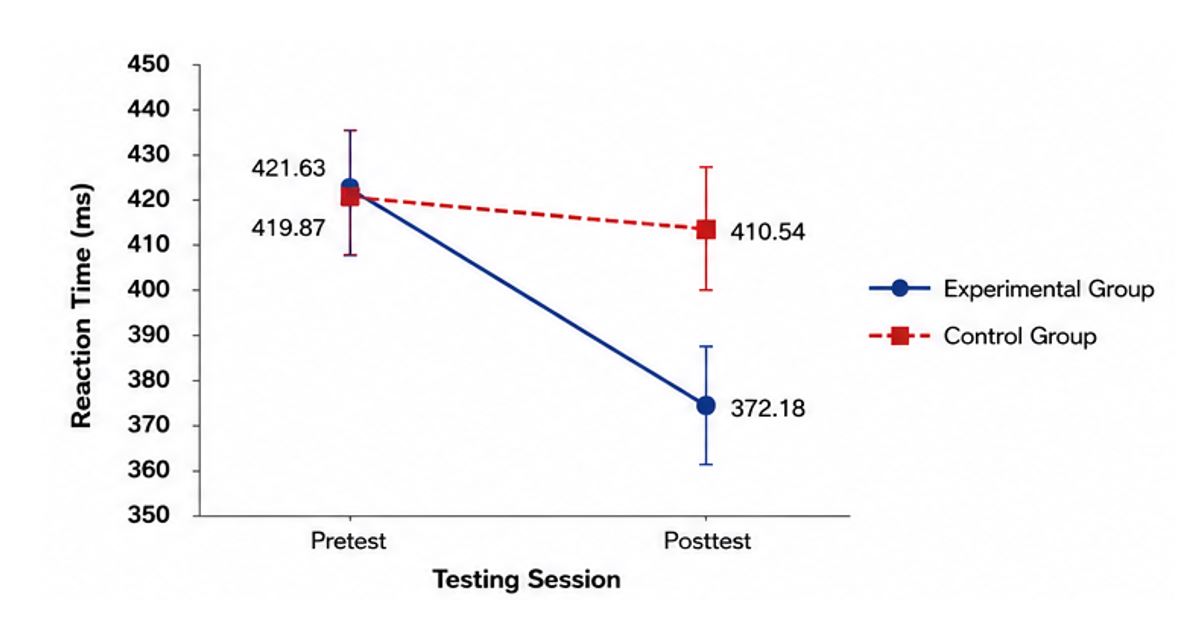
The experimental group demonstrated greater improvements in anticipation ability, reaction time, and stroke accuracy compared with the control group following the intervention period. Significant time × group interaction effects were identified for anticipation performance (p < 0.001), reaction time (p < 0.001), and stroke accuracy (p < 0.001). The experimental group showed substantial increases in anticipation accuracy and stroke performance, accompanied by a marked reduction in visuomotor reaction time. In addition, multivariate analysis revealed moderate-to-large intervention effects across all dependent variables (partial η² = 0.463–0.702).
Conclusions:
Random visual stimulus training was associated with improvements in anticipation ability, visuomotor reaction time, and stroke accuracy in competitive table tennis players. The findings suggest that integrating sport-specific perceptual-cognitive training into routine practice environments may contribute to enhanced perceptual-motor responsiveness and technical execution under dynamic competitive conditions. These results support the application of perception–action coupling approaches within contemporary table tennis athlete development programs.
Downloads