The Effect of Kinesiotaping on Anterior Cruciate Ligament Reconstruction: A Systematic Review and Meta-analysis
DOI:
https://doi.org/10.61838/kman.intjssh.4758Keywords:
ACL reconstruction, Kinesio taping, Rehabilition, Pain, Balance, Muscle strength, EdemaAbstract
Objective: Anterior cruciate ligament reconstruction (ACLR) is one of the most common orthopedic surgeries, and optimal functional recovery requires a precise and multifaceted rehabilitation program. Kinesio taping (KT) has emerged as a non-invasive adjunctive therapy for managing postoperative complications. This study aimed to systematically review and meta-analyze the effects of KT on balance, muscle strength, pain, and edema in patients following ACLR.
Methods and Materials: A systematic search was conducted across six databases PubMed, Medline, Scopus, EMBASE, Google Scholar, and the Cochrane Central Register of Controlled Trials (CENTRAL) from 2014 until the final search date in February 2025. Eligible studies were randomized controlled trials (RCTs) evaluating the effects of KT in post-ACLR patients. Study quality was assessed using the Cochrane Risk of Bias tool (RoB 2). Data were pooled using a random-effects model, and the standardized mean difference (SMD) was calculated as the effect size.
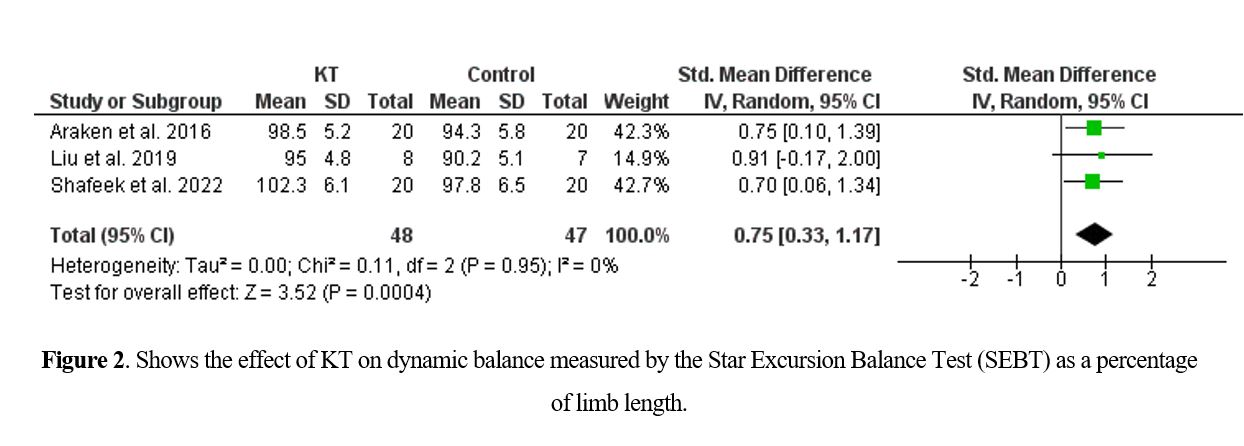
Findings: Thirteen studies with 631 participants were included in the final analysis. Meta-analysis revealed that KT was significantly associated with improved dynamic balance (SMD = 0.75, 95% CI: 0.33 to 1.17), increased quadriceps strength (SMD = 0.53, 95% CI: 0.19 to 0.87), reduced pain (SMD = 0.53, 95% CI: 0.22 to 0.85), and decreased edema (SMD = 1.01, 95% CI: 0.68 to 1.35). Heterogeneity across studies was low to moderate (I² = 45–68%).
Conclusion: Current evidence supports KT as a safe and effective adjunctive intervention in ACLR rehabilitation, providing significant improvements in balance, muscle strength, pain, and swelling.
Downloads
References
References
1. Rivera‐Brown AM, Frontera WR, Fontánez R, Micheo WF. Evidence for isokinetic and functional testing in return to sport decisions following ACL surgery. Pm&r. 2022;14(5):678-90.
2. Ramachandran AK, Pedley JS, Moeskops S, Oliver JL, Myer GD, Lloyd RS. Changes in Lower Limb Biomechanics Across Various Stages of Maturation and Implications for ACL Injury Risk in Female Athletes: A Systematic Review. Sports Medicine. 2024:1-26.
3. Rodríguez-Merchán EC. Anterior cruciate ligament reconstruction: is biological augmentation beneficial? International Journal of Molecular Sciences. 2021;22(22):12566.
4. Gornitzky AL, Lott A, Yellin JL, Fabricant PD, Lawrence JT, Ganley TJ. Sport-specific yearly risk and incidence of anterior cruciate ligament tears in high school athletes: a systematic review and meta-analysis. The American journal of sports medicine. 2016;44(10):2716-23.
5. Arendt E, Dick R. Knee injury patterns among men and women in collegiate basketball and soccer: NCAA data and review of literature. The American journal of sports medicine. 1995;23(6):694-701.
6. Boden BP, Dean GS, Feagin JA, Garrett WE. Mechanisms of anterior cruciate ligament injury. SLACK Incorporated Thorofare, NJ; 2000. p. 573-8.
7. Yao S, Fu BS-C, Yung PS-H. Graft healing after anterior cruciate ligament reconstruction (ACLR). Asia-Pacific journal of sports medicine, arthroscopy, rehabilitation and technology. 2021;25:8-15.
8. Nelson C, Rajan L, Day J, Hinton R, Bodendorfer BM. Postoperative rehabilitation of anterior cruciate ligament reconstruction: a systematic review. Sports Medicine and Arthroscopy Review. 2021;29(2):63-80.
9. Van Grinsven S, Van Cingel R, Holla C, Van Loon C. Evidence‐based rehabilitation following anterior cruciate ligament reconstruction. Knee Surgery, Sports Traumatology, Arthroscopy. 2010;18(8):1128-44.
10. Balki S, Göktaş HE, Öztemur Z. Kinesio taping as a treatment method in the acute phase of ACL reconstruction: a double-blind, placebo-controlled study. Acta orthopaedica et traumatologica turcica. 2016;50(6):628-34.
11. Labianca L, Andreozzi V, Princi G, Princi AA, Calderaro C, Guzzini M, et al. The effectiveness of Kinesio Taping in improving pain and edema during early rehabilitation after Anterior Cruciate Ligament Reconstruction: A Prospective, Randomized, Control Study. Acta Bio Medica: Atenei Parmensis. 2022;92(6):e2021336.
12. Lin Z-M, Yang J-F, Lin Y-L, Cheng Y-C, Hung C-T, Chen C-S, et al. Effect of kinesio taping on hand sensorimotor control and brain activity. Applied Sciences. 2021;11(22):10522.
13. Ogrodzka-Ciechanowicz K, Głąb G, Ślusarski J, Gądek A, Nawara J. Does kinesiotaping can improve static stability of the knee after anterior cruciate ligament rupture? A randomized single-blind, placebo‐controlled trial. BMC Sports Science, Medicine and Rehabilitation. 2021;13:1-12.
14. Page MJ, McKenzie JE, Bossuyt PM, Boutron I, Hoffmann TC, Mulrow CD, et al. The PRISMA 2020 statement: an updated guideline for reporting systematic reviews. International journal of surgery. 2021;88:105906.
15. Zhang S, Wang L, Liu X, Wang G, Chen P. Effects of Kinesio taping on lower limb biomechanical characteristics during the cutting maneuver in athletes after anterior cruciate ligament reconstruction. Plos one. 2024;19(3):e0299216.
16. Liu K, Qian J, Gao Q, Ruan B. Effects of Kinesio taping of the knee on proprioception, balance, and functional performance in patients with anterior cruciate ligament rupture: A retrospective case series. Medicine. 2019;98(48):e17956.
17. Kirupa K, Divya Mary S, Nithyanisha R, Vaishnavi G, Pavithralochani V, Abirami Intrenee K. Efficacy of Kinesio taping versus McConnell (rigid) taping in treating anterior cruciate ligament injuries among football players. Drug Invention Today. 2019;11:351-4.
18. Ulusoy B, HARPUT G, ÖZER H, Baltaci G. External Supports Improve Knee Performance In Acl Reconstructed Individuals With Higher Kinesiophobia Levels. 2016.
19. Oliveira AK, Borges DT, Lins CA, Cavalcanti RL, Macedo LB, Brasileiro JS. Immediate effects of Kinesio Taping® on neuromuscular performance of quadriceps and balance in individuals submitted to anterior cruciate ligament reconstruction: a randomized clinical trial. Journal of science and medicine in sport. 2016;19(1):2-6.
20. Laborie M, Klouche S, Herman S, Gerometta A, Lefevre N, Bohu Y. Inefficacy of Kinesio-Taping on early postoperative pain after ACL reconstruction: Prospective comparative study. Orthopaedics & Traumatology: Surgery & Research. 2015;101(8):963-7.
21. Baltaci G, Ozunlu Pekyavas N, Atay OA. Short-time effect of sterile kinesio tape applied during anterior cruciate ligament reconstruction on edema, pain and range of motion. Research in Sports Medicine. 2023;31(5):550-61.
22. Kwon H-J, Park D-S, Jeong JR, Jung K-I. The effect of silicone sleeve and taping on balance and strength in anterior cruciate ligament reconstruction patients. The Journal of Korean Physical Therapy. 2014;26(3):147-55.
23. Shafeek MM, Ahmed YF, Ibrahim HM, Elnegamy TE. The immediate and late effect of kinesio taping on dynamic balance in young athletes with the anterior cruciate ligament injury. Turkish Journal of Physiotherapy and Rehabilitation.32:2.
24. Mahdi AK, Hossein S. The mid-term effect of kinesio taping on peak power of quadriceps and hamstring muscles after anterior cruciate ligament reconstruction. Physical education of students. 2017;21(1):27-32.
25. Nazary-Moghadam S, Abbasi Z, Sekandari R, Razi A, Zeinalzadeh A, Rostami S, et al. Kinesiotaping Is Not Better Than a Placebo: Kinesiotaping for Postural Control in Anterior Cruciate Ligament-Reconstructed Patients—A Randomized Controlled Trial. Journal of Sport Rehabilitation. 2024;33(4):245-51.
26. McGough JJ, Faraone SV. Estimating the size of treatment effects: moving beyond p values. Psychiatry (Edgmont). 2009;6(10):21.
27. Higgins JP, Thompson SG, Deeks JJ, Altman DG. Measuring inconsistency in meta-analyses. Bmj. 2003;327(7414):557-60.
28. Ogrodzka-Ciechanowicz K, Głąb G, Ślusarski J, Gądek A, Nawara J. Does kinesiotaping can improve static stability of the knee after anterior cruciate ligament rupture? A randomized single-blind, placebo‐controlled trial. BMC Sports Science, Medicine and Rehabilitation. 2021;13(1):24.
Downloads
Publication Timeline
- Submitted
- Revised
- Accepted