The Effect of Cooperative Learning-Based Physical Activity on Quality of Life in Male Students: A Quasi-Experimental Study from Iran
Keywords:
Cooperative Learning, Physical Education, Quality of Life, PedsQL, Elementary School StudentsAbstract
Objective: In the 21st century, students face unprecedented challenges, highlighting the need for innovative educational approaches that promote holistic development and quality of life (QoL). Cooperative learning (CL), with its emphasis on positive interdependence and social interaction, presents a promising alternative to traditional, competitive physical education (PE) methods. However, the specific effects of structured CL-based physical activity on the multi-dimensional QoL of elementary students, particularly from both child and parent perspectives, remain underexplored .To the best of our knowledge, this study is the first to examine the effect of a cooperative learning-based physical activity program on the multidimensional quality of life of elementary school students using a dual informant (child and parent) perspective. This study aimed to investigate and compare the effects of a structured CL-based physical activity program versus a traditional PE approach on the QoL of elementary school male students.
Methods and Materials: A quasi-experimental design with a pre-test/post-test control group was employed. Forty 5th-grade male students (Mean age = 10.4 years) from Kermanshah, Iran, were selected through stratified random sampling and randomly assigned to either a CL intervention group (n=20) or a traditional instruction (TI) control group (n=20). Both groups participated in 14 sessions (45 minutes each, twice a week) of their respective programs. The Pediatric Quality of Life Inventory (PedsQL) was used to assess QoL dimensions (physical, emotional, social, and school functioning) from both student and parent perspectives before and after the intervention. Data were analyzed using Analysis of Covariance (ANCOVA) after confirming its statistical assumptions in SPSS version 27
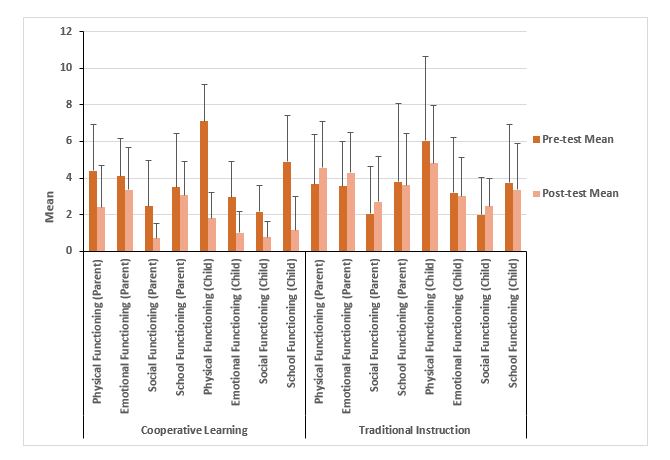
Findings: The CL intervention resulted in statistically significant improvements in all QoL domains from the students' perspective (physical, emotional, social, and school functioning; p<0.05) compared to the TI group. Furthermore, from the parents' perspective, significant improvements were observed in the physical and social domains of their children's QOL (p<0.05).
Conclusion: A structured cooperative learning approach in physical education is significantly more effective than traditional methods in enhancing the multidimensional quality of life of elementary school students. Integrating CL into school PE curricula is recommended as a sustainable strategy to foster students' physical, psychosocial, and educational well-being, aligning with the holistic goals of 21st-century education.
Downloads
References
1. Lillekroken D, Bjorge H, Halvorsrud L, Lidal IB. Assessing quality of life-a scoping review of studies presenting quality of life instruments for informal caregivers of persons with dementia. BMC Geriatr2025;25(1):976. [DOI:10.1186/s12877-025-06455-x].
2. Michalos AC. Encyclopedia of Quality of Life and Well-Being Research: Springer; 2014. [DOI:10.1007/978-94-007-0753-5].
3. Nikolaou II, Tsalis TA, Trevlopoulos NS, Mathea A, Avlogiaris G, Vatalis KI. Exploring the sustainable reporting practices of universities in relation to the United Nations’ 2030 Agenda for sustainable development. Discover Sustainability.2023;4(1):46. [DOI:10.1007/s43621-023-00167-1].
4. Norden P, Lyndon M, Krägeloh CU, Henning M, Medvedev O. Longitudinal investigation of the stable and dynamic components of the World Health Organization Quality of Life Measure (WHOQOL-BREF) using generalizability theory. Current Psychology. 2023;42(14):11809-18. [DOI:10.1007/s12144-021-02474-0].
5. Bjorklund DF. Children's Evolved Learning Abilities and Their Implications for Education. Educ Psychol Rev. 2022;34(4):2243-73. [DOI:10.1007/s10648-022-09688-z].
6. Bandura A, Walters RH. Social learning theory: Prentice hall Englewood Cliffs, NJ; 1977.[link].
7. Bailey R. Sport, physical education and educational worth. Educational Review. 2018;70(1):51-66. [DOI:10.1080/00131911.2018.1403208].
8. Carse N, Jess M, Keay J. Primary physical education: Shifting perspectives to move forwards. European Physical Education Review. 2018;24(4):487-502. [DOI:10.1177/1356336X16688598].
9. Fernandez-Rio J, Casey A. Sport education as a cooperative learning endeavour. Physical Education and Sport Pedagogy. 2021;26(4):375-87. [DOI:10.1080/17408989.2020.1810220].
10. HATTIE, John; ANDERMAN, Eric M. (ed.). International guide to student achievement. New York, NY: Routledge, 2013. p. 372-4. [DOI:10.4324/9780203850398].
11. Fernandez-Rio J, Sanz N, Fernandez-Cando J, Santos L. Impact of a sustained Cooperative Learning intervention on student motivation. Physical Education and Sport Pedagogy. 2016;22(1):89-105. [DOI:10.1080/17408989.2015.1123238].
12. Deutsch M. Cooperation and trust: Some theoretical notes. 1962. [LINK].
13. Baloche L, Brody CM. Cooperative learning: Exploring challenges, crafting innovations. Taylor & Francis; 2017. p. 274-83. [DOI:10.1080/02607476.2017.1319513].
14. Bores-Garcia D, Hortiguela-Alcala D, Fernandez-Rio FJ, Gonzalez-Calvo G, Barba-Martin R. Research on Cooperative Learning in Physical Education: Systematic Review of the Last Five Years. Res Q Exerc Sport. 2021;92(1):146-55. [DOI:10.1080/02701367.2020.1719276].
15. Colomer J, Cañabate D, Stanikūnienė B, Bubnys R. Formulating modes of cooperative leaning for education for sustainable development. MDPI; 2021. p. 3465. [DOI:10.3390/su13063465].
16. Mendo-Lazaro S, Leon-Del-Barco B, Polo-Del-Rio MI, Lopez-Ramos VM. The Impact of Cooperative Learning on University Students' Academic Goals. Front Psychol. 2021;12:787210. [DOI:10.3389/fpsyg.2021.787210].
17. Ryff CD. Psychological well-being revisited: advances in the science and practice of eudaimonia. Psychother Psychosom. 2014;83(1):10-28. [DOI:10.1159/000353263].
18. Cecchini JA, Fernandez-Rio J, Mendez-Gimenez A, Gonzalez C, Sanchez-Martínez B, Carriedo A. High versus low-structured cooperative learning. Effects on prospective teachers’ regulation dominance, motivation, content knowledge and responsibility. European Journal of Teacher Education. 2020;44(4):486-501. [DOI:10.1080/02619768.2020.1774548].
19. Li H. Impact of collaborative learning on student engagement in college English programs: mediating effect of peer support and moderating role of group size. Front Psychol. 2025;16:1525192. [DOI:10.3389/fpsyg.2025.1525192].
20. Alsubaie MM, Stain HJ, Webster LAD, Wadman R. The role of sources of social support on depression and quality of life for university students. International Journal of Adolescence and Youth. 2019;24(4):484-96. [DOI:10.1080/02673843.2019.1568887].
21. Johnson DW, Johnson RT. Cooperative learning: The foundation for active learning. Active learning—Beyond the future. 2018:59-71. [DOI:10.5772/intechopen.81086].
22 Johnson DW, Johnson RT. An Educational Psychology Success Story: Social Interdependence Theory and Cooperative Learning. Educational Researcher. 2009;38(5):365-79. [DOI:10.3102/0013189x09339057].
23. Dyson B, Shen Y, Xiong W, Dang L. How Cooperative Learning Is Conceptualized and Implemented in Chinese Physical Education: A Systematic Review of Literature. ECNU Review of Education. 2021;5(1):185-206. [DOI:10.1177/20965311211006721].
24. Dyson B, Casey A. Cooperative Learning in Physical Education and Physical Activity: Routledge; 2016.[DOI:10.4324/9781315739496].
25. Bjørke L, Mordal Moen K. Cooperative learning in physical education: a study of students’ learning journey over 24 lessons. Physical Education and Sport Pedagogy. 2020;25(6):600-12. [DOI:10.1080/17408989.2020.1761955].
26. Casey A, Quennerstedt M. Cooperative learning in physical education encountering Dewey’s educational theory. European Physical Education Review. 2020;26(4):1023-37. [DOI:10.1177/1356336x20904075].
27. Dyson B, Howley D, Wright PM. A scoping review critically examining research connecting social and emotional learning with three model-based practices in physical education: Have we been doing this all along? European Physical Education Review. 2020;27(1):76-95. [DOI:10.1177/1356336x20923710].
28. Darnis F, Lafont L. Cooperative learning and dyadic interactions: two modes of knowledge construction in socio-constructivist settings for team-sport teaching. Physical Education and Sport Pedagogy. 2013;20(5):459-73. [DOI:10.1080/17408989.2013.803528].
29. Walseth K, Engebretsen B, Elvebakk L. Meaningful experiences in PE for all students: an activist research approach. Physical Education and Sport Pedagogy. 2018;23(3):235-49. [DOI:10.1080/17408989.2018.1429590].
30. Lafont L, Rivière C, Darnis F, Legrain P. How to structure group work? Conditions of efficacy and methodological considerations in physical education. European Physical Education Review. 2017;23(3):327-38 [DOI:10.1177/1356336X15626639].
31. Hovdal DOG, Haugen T, Larsen IB, Johansen BT. Students’ experiences and learning of social inclusion in team activities in physical education. European Physical Education Review. 2021;27(4):889-907. [DOI:10.1177/1356336x211002855].
32. Teraoka E, Jancer Ferreira H, Kirk D, Bardid F. Affective Learning in Physical Education: A Systematic Review. Journal of Teaching in Physical Education. 2021;40(3):460-73. [DOI:10.1123/jtpe.2019-0164].
33 .Espoz-Lazo S, Rodríguez Huete R, Espoz-Lazo P, Farías-Valenzuela C, Valdivia-Moral P. Emotional Education for the Development of Primary and Secondary School Students Through Physical Education: Literature Review. Education Sciences. 2020;10(8):192. [DOI:10.3390/educsci10080192].
34. Aggerholm K, Standal O, Barker D, Larsson H. On practising in physical education: Outline for a pedagogical model. Physical Education and Sport Pedagogy. 2018;23(2):197-208. [DOI:10.1080/17408989.2017.1372408].
35. Lafont L, Rivière C, Darnis F, Legrain P. How to structure group work? Conditions of efficacy and methodological considerations in physical education. European Physical Education Review. 2016;23(3):327-38. [DOI:10.1177/1356336x15626639].
36. Yang C, Chen R, Chen X, Lu KH. The Efficiency of Cooperative Learning in Physical Education on the Learning of Action Skills and Learning Motivation. Front Psychol. 2021;12:717528. [DOI:10.3389/fpsyg.2021.717528].
37. Medrano PMG, López LMG, Río JF. Aprendizaje cooperativo. Materiales curriculares para Educación Secundaria en Educación Física: Ediciones de la Universidad de Castilla La Mancha; 2022. [DOI:10.18239/atenea_2022.35.00].
38. Varni JW, Seid M, Rode CA. The PedsQL: measurement model for the pediatric quality of life inventory. Med Care. 1999;37(2):126-39. [DOI:10.1097/00005650-199902000-00003].
39. Desai AD, Zhou C, Stanford S, Haaland W, Varni JW, Mangione-Smith RM. Validity and responsiveness of the pediatric quality of life inventory (PedsQL) 4.0 generic core scales in the pediatric inpatient setting. JAMA Pediatr. 2014;168(12):1114-21. [DOI:10.1001/jamapediatrics.2014.1600].
40. Rosenberg AR, Orellana L, Ullrich C, Kang T, Geyer JR, Feudtner C, et al. Quality of Life in Children With Advanced Cancer: A Report From the PediQUEST Study. J Pain Symptom Manage. 2016;52(2):243-53. [DOI:10.1016/j.jpainsymman.2016.04.002].
41. Amiri P, Eslamian G, Mirmiran P, Shiva N, Jafarabadi MA, Azizi F. Validity and reliability of the Iranian version of the Pediatric Quality of Life Inventory 4.0 (PedsQL) Generic Core Scales in children. Health Qual Life Outcomes. 2012;10(1):3. [DOI:10.1186/1477-7525-10-3].
42. Metzler M. Instructional Models in Physical Education: Routledge; 2017. [DOI:10.4324/9781315213521].
43. Casey A, Goodyear VA. Can Cooperative Learning Achieve the Four Learning Outcomes of Physical Education? A Review of Literature. Quest. 2015;67(1):56-72. [DOI:10.1080/00336297.2014.984733].
44. Shen Y, Dyson B, Baek S, Howley D, Zhang F. Social and Emotional Learning Through a Sports-Based Youth Development Program Grounded in a Hybrid Model-Based Practice. Journal of Teaching in Physical Education. 2025;44(1):123-32.
[DOI:10.1123/jtpe.2024-0011].
45. Hortigüela Alcalá D, Hernando Garijo A, Pérez-Pueyo Á, Fernández-Río J. Cooperative Learning and Students’ Motivation, Social Interactions and Attitudes: Perspectives from Two Different Educational Stages. Sustainability. 2019;11(24):7005. [DOI:10.3390/su11247005].
46. Tadesse T, Ware H, Asmare A, Gillies RM. Enhancing Student Engagement and Outcomes: The Effects of Cooperative Learning in an Ethiopian University’s Classrooms. Education Sciences.2024;14(9):975. [DOI:10.3390/educsci14090975].
47. Zavala Berbena MA, Valadez Sierra MDlD, Vargas Vivero MDC. Inteligencia emocional y habilidades sociales en adolescentes con alta aceptación social. Electronic Journal of Research in Education Psychology. 2017;6(15):199-214. [DOI:10.25115/ejrep.v6i15.1291].
48. Boke H, Aygun Y, Tufekci S, Yagin FH, Canpolat B, Norman G, et al. Effects of cooperative learning on students' learning outcomes in physical education: a meta-analysis. Front Psychol. 2025;16:1508808. [DOI:10.3389/fpsyg.2025.1508808].
49. Opstoel K, Chapelle L, Prins FJ, De Meester A, Haerens L, van Tartwijk J, et al. Personal and social development in physical education and sports: A review study. European Physical Education Review. 2019;26(4):797-813. [DOI:10.1177/1356336x19882054].
50. León B, Fernandez-Rio J, Rivera-Pérez S, Iglesias D. Cooperative Classrooms and Academic Performance in Physical Education: A Multilevel Analysis. Journal of Teaching in Physical Education.2022;41(4):660-8. [DOI:10.1123/jtpe.2021-0008].
51. Dyson B, Howley D, Shen Y. ‘Being a team, working together, and being kind’: Primary students’ perspectives of cooperative learning's contribution to their social and emotional learning. Physical Education and Sport Pedagogy.2020;26(2):137-54. [DOI:10.1080/17408989.2020.1779683].
52. Hogenkamp L, van Dijk AM, Eysink THS. Analyzing Socially Shared Regulation of Learning during Cooperative Learning and the Role of Equal Contribution: A Grounded Theory Approach. Education Sciences. 2021;11(9):512. [DOI:10.3390/educsci11090512].
53. Johnson DW, Johnson RT. The use of cooperative procedures in teacher education and professional development. Journal of education for teaching. 2017;43(3):284-95. [DOI:10.1080/02607476.2017.1328023].
54. Zach S, Shoval E, Shulruf B, editors. Cooperative learning in physical education lessons-literature review. Frontiers in Education; 2023: Frontiers Media SA. [DOI:10.3389/feduc.2023.1273423].
55. Zhou T, Wang H, Li D. Focusing on the value of cooperative learning in physical education: a bibliometric analysis. Front Psychol. 2023;14:1300986. [DOI:10.3389/fpsyg.2023.1300986].
56. Aggerholm K, Standal ØF, Hordvik MM. Competition in Physical Education: Avoid, Ask, Adapt or Accept? Quest. 2018;70(3):385-400. [DOI:10.1080/00336297.2017.1415151].
57. Zhai F, Raver CC, Jones SM. Social and Emotional Learning Services and Child Outcomes in Third Grade: Evidence from a Cohort of Head Start Participants. Child Youth Serv Rev. 2015;56:42-51. [DOI:10.1016/j.childyouth.2015.06.016].
58. Wibowo J, Krieger C, Gaum C, Dyson B. Bildung: A German student-centered approach to health and physical education. European Physical Education Review. 2022;29(2):233-50. [DOI:10.1177/1356336x221133060].
59. Van Ryzin MJ, Roseth CJ. Effects of cooperative learning on peer relations, empathy, and bullying in middle school. Aggress Behav. 2019;45(6):643-51. [DOI:10.1002/ab.21858].
60. Van Ryzin MJ, Roseth CJ. Cooperative Learning in Middle School: A Means to Improve Peer Relations and Reduce Victimization, Bullying, and Related Outcomes. J Educ Psychol. 2018;110(8):1192-201.[DOI:10.1037/edu0000265].
Downloads
Publication Timeline
- Submitted
- Revised
- Accepted