Linear Speed and Cognitive-Motor Responsiveness as Predictors of Elite Kho-Kho Performance in Female National-Level Athletes
DOI:
https://doi.org/10.61838/kman.intjssh.5140Keywords:
Kho-Kho, multidimensional predictors, performance analytics, elite plateau, Reaction Time, linear speedAbstract
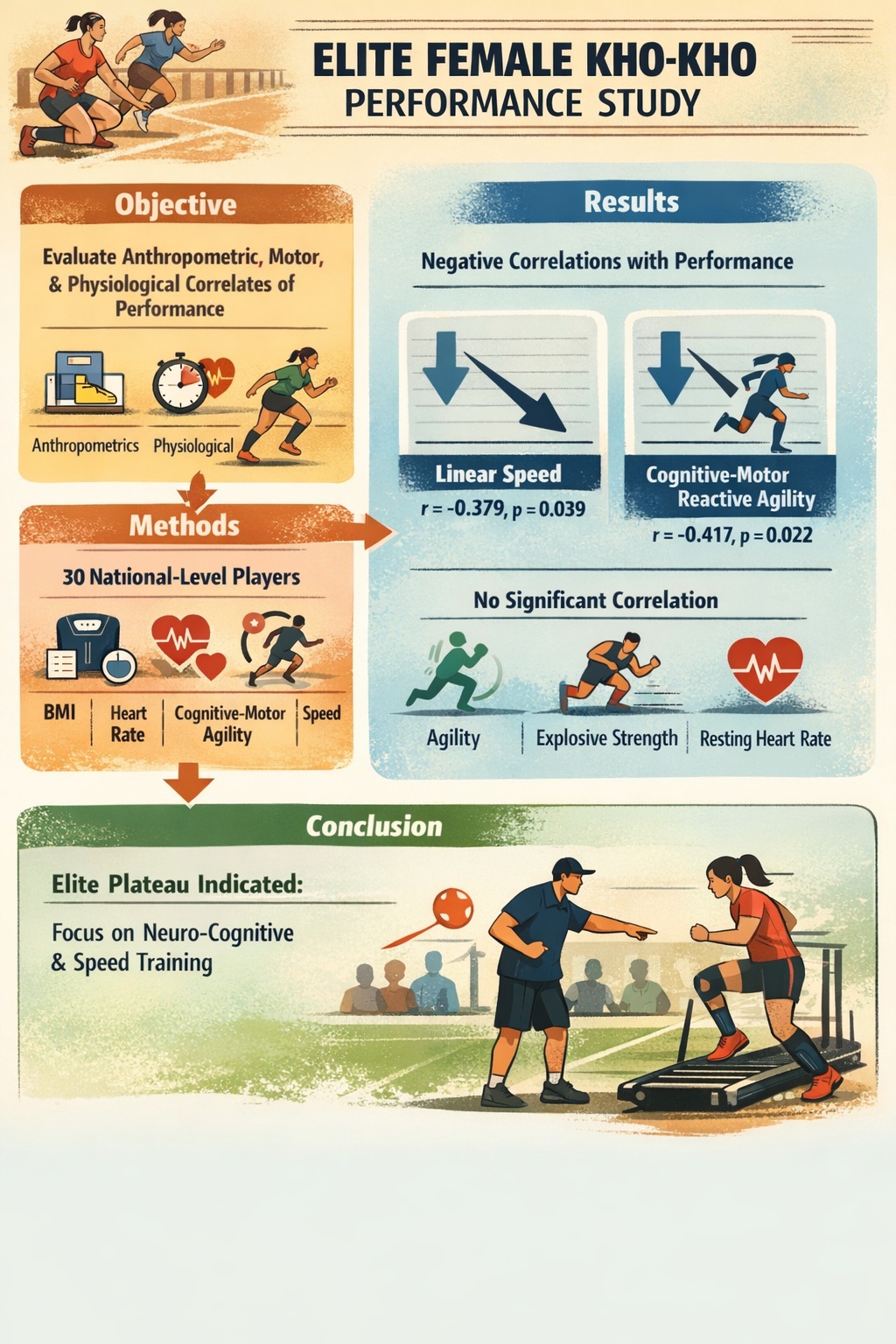
Objective: This study aimed to evaluate the anthropometric, motor, and physiological correlates of competitive success among elite female Kho-Kho players and to identify the primary predictors of match performance.
Materials and Methods: This correlational study recruited 30 national-level female Kho-Kho players. Multidimensional profiling included assessment of Body Mass Index, resting heart rate, reaction time, linear speed, agility, and explosive strength. In-game performance was evaluated during a competitive event by expert coaches using a structured Likert-scale assessment covering six fundamental skill components. Pearson’s product-moment correlation coefficients were used for data analysis after verifying parametric assumptions.
Results: The analysis showed a statistically significant inverse relationship between match performance and linear speed (r = -0.379, p = 0.03), as well as between match performance and cognitive-motor reaction time (r = -0.417, p = 0.02). However, agility, explosive strength, resting heart rate, and other foundational metrics did not show statistically significant correlations with match performance.
Conclusion: The findings suggest that among national-level female Kho-Kho players, linear speed and reaction time are the main factors differentiating match performance. The absence of significant associations for other physical and physiological variables may indicate an “elite plateau” effect, where baseline physical traits are already highly developed. Therefore, elite Kho-Kho training programs should place greater emphasis on targeted neuro-cognitive drills and overspeed training to enhance competitive performance.
Downloads
References
1. Das M, Dutta N, Sahu DP. Kho Kho’s journey: indigenous to global sports. ijyesspe. 2024;9(Special Issue):66-72. Available from: https://jyesspe.in/index.php/ijyesspe/article/view/64.
2. Mahapatra C, Abhinandan A. Correlation between speed and agility with an influence of gender in adolescent Kho-Kho players—an observational study. Bull Fac Phys Ther. 2023;28(1):41. doi: 10.1186/s43161-023-00148-5.
3. Saha G. A comparative study on explosive strength and reaction ability between female Kabaddi and Kho Kho players. J Adv Sports Phys Educ. 2022;5(6):123-128. doi: 10.36348/jaspe.2022.v05i06.003.
4. Chiu CN, Chen CY, Muggleton NG. Sport, time pressure, and cognitive performance. Prog Brain Res. 2017;234:85-99. doi: 10.1016/bs.pbr.2017.06.007.
5. Zwierko M, Jedziniak W, Popowczak M, et al. Effects of six-week stroboscopic training program on visuomotor reaction speed in goal-directed movements in young volleyball players: a study focusing on agility performance. BMC Sports Sci Med Rehabil. 2024;16(1):59. doi: 10.1186/s13102-024-00848-y.
6. Ferraz A, Duarte-Mendes P, Sarmento H, Valente-Dos-Santos J, Travassos B. Tracking devices and physical performance analysis in team sports: a comprehensive framework for research—trends and future directions. Front Sports Act Living. 2023;5:1284086. doi: 10.3389/fspor.2023.1284086.
7. Deepak NK, Yadav A, Sagre S. Relationship between motor ability and anthropometric components of Kho-Kho and Kabaddi players. Int J Physiol Nutr Phys Educ. 2022;7(2):200-203. doi: 10.22271/journalofsport.2022.v7.i2d.2590.
8. Raspal S, Hoshiyar S. An evaluation of selected physical fitness variables of Kabaddi, Kho-Kho, and wrestling players from Haryana and Punjab, India. Res J Phys Educ Sci. 2013;1(2):1-5. Available from: https://www.isca.me/PHY_EDU_SCI/Archive/v1/i2/1.ISCA-RJPES-2013-008.pdf.
9. Rathore VS, Singh AB. Analysis of physical and physiological parameters of kabaddi and kho-kho inter-varsity players. Am J Sports Sci Med. 2014;2(5A):13-16. doi: 10.12691/ajssm-2-5A-4.
10. Raju S, Madialagan S. Performance of university level kho-kho players in relation to selected cognitive variables. Asian J Dev Matters. 2015;9(2):141-149. Available from: https://indianjournals.com/article/ajdm-9-2-015.
11. Rahman MH, Islam MS. Investigation of audio-visual simple reaction time of university athletes and non-athletes. J Adv Sports Phys Educ. 2021;4(3):24-29. doi: 10.36348/jaspe.2021.v04i03.002.
12. Faridi M, Wani IA, Singh GP. A ridit analysis of formulation and implementation success of strategic planning for sports development among the universities of India. Int J Prof Bus Rev. 2022;7(6):e802. doi: 10.26668/businessreview/2022.v7i6.e802.
13. Sandhyamol MS, Vasanthi G, Prajishkumar P. The impact of high-intensity interval training on reaction time and agility in women KHO-KHO players on varied surfaces. Int J Phys Educ Sports Health. 2024;11(4):463-466. doi: 10.22271/kheljournal.2024.v11.i4h.3458.
14. Wani IA, Dachen J, Singh S, Shukla TD, Sharma M, Pal A. Assessment of healthy lifestyle and physical movement levels among female university students: a cross-sectional study. Hum Mov. 2025;26(3):89-100. doi: 10.5114/hm/203541.
15. Wani IA, Choudhary S, Awan AM, Ganaie MD, Nissa B, Shah MM, et al. Development and validation of the healthy lifestyle scale (HLS) for regions with icy winters and dry summers. Univers J Public Health. 2025;13(3):726-745. doi: 10.13189/ujph.2025.130321.
16. Wani IA, Pal A, Hussein MNA, Suhail MT, Sharma M, Rawat B. Sports event data acquisition method based on wireless sensor technology and BP neural networks. 2023 6th International Conference on Contemporary Computing and Informatics (IC3I). 2023:1354-1360. doi: 10.1109/IC3I59117.2023.10397943.