Outdoor Activity-Based Physical Education and Wearable Technology for Student Fitness and Well-Being Support
DOI:
https://doi.org/10.61838/kman.intjssh.5555Keywords:
Outdoor Activity, Physical Education, Wearable Technology, Psychological Well-Being, Physical Fitness, SDG 3Abstract
Objective: Physical inactivity among adolescents is a critical global health issue, with over 80% of adolescents failing to meet WHO recommendations for daily physical activity. While conventional physical education (PE) contributes to student health, there remains a need for pedagogical innovation that enhances objective monitoring and deeper student engagement. An outdoor activity-based PE approach integrated with wearable technology offers a promising model within the framework of achieving SDG 3. This study aims to examine the effectiveness of a physical education program based on outdoor activities integrated with wearable technology in improving the physical fitness and psychological well-being of high school students.
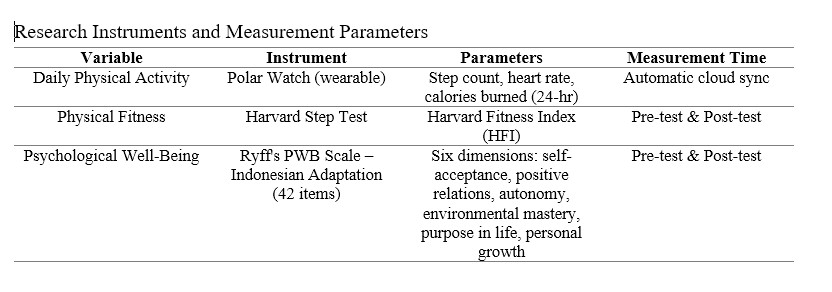
Methods and Materials: A pretest–posttest quasi-experimental design with a control group was applied to 30 male students at State Senior High School 12 Semarang, divided equally into an experimental group (n = 15) and a control group (n = 15) using ordinal pairing based on initial Harvard Fitness Index (HFI) scores. The experimental group participated in a structured outdoor physical education program for eight weeks (3 sessions/week, 50–65 minutes/session) using Polar Watch devices. Psychological well-being was measured using the Indonesian adaptation of Ryff's Psychological Well-Being Scale (RPWB; 6 dimensions), and physical fitness was assessed via the Harvard Step Test (HFI). Data were analyzed using the Wilcoxon Signed-Rank Test and the Mann-Whitney U Test (α = 0.05).
Findings: All variables in the experimental group showed statistically significant improvements (p ≤ 0.05) with moderate to large effect sizes: total well-being score (W = 0.0; Z = −3.41; p = 0.001; r = 0.604), all six RPWB dimensions (r = 0.376–0.548), and HFI (W = 0.0; Z = −3.40; p = 0.001; r = 0.602). The proportion of students categorized as Good fitness increased from 0% to 46.7%, and the Low Well-being category disappeared entirely in the post-test. Notably, the control group also showed significant within-group improvements across all variables, confirming that regular physical education also produced meaningful benefits. There were no significant differences in gains between groups (p > 0.05) for seven of eight outcomes; the only significant between-group difference was in Environmental Mastery, which favored the control group (p = 0.011).
Conclusion: An outdoor activity-based physical education program integrated with wearable technology was associated with significant improvements in psychological well-being and physical fitness within the experimental group of male high school students. However, the absence of significant between-group differences indicates that structured physical activity in any format—whether outdoor or conventional—can provide meaningful health benefits for adolescents. Although wearable technology may have supported objective monitoring and self-regulatory awareness during the program, its independent contribution to outcome improvements could not be established in this study.
Downloads
References
1. Baena-Morales S, González-Víllora S. Physical Education For Sustainable Development Goals: Reflections And Comments For Contribution In The Educational Framework. Sport, Education and Society. 2023;28(6):697-713. [DOI]
2. Fröberg A, Lundvall S. The Distinct Role Of Physical Education In The Context Of Agenda 2030 And Sustainable Development Goals: An Explorative Review And Suggestions For Future Work. Sustainability. 2021;13(21). [DOI]
3. Baena-Morales S, Ferriz-Valero A. What About Physical Education And Sustainable Development Goals? A Scoping Review. Physical Education and Sport Pedagogy. 2025;30(2):200-17. [DOI]
4. Ahmed MD, Al Salim ZA. Provision Of Quality Physical Education To Enhance The Motive Of Physical Activity And Its Underlying Behavior Among University Students. Heliyon. 2024;10(3):e25152. [PMID: 38327484] [PMCID: PMC10847599] [DOI]
5. Sun H, Du CR, Wei ZF. Physical Education And Student Well-Being: Promoting Health And Fitness In Schools. PLoS One. 2024;19(1):e0296817. [PMID: 38271399] [PMCID: PMC10810495] [DOI]
6. World Health O. WHO Guidelines on Physical Activity and Sedentary Behaviour. World Health Organization; 2020.
7. Guthold R, Stevens GA, Riley LM, Bull FC. Global Trends In Insufficient Physical Activity Among Adolescents: A Pooled Analysis Of 298 Population-Based Surveys With 1.6 Million Participants. The Lancet Child & Adolescent Health. 2020;4(1):23-35. [PMID: 31761562] [DOI]
8. World Health O. Global status report on physical activity 2022: country profiles. World Health Organization; 2022.
9. Andriyani FD, Biddle SJH, Arovah NI, De Cocker K. Physical Activity And Sedentary Behavior Research In Indonesian Youth: A Scoping Review. International Journal of Environmental Research and Public Health. 2020;17(20):7665. [PMID: 33096653] [PMCID: PMC7593924] [DOI]
10. Lopez-Fernandez J, Serrano C, Hernandez-Martin A, Martin-Sanchez ML. Physical Inactivity Behaviour Of European Adolescents Between 2013 And 2022. BMC Public Health. 2025;25(1). [PMID: 41204150] [PMCID: PMC12595841] [DOI]
11. Hanifah L, Nasrulloh N, Sufyan DL. Sedentary Behavior And Lack Of Physical Activity Among Children In Indonesia. Children. 2023;10(8). [PMID: 37628282] [PMCID: PMC10453900] [DOI]
12. Andriyani FD, Biddle SJH, De Cocker K. Adolescents' Physical Activity And Sedentary Behaviour In Indonesia During The COVID-19 Pandemic: A Qualitative Study Of Mothers' Perspectives. BMC Public Health. 2021;21(1):1-14. [PMID: 34654384] [PMCID: PMC8519321] [DOI]
13. Raehang, Virama LOA, Yudhistira D. Identifying Challenges And Opportunities In The Implementation Of Mobile Learning In Physical Education: A Literature Review. Physical Education Theory and Methodology. 2025;25(3):719-24. [DOI]
14. Rizka M, Ambardini RL, Virama LOA, Yudhistira D. The Effect Of Walking Exercise On Blood Pressure And Blood Glucose In The Elderly. International Journal of Kinesiology and Sports Science. 2022;10(1):30-5. [DOI]
15. Pasek M, Szark-Eckardt M, Wilk B. Physical Fitness As Part Of The Health And Well-Being Of Students Participating In Physical Education Lessons Indoors And Outdoors. International Journal of Environmental Research and Public Health. 2020;17(1):1-14. [PMID: 31906407] [PMCID: PMC6981643] [DOI]
16. Rocliffe P, Adamakis M, O'Keeffe BT. The Impact Of Typical School Provision Of Physical Education, Physical Activity And Sports On Adolescent Mental Health And Wellbeing: A Systematic Literature Review. Adolescent Research Review. 2024;9(2):339-64. [DOI]
17. Simonsen N, Wackström N, Ray J. Lärmiljö (Learning Environment) - Study Protocol: Movement, Outdoor Learning And Well-Being In School. European Journal of Public Health. 2022;32(Suppl_3):ckac131.337. [PMCID: PMC9594400] [DOI]
18. Biernat E, Piątkowska M. Outdoor Physical Activity In The Service Of Sustainable Development And One Health: The Role Of Physical Activity In Shaping Pro-Social And Pro-Environmental Attitudes. Sustainability. 2025;17(15). [DOI]
19. O'Carroll C, Scanlon D. An Outdoor Educator'S Self-Study Of Enacting A Pedagogical Model For Outdoor Adventure Education To Facilitate Affective Learning Experiences. Physical Education and Sport Pedagogy. 2026;31(1):81-96. [DOI]
20. Martínez-Mirambell C, Boned-Gómez S, Urrea-Solano M, Baena-Morales S. Step By Step Towards A Greener Future: The Role Of Plogging In Educating Tomorrow'S Citizens. Sustainability. 2023;15(18):1-15. [DOI]
21. Molyneux TM, Zeni M, Oberle E. Choose Your Own Adventure: Promoting Social And Emotional Development Through Outdoor Learning. Early Childhood Education Journal. 2023;51(8):1525-39. [PMID: 36277325] [PMCID: PMC9579527] [DOI]
22. Nugraha H, Ali M, Rahmat A, Septianto I, Suryadi D. Actividades Al Aire Libre Y Entornos Al Aire Libre Para La Forma Física Y La Salud Mental: Una Revisión Sistemática. Retos. 2024;2041:642-8. [DOI]
23. Davidson C, Ewert A. Exploring Mental Health Outcome Variables In Outdoor Adventure And Experiential Education. Journal of Experiential Education. 2024;47(2):185-90. [DOI]
24. Down M, Picknoll D, Hoyne G. 'When The Real Stuff Happens': A Qualitative Descriptive Study Of The Psychosocial Outcomes Of Outdoor Adventure Education For Adolescents. Journal of Outdoor and Environmental Education. 2025;28(1):43-63. [DOI]
25. Drapeau C, Lenze L, Montiel C. Association Between Outdoor Physical Activity And Positive Mental Health In Adolescence: Estimating The Mediation Effect Of Autonomy, Competence And Relatedness. International Journal of Behavioral Nutrition and Physical Activity. 2025;22(1):1-12. [PMID: 41286859] [PMCID: PMC12642063] [DOI]
26. Loose T, Fuoco J, Malboeuf-Hurtubise C. A Nature-Based Intervention And Mental Health Of Schoolchildren: A Cluster Randomized Clinical Trial. JAMA Network Open. 2024;7(11):e2444824. [PMID: 39546315] [PMCID: PMC11568460] [DOI]
27. Davidson C, Ewert A. College Student Commitment And Outdoor Orientation Programming. Journal of Experiential Education. 2020;43(3):299-316. [DOI]
28. Pearson R, Owen M, Inman J, Relph N. 'I Climbed A Mountain! I Can Do It!' Outdoor Adventure For Female Youth Resilience. International Journal of Adolescence and Youth. 2026;31(1):2606688. [DOI]
29. Loose T, Côté S, Malboeuf-Hurtubise C. Protocol For The Open Sky School: A Two-Arm Clustered Randomized Controlled Trial. BMC Public Health. 2023;23(1):1-9. [PMID: 36737725] [PMCID: PMC9896439] [DOI]
30. Ridho AMY, Siregar NM. Outdoor Education Model Based On Experiential Learning In Character Education For Junior High School Students. Gladi Jurnal Ilmu Keolahragaan. 2023;14(01):1-17.
31. Rachmayani D, Ramdhani N, editors. Adaptasi Bahasa Dan Budaya Skala Psychological Well-Being2014.
32. Ryff CD. Happiness Is Everything, OR Is It? Explorations On The Meaning Of Psychological Well-Being. Journal of Personality and Social Psychology. 1989;57(6):1069. [DOI]
33. Huhn S, Axt M, Gunga HC. The Impact Of Wearable Technologies In Health Research: Scoping Review. JMIR mHealth and uHealth. 2022;10(1):e34384. [PMID: 35076409] [PMCID: PMC8826148] [DOI]
34. Creaser AV, Frazer MT, Costa S. The Use Of Wearable Activity Trackers In Schools To Promote Child And Adolescent Physical Activity. International Journal of Environmental Research and Public Health. 2022;19(21). [PMID: 36360944] [DOI]
35. Zhong Q, Jiang J, Bai W. Application Of Digital-Intelligent Technologies In Physical Education: A Systematic Review. Frontiers in Public Health. 2025;13. [PMID: 40777650] [PMCID: PMC12328460] [DOI]
36. Chen X, Wang F, Zhang H. Effectiveness Of Wearable Activity Trackers On Physical Activity Among Adolescents In School-Based Settings: A Systematic Review And Meta-Analysis. BMC Public Health. 2025;25(1). [PMID: 40102761] [PMCID: PMC11921619] [DOI]
37. Sousa AC, Ferrinho SN, Travassos B. The Use Of Wearable Technologies In The Assessment Of Physical Activity In Preschool- And School-Age Youth: Systematic Review. International Journal of Environmental Research and Public Health. 2023;20(4). [PMID: 36834100] [PMCID: PMC9966103] [DOI]
38. AU WW, Recchia F, Fong DY. Effect Of Wearable Activity Trackers On Physical Activity In Children And Adolescents: A Systematic Review And Meta-Analysis. The Lancet Digital Health. 2024;6(9):e625-39. [PMID: 39112110] [DOI]
39. Cui Z, Song Y, Du X. Multilevel Modeling Of Technology Use, Student Engagement, And Fitness Outcomes In Physical Education Classes. Frontiers in Psychology. 2024;15. [PMID: 39512567] [PMCID: PMC11540672] [DOI]
40. Martín-Rodríguez A, Madrigal-Cerezo R. Technology-Enhanced Pedagogy In Physical Education: Bridging Engagement, Learning, And Lifelong Activity. Education Sciences. 2025;15(4):1-31. [DOI]
41. Grove SK, Burns N, Gray J. The Practice Of Nursing Research: Appraisal, Synthesis, And Generation Of Evidence: Elsevier Health Sciences; 2012.
42. Maciejewski ML. Quasi-Experimental Design. Biostatistics & Epidemiology. 2020;4(1):38-47. [PMCID: PMC11527330] [DOI]
43. Cook TD. Quasi-Experimentation: Design And Analysis Issues For Field Settings: Rand McNally College Publishing; 1979.
44. Gasser M, Nadenbousch AM, Egger F. Increasing Adolescents' Physical Activity Levels Through A Comprehensive School-Based Physical Activity Program: Study Protocol Of Active School. BMC Pediatrics. 2024;24(1). [PMID: 39232723] [PMCID: PMC11373237] [DOI]
45. Gasser M, Nadenbousch AM, Egger F, Kamer M, Valkanover S, Schmidt M. Increasing Adolescents' Physical Activity Levels Through A Comprehensive School-Based Physical Activity Program: Study Protocol Of The Cluster Randomized Controlled Trial Active School. BMC Pediatrics. 2024;24(1). [PMID: 39232723] [PMCID: PMC11373237] [DOI]
46. Mackenzie B. 101 Performance Evaluation Tests2008.
47. Fadhil A. Evaluasi Properti Psikometris Skala Psychological Well-Being (Pwb) Versi Indonesia. Jurnal Pendidikan Tambusai. 2021;5(2):4666-74.
48. Portney LG. Foundations Of Clinical Research: Applications To Evidence-Based Practice: FA Davis; 2020.
49. Field A. Discovering Statistics Using Ibm SPSS Statistics: Sage Publications Limited; 2024.
50. Barton B, Peat J. Medical Statistics: A Guide To SPSS, Data Analysis And Critical Appraisal: John Wiley & Sons; 2014.
51. Biernat E, Piątkowska M. Outdoor Physical Activity In The Service Of Sustainable Development And One Health. Sustainability. 2025;17(15):6926. [DOI]
52. Fang BB, Lu FJH, Gill DL, Liu SH, Chyi T, Chen B. A Systematic Review And Meta-Analysis Of The Effects Of Outdoor Education Programs On Adolescents' Self-Efficacy. Perceptual and Motor Skills. 2021;128(5):1932-58. [PMID: 34107802] [DOI]
53. Fu Q, Li L, Li Q, Wang J. The Effects Of Physical Activity On The Mental Health Of Typically Developing Children And Adolescents: A Systematic Review And Meta-Analysis. BMC Public Health. 2025;25(1). [PMID: 40269876] [PMCID: PMC12016293] [DOI]
54. Jovanović R, Živković M, Stanković M. Effects Of School-Based High-Intensity Interval Training On Health-Related Fitness In Adolescents. Frontiers in Physiology. 2024;15. [PMID: 39619092] [PMCID: PMC11604620] [DOI]
55. Domaradzki J, Popowczak M, Kochan-Jacheć K. Effects Of Two Forms Of School-Based High-Intensity Interval Training On Body Fat, Blood Pressure, And Cardiorespiratory Fitness In Adolescents: The Peer-Heart Study. Frontiers in Physiology. 2025;16. [PMID: 40265155] [PMCID: PMC12011756] [DOI]
56. Van Dierendonck D, Lam H. Interventions To Enhance Eudaemonic Psychological Well-Being: A Meta-Analytic Review With Ryff'S Scales Of Psychological Well-Being. Applied Psychology: Health and Well-Being. 2023;15(2):594-610. [PMID: 36073601] [DOI]
57. Fang WT, Hassan A, Lepage BA. The Living Environmental Education2023. 1-264 p. [DOI]
58. Down MJA, Picknoll D, Edwards T. Outdoor Adventure Education For Adolescent Social And Emotional Wellbeing: A Systematic Review And Meta-Analysis. Journal of Adventure Education and Outdoor Learning. 2025;25(4):869-98. [DOI]
59. Gray T, Down MJA, Mann J. Risky Outdoor Play And Adventure Education In Nature For Child And Adolescent Wellbeing: A Scoping Review. Behavioral Sciences. 2025;16(1). [PMID: 41594946] [PMCID: PMC12837311] [DOI]
60. Li Z, Li J, Kong J. Adolescent Mental Health Interventions: A Narrative Review Of The Positive Effects Of Physical Activity And Implementation Strategies. Frontiers in Psychology. 2024;15. [PMID: 38993342] [PMCID: PMC11236730] [DOI]
61. Mccambridge J, Witton J, Elbourne DR. Systematic Review Of The Hawthorne Effect: New Concepts Are Needed To Study Research Participation Effects. Journal of Clinical Epidemiology. 2014;67(3):267-77. [PMID: 24275499] [PMCID: PMC3969247] [DOI]
62. Thomas JR, Nelson JK. Research Methods In Physical Activity: Human Kinetics Publishers; 1990.
63. Ryff CD, Keyes CLM. The Structure Of Psychological Well-Being Revisited. Journal of Personality and Social Psychology. 1995;69(4):719. [PMID: 7473027] [DOI]
Downloads
Publication Timeline
- Submitted
- Revised
- Accepted