Executive and Motor Function Responses to Brain Gym and Aerobic Exercise in Girls With ADHD
Keywords:
ADHD; Brain Gym; Eerobic Exercise; Executive Functions; Motor Skills; GirlsAbstract
Objective: Attention-deficit/hyperactivity disorder (ADHD) is commonly accompanied by difficulties in executive functioning and motor performance, both of which may interfere with academic participation, behavioral regulation, and everyday functioning. This study compared executive and motor function responses to two movement-based interventions, Brain Gym and walking-based aerobic exercise, in girls screened positive for ADHD symptoms.
Methods: A quasi-experimental pretest-posttest design with two experimental groups and one waiting-list control group was used. Forty-five girls screened positive for ADHD symptoms in Tehran were selected by convenience sampling and allocated in a 1:1:1 ratio to Brain Gym, aerobic exercise, or control groups (n = 15 per group). ADHD eligibility was based on parent-reported ADHD symptoms assessed with the SNAP-IV parent form and available clinical/school documentation; the SNAP-IV was not treated as a stand-alone clinical diagnostic interview. Eligibility required normal intellectual functioning and no reported major neurological, sensory, or motor disorders based on available records. Both active groups completed 25 training sessions. Executive functions were assessed as a standardized composite derived from Continuous Performance Test indicators and the Rey-Osterrieth Complex Figure task, and motor skills were evaluated with the Test of Gross Motor Development, Third Edition. Data were analyzed using covariance-based group comparisons with pretest scores treated as covariates.
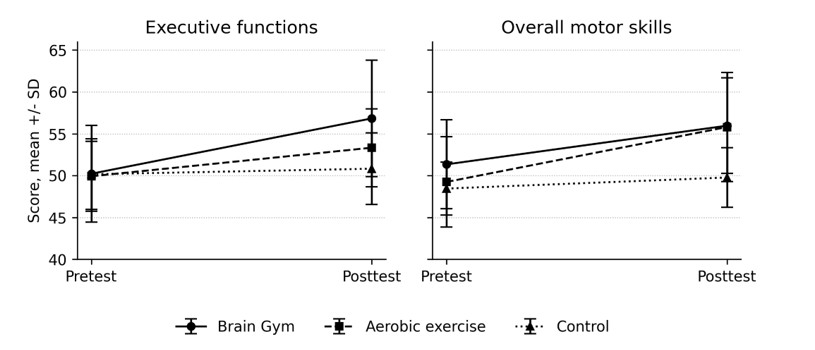
Results: Covariance-based comparisons indicated significant group effects for executive functions (F(2, 41) = 31.008, p < .001, partial eta squared = .602) and overall motor skills (F(2, 41) = 18.473, p < .001, partial eta squared = .474). Bonferroni comparisons showed that both Brain Gym and aerobic exercise outperformed the waiting-list control group for executive and motor outcomes. Brain Gym showed a higher adjusted executive-function composite score than aerobic exercise (mean difference = 3.184, SE = 0.750, p = .001). For overall motor skills, the difference between Brain Gym and aerobic exercise was not statistically significant (aerobic exercise minus Brain Gym = 1.999, SE = 0.888, p = .090).
Conclusion: The findings provide preliminary evidence that structured movement-based interventions may be associated with short-term improvements in executive and motor outcomes among girls screened positive for ADHD symptoms. Brain Gym showed a higher adjusted executive-function composite outcome, whereas both interventions produced broadly comparable overall motor benefits.
Downloads