Effects of a Collaborative Physical Education–Family School Partnership Intervention on Fundamental Movement Skills and Physical Literacy-Related Outcomes in Primary School Children
Keywords:
Physical Literacy; Fundamental Movement Skills; Physical Education; Family–School Partnership; School-Based Intervention; Primary School ChildrenAbstract
Objective: This quasi-experimental study examined whether an eight-week Collaborative Physical Education–Family School Partnership (CPE-FSP) intervention could improve fundamental movement skills (FMS) and selected physical literacy-related capacities in Grade 1 children.
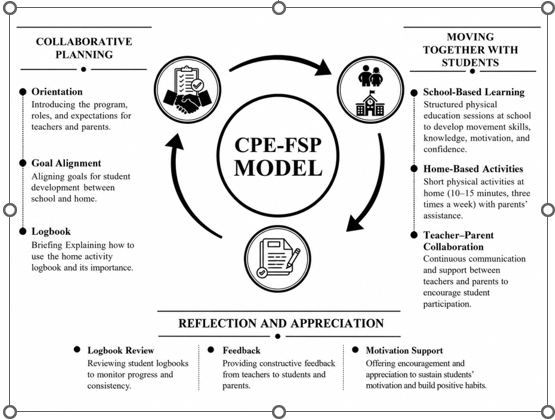
Methods: A total of 239 children aged 6.5–7.5 years from five primary schools participated in 10 intact classes, with one intervention and one control class in each school (CPE-FSP, n = 119; control, n = 120). The intervention combined one 90-minute school physical education lesson per week with structured parent-assisted home movement activities lasting 10–15 minutes three times weekly. Outcomes included FMS, physical activity knowledge, motivation, and self-confidence. Data were analyzed using school-adjusted ANCOVA and matched-class sensitivity analysis.
Results: School-adjusted ANCOVA showed significantly higher adjusted posttest scores in the CPE-FSP group for FMS (34.80 vs. 31.17; adjusted difference = 3.63, 95% CI: 3.10–4.17; p < .001) and self-confidence (36.89 vs. 32.53; adjusted difference = 4.36, 95% CI: 3.90–4.81; p < .001). Knowledge and motivation also showed favorable average adjusted differences; however, significant baseline-by-group interactions indicated that intervention effects varied according to baseline scores. Matched-class sensitivity analysis across the five school pairs showed intervention-favoring posttest differences for all four outcomes.
Conclusion: The CPE-FSP intervention represents a promising approach to improving fundamental movement skills and selected cognitive and affective capacities related to physical literacy in young children. Integrating school physical education with family-supported movement activities may strengthen school–family pedagogical continuity. However, longer-term studies with larger numbers of clusters are needed to establish the sustainability and health relevance of these findings
Downloads