The Effectiveness of Project-Based Learning in Improving Students' Physical Literacy and Character in Physical Education
Abstract
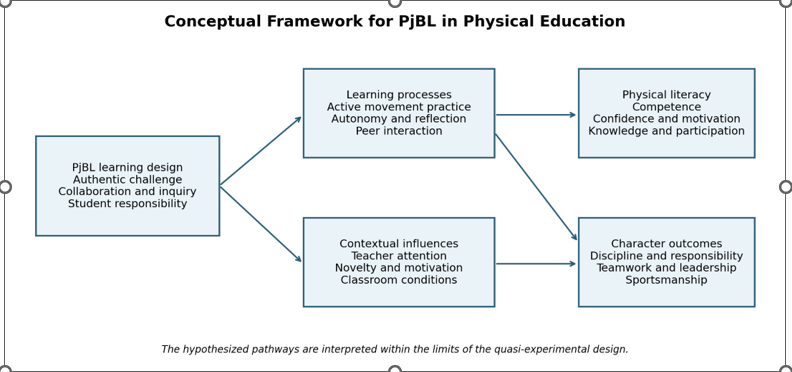
Objective: Physical education in the twenty-first century is expected to improve students' physical competence, foster character development, and promote lifelong participation in physical activity. Nevertheless, teacher-centered approaches that offer limited opportunities for active participation, collaboration, and meaningful learning remain prevalent in many physical education classes. This study examined the effectiveness of Project-Based Learning (PjBL) in improving students' physical literacy and character within physical education learning.
Methods and Materials: A quasi-experimental design with a pretest–posttest control group was employed involving 72 Grade VIII students from a public junior secondary school in Medan, Indonesia. Two intact classes were assigned to either an experimental group (n = 36) that received eight weeks of Project-Based Learning or a control group (n = 36) that received conventional teacher-centered instruction. Physical literacy and character were assessed using validated multidimensional instruments before and after the intervention. Data were analyzed using Multivariate Analysis of Covariance (MANCOVA) and follow-up univariate Analysis of Covariance (ANCOVA).
Findings: The multivariate test revealed a significant effect of group membership on the combined outcomes, Wilks' Λ = 0.421, F(2, 67) = 46.82, p < 0.001, partial η² = 0.579. Follow-up ANCOVA indicated significant univariate effects for physical literacy (F = 58.14, p < 0.001, partial η² = 0.462) and character (F = 63.29, p < 0.001, partial η² = 0.489). The experimental group demonstrated substantially greater gains than the control group in both physical literacy (+33.8% vs. +12.3%) and character (+33.4% vs. +12.9%).
Conclusion: These findings suggest that Project-Based Learning is a promising pedagogical approach for integrating physical, cognitive, and social development in school physical education. The results contribute empirical evidence from the Indonesian educational context and support the implementation of student-centered, project-oriented instructional strategies in physical education.
Downloads