Effects of an Autonomy-Supportive Choice-Based Adaptive Physical Activity Program on Motor Competence, Physical Activity Enjoyment, Autonomous Motivation, and Psychological Need Satisfaction in Children with Intellectual Disabilities: A Randomized Controlled Trial
Keywords:
Intellectual disabilities, Adaptive physical activity, Autonomy-supportive instruction, Motor competence, Autonomous motivationAbstract
Objective:
Children with intellectual disabilities may experience difficulties in motor competence and may also have limited opportunities to develop positive motivational experiences during physical activity. Autonomy-supportive instructional approaches may provide a promising strategy for addressing these domains within adaptive physical activity. This randomized controlled trial examined the effects of an Autonomy-Supportive Choice-Based Adaptive Physical Activity (ASC-APA) program on motor competence, physical activity enjoyment, autonomous motivation, and psychological need satisfaction compared with conventional teacher-directed adaptive physical activity.
Materials and Methods:
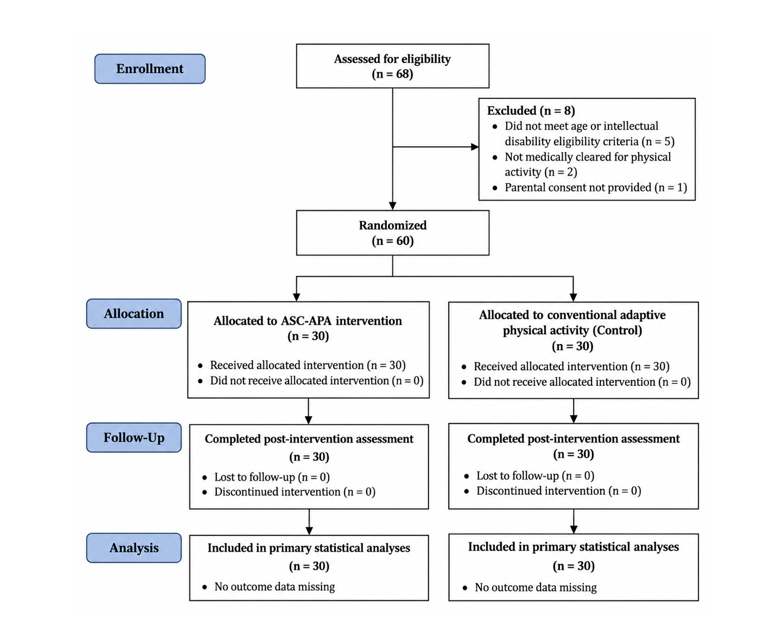
A two-arm, parallel-group randomized controlled trial was conducted among 60 children with intellectual disabilities aged 10–15 years recruited from two special education schools. Participants were randomly allocated to an ASC-APA group (n = 30) or a conventional teacher-directed adaptive physical activity control group (n = 30). Both groups participated in 8 weeks of adaptive physical activity, three sessions per week, with 24 sessions in total and approximately 45 minutes per session. The ASC-APA program incorporated structured choice, acknowledgment of preferences, informational feedback, self-paced exploration, progressive task difficulty, and guided reflection while maintaining standardized motor-learning objectives. Outcomes were assessed before and after the intervention using the Test of Gross Motor Development–Third Edition, Physical Activity Enjoyment Scale, an adapted Perceived Locus of Causality scale for autonomous motivation, and the Basic Psychological Need Satisfaction in Exercise Scale. Data were analyzed using two-way mixed-design ANOVA, with effect sizes expressed as partial eta squared (ηp²).
Results:
All 60 participants completed the study and were included in the primary analyses. Significant Time × Group interactions favored ASC-APA for motor competence (F(1,58) = 133.395, p < .001, ηp² = .697), physical activity enjoyment (F(1,58) = 125.729, p < .001, ηp² = .684), autonomous motivation (F(1,58) = 89.098, p < .001, ηp² = .606), and psychological need satisfaction (F(1,58) = 287.558, p < .001, ηp² = .832). Mean improvements were greater in the ASC-APA group than in the control group for motor competence (+5.763 vs. +1.120), enjoyment (+3.640 vs. +0.727), autonomous motivation (+0.196 vs. +0.038), and need satisfaction (+6.483 vs. +1.370). Sensitivity analyses using Welch’s unequal-variance tests of change scores yielded consistent between-group differences for all four outcomes (p < .001).
Conclusions:
An 8-week ASC-APA program produced greater improvements in motor competence, physical activity enjoyment, autonomous motivation, and psychological need satisfaction than conventional teacher-directed adaptive physical activity in children with intellectual disabilities. The findings support the integration of autonomy-supportive instructional strategies within adaptive physical activity while maintaining structured motor-learning objectives. Because ASC-APA is a multicomponent intervention, the independent contribution of structured choice or any individual instructional component cannot be determined from this trial.
Downloads