Social Interaction Patterns in Children with Speech Disorder: Parent and Teacher Perspectives
DOI:
https://doi.org/10.61838/kman.prien.2.2.2Keywords:
speech disorders, social interactions, children, parents, teachers, communication strategies, inclusive practices, speech therapyAbstract
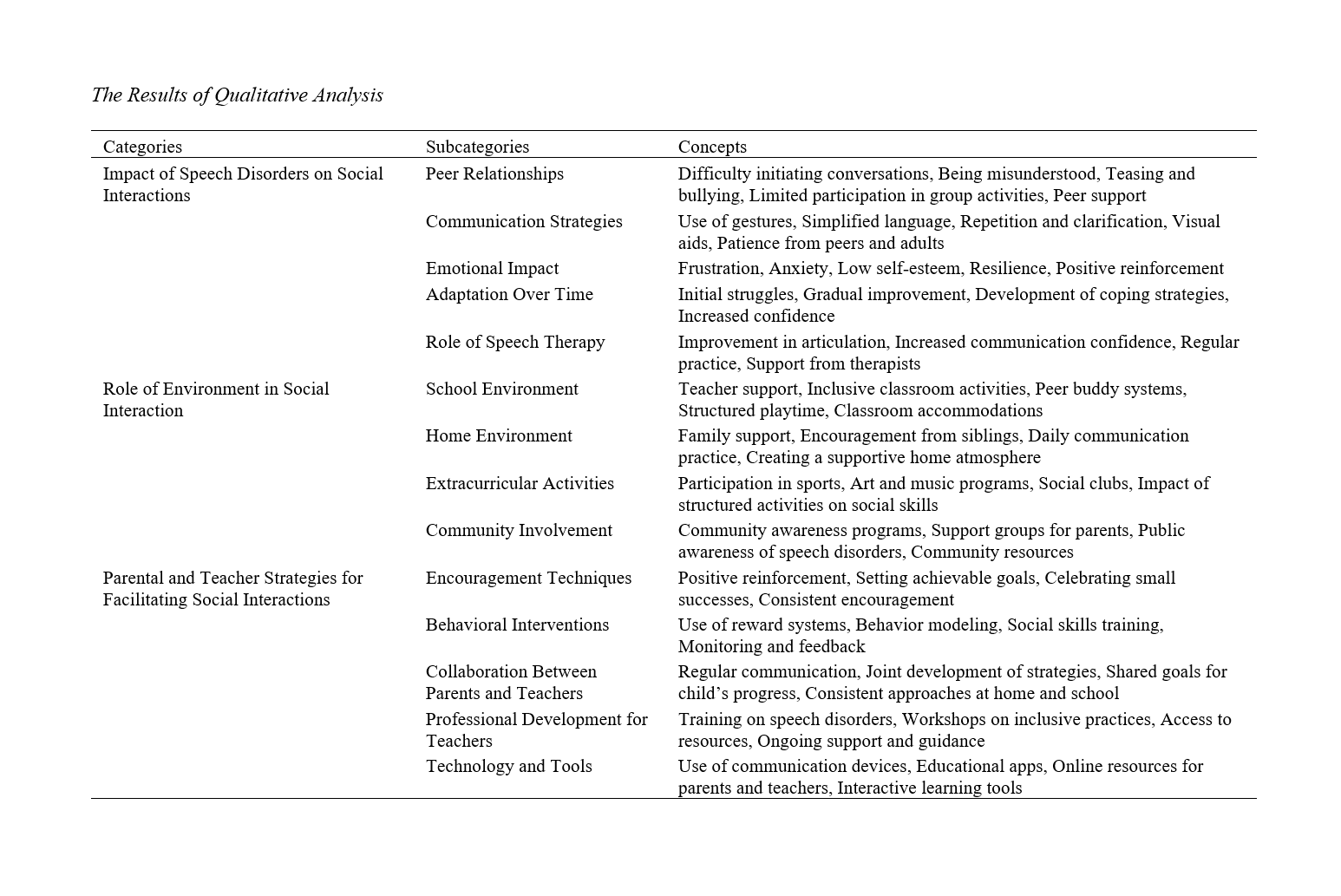
The objective of this study is to explore the social interaction patterns of children with speech disorders from the perspectives of their parents and teachers. This qualitative study employed semi-structured interviews to gather in-depth data from 20 participants, including 10 parents and 10 teachers of children aged 4-10 years diagnosed with speech disorders. Participants were selected through purposive sampling to ensure a diverse range of experiences. The interviews were audio-recorded, transcribed verbatim, and analyzed using thematic analysis. The analysis focused on identifying common themes related to social interactions, communication strategies, and the emotional impact of speech disorders. Three main themes emerged from the data: the impact of speech disorders on social interactions, the role of the environment in social interaction, and strategies for facilitating social interactions. Children with speech disorders faced significant challenges in peer relationships, often experiencing social isolation and bullying. The home and school environments were critical in shaping social experiences, with teacher support and family encouragement playing pivotal roles. Parents and teachers employed various strategies, such as positive reinforcement, visual aids, and behavioral interventions, to support children's social interactions. Collaboration between parents and teachers was essential for providing consistent support. The study highlights the multifaceted nature of social interaction challenges for children with speech disorders and underscores the importance of supportive environments and collaborative strategies. Effective interventions require a comprehensive approach involving parents, teachers, and speech therapists. Future research should focus on larger, more diverse samples and include the perspectives of children with speech disorders to develop child-centered interventions. Practical recommendations include implementing inclusive practices in schools, enhancing parent-teacher collaboration, integrating speech therapy services into schools, and promoting community awareness to reduce stigma.
Downloads
References
Björelius, H., & Tükel, Ş. (2017). Comorbidity of Motor and Sensory Functions in Childhood Motor SpeechDisorders.https://doi.org/10.5772/intechopen.69710
Bruinsma, G. I. (2024). Communication in Daily Life of Children With Developmental Language Disorder: Parents' and Teachers' Perspectives. Language Speech and Hearing Services in Schools, 55(1), 105-129.https://doi.org/10.1044/2023_lshss-23-00051
Crosbie, S., Holm, A., & Dodd, B. (2005). Intervention for Children With Severe Speech Disorder: A Comparison of Two Approaches. International Journal of Language & Communication Disorders, 40(4), 467-491.https://doi.org/10.1080/13682820500126049
Daniel, G., & McLeod, S. (2017). Children With Speech Sound Disorders at School: Challenges for Children, Parents and Teachers. Ajte, 81-101.https://doi.org/10.14221/ajte.2017v42n2.6
Docherty, N. M. (2011). On Identifying the Processes Underlying Schizophrenic Speech Disorder. Schizophrenia Bulletin.https://doi.org/10.1093/schbul/sbr048
Drayna, D., & Kang, C. (2011). Genetic approaches to understanding the causes of stuttering. Journal of Neurodevelopmental Disorders, 3(4), 374-380.https://doi.org/10.1007/s11689-011-9090-7
Gallagher, A., Murphy, C.-A., Conway, P. F., & Perry, A. (2019). Engaging Multiple Stakeholders to Improve Speech and Language Therapy Services in Schools: An Appreciative Inquiry-Based Study. BMC Health Services Research, 19(1).https://doi.org/10.1186/s12913-019-4051-z
Iverach, L., Lowe, R., Jones, M., O’Brian, S., Menzies, R. G., Packman, A., & Onslow, M. (2017). A Speech and Psychological Profile of Treatment-Seeking Adolescents Who Stutter. Journal of Fluency Disorders.https://doi.org/10.1016/j.jfludis.2016.11.001
Klatte, I. S. (2023). Collaborative Working in Speech and Language Therapy for Children With DLD—What Are Parents’ Needs?International Journal of Language & Communication Disorders, 59(1), 340-353.https://doi.org/10.1111/1460-6984.12951
López, K. J. d., Lyons, R., Novogrodsky, R., Baena, S., Feilberg, J., Harding, S., Kelić, M., Klatte, I., Mantel, T. C., Tomazin, M. O., Ulfsdottir, T. S., Zajdó, K., & Isabel de los Reyes Rodríguez, O. (2021). Exploring Parental Perspectives of Childhood Speech and Language Disorders Across 10 Countries: A Pilot Qualitative Study. Journal of Speech Language and Hearing Research, 64(5), 1739-1747.https://doi.org/10.1044/2020_jslhr-20-00415
Miron, C. (2010). The Parent Experience. Communication Disorders Quarterly, 33(2), 96-110.https://doi.org/10.1177/1525740110384131
Qiang, Y. (2023). An Intervention Study of Language Cognition and Emotional Speech Community Method for Children’s Speech Disorders. International Journal of Mental Health Promotion.https://doi.org/10.32604/ijmhp.2023.025746
Simoni, S. N. d., Leidow, I. C., Britz, D. L., Denis Altieri de Oliveira, M., & Keske-Soares, M. (2019). Impact of the Speech Sound Disorders: Family and Child Perception. Revista Cefac, 21(3).https://doi.org/10.1590/1982-0216/201921310718
Terband, H., Maassen, B., & Maas, E. (2019). A Psycholinguistic Framework for Diagnosis and Treatment Planning of Developmental Speech Disorders. Folia Phoniatrica Et Logopaedica.https://doi.org/10.1159/000499426
Vollebergh, W., Have, M. t., Deković, M., Oosterwegel, A., Pels, T., Veenstra, R., Winter, A. d., Ormel, H., & Verhulst, F. C. (2005). Mental Health in Immigrant Children in the Netherlands. Social Psychiatry and Psychiatric Epidemiology, 40(6), 489-496.https://doi.org/10.1007/s00127-005-0906-1
Weismer, G. (2006). Philosophy of Research in Motor Speech Disorders. Clinical Linguistics & Phonetics.https://doi.org/10.1080/02699200400024806
Wren, Y., Pagnamenta, E., Peters, T. J., Emond, A., Northstone, K., Miller, L. L., & Roulstone, S. (2021). Educational Outcomes Associated With Persistent Speech Disorder. International Journal of Language & Communication Disorders, 56(2),299-312.https://doi.org/10.1111/1460-6984.12599
Downloads
Additional Files
Publication Timeline
Issue
Section
License

This work is licensed under a Creative Commons Attribution-NonCommercial 4.0 International License.