Exploring the Influence of Psychological and Spiritual Factors on Job Self-Efficacy in Individuals with Hearing Impairments
DOI:
https://doi.org/10.61838/kman.prien.2.2.6Keywords:
Job self-efficacy, sense of coherence, spiritual well-being, hearing impairments, psychological resilience, workplace interventionsAbstract
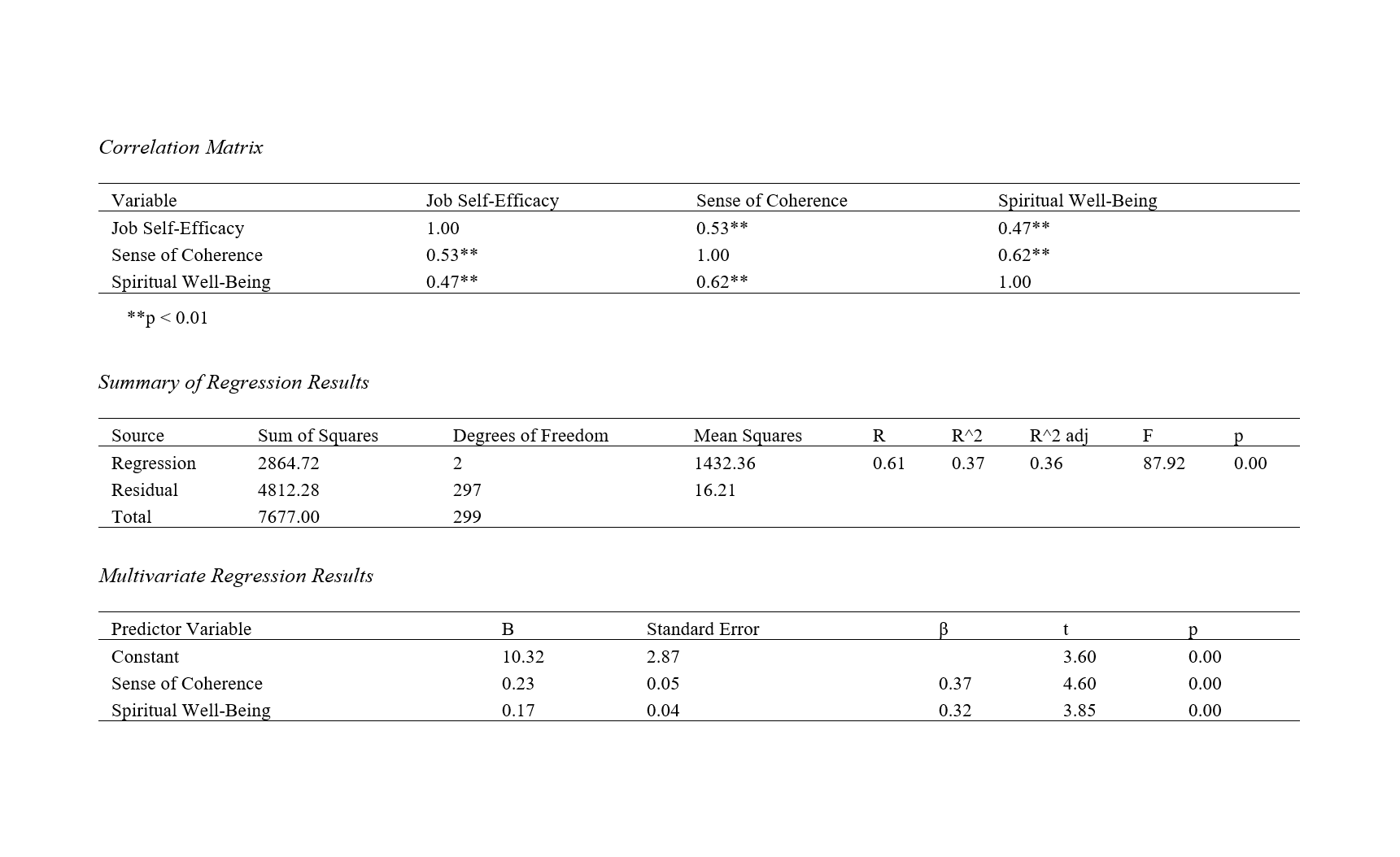
This study aimed to investigate the relationships between job self-efficacy, sense of coherence, and spiritual well-being among adults with hearing impairments. Specifically, it sought to determine the extent to which sense of coherence and spiritual well-being predict job self-efficacy in this population. A cross-sectional study design was employed, involving 300 adults with hearing impairments. Participants were recruited from rehabilitation centers, support groups, and online platforms. Data were collected using three standardized instruments: the General Self-Efficacy Scale (GSE), the Sense of Coherence Scale (SOC-13), and the Spiritual Well-Being Scale (SWBS). Descriptive statistics, Pearson correlation, and multiple linear regression analyses were conducted using SPSS-27 to explore the relationships between the variables. The mean job self-efficacy score was 28.56 (SD = 6.43), the mean sense of coherence score was 70.28 (SD = 14.92), and the mean spiritual well-being score was 92.65 (SD = 16.37). Job self-efficacy was significantly correlated with both sense of coherence (r = 0.53, p < 0.01) and spiritual well-being (r = 0.47, p < 0.01). The regression analysis revealed that sense of coherence (β = 0.37, p < 0.001) and spiritual well-being (β = 0.32, p < 0.001) were significant predictors of job self-efficacy, explaining 37% of the variance (F(2, 297) = 87.92, p < 0.001). The study highlights the significant roles of sense of coherence and spiritual well-being in predicting job self-efficacy among adults with hearing impairments. These findings suggest that interventions aimed at enhancing these psychological and spiritual dimensions could effectively support job self-efficacy in this population. Future research should focus on longitudinal studies and explore additional factors that may influence job self-efficacy.
Downloads
References
Aghaziarati, A., Ashori, M., & Norouzi, G. (2021). Analyzing and Discovering the Challenges of Raising a Child with Hearing Loss from the Perspective of Parents with Normal Hearing and the Adolescents with Hearing Loss: A Pilot Study. Journal of Family Research, 17(2), 283-301.https://doi.org/10.52547/jfr.17.2.283
Aghaziarati, A., Ashori, M., Norouzi, G., & Hallahan, D. P. (2023). The effectiveness of mindful parenting on cognitive and behavioral emotion regulation in mothers of children with hearing loss. KAUMS Journal (FEYZ), 27(1), 825-833.http://dx.doi.org/10.48307/FMSJ.2023.27.1.76
Ashori, M., & Aghaziarati, A. (2022). The relationships among social-emotional assets and resilience, empathy and behavioral problems in deaf and hard of hearing children. Current Psychology, 1-9.https://doi.org/10.1007/s12144-022-03152-5
Bargehr, B., Fischer von Weikersthal, L., Junghans, C., Zomorodbakhsch, B., Stoll, C., Prott, F. J., Fuxius, S., Micke, O., Hübner, J., Büntzel, J., & Hoppe, C. (2023). Sense of coherence and its context with demographics, psychological aspects, lifestyle, complementary and alternative medicine and lay aetiology. Journal of Cancer Research and Clinical Oncology, 149(11), 8393-8402.https://doi.org/10.1007/s00432-023-04760-9
Bekelman, D. B., Dy, S. M., Becker, D. M., Wittstein, I. S., Hendricks, D. E., Yamashita, T. E., & Gottlieb, S. H. (2007). Spiritual Well-Being and Depression in Patients With Heart Failure. Journal of General Internal Medicine, 22(4), 470-477.https://doi.org/10.1007/s11606-006-0044-9
Ben-Naim, S., Laslo-Roth, R., Einav, M., Biran, H., & Margalit, M. (2019). Academic self-efficacy, sense of coherence, hope and tiredness among college students with learning disabilities. In Postsecondary Educational Opportunities for Students with Special Education Needs (pp. 18-34). Routledge.https://www.taylorfrancis.com/chapters/edit/10.4324/978135
1107570-3/academic-self-efficacy-sense-coherence-hopetiredness-among-college-students-learning-disabilities-shiriben-naim-roni-laslo-roth-michal-einav-hadar-biran-malkamargalit Chang, P. S., Oh, B., & Funk, M. (2018). Physical and Psychological Effects of Qigong Exercise in CommunityDwelling Older Adults: An Exploratory Study. Geriatric Nursing, 39(1), 88-94.https://doi.org/10.1016/j.gerinurse.2017.07.004
Coppola, I., Rania, N., Parisi, R., & Lagomarsino, F. (2021). Spiritual Well-Being and Mental Health During the COVID-19 Pandemic in Italy. Frontiers in Psychiatry, 12.https://doi.org/10.3389/fpsyt.2021.626944
Flensborg-Madsen, T., Ventegodt, S., & Merrick, J. (2006). Sense of Coherence and Health. The Construction of an Amendment to Antonovsky's Sense of Coherence Scale (SOC II). TheScientificWorldJOURNAL, 6, 907548.https://doi.org/10.1100/tsw.2006.342
Ghayth, E. I. (2023). Cognitive Status and Psychological WellBeing of Older Adults With Hearing, Vision, or Dual Sensory Impairments. Egyptian Journal of Health Care, 14(3), 1048-1063.https://doi.org/10.21608/ejhc.2023.328834
Gispen, F., Chen, D. S., Genther, D. J., & Lin, F. R. (2014). Association Between Hearing Impairment and Lower Levels of Physical Activity in Older Adults. Journal of the American Geriatrics Society, 62(8), 1427-1433.https://doi.org/10.1111/jgs.12938
Gomez, R., & Fisher, J. W. (2003). Domains of spiritual well-being and development and validation of the Spiritual Well-Being Questionnaire. Personality and individual differences, 35(8), 1975-1991.https://doi.org/10.1016/S0191-8869(03)00045-X
Hourzad, A., Pouladi, S., Ostovar, A., & Ravanipour, M. (2018). The Effects of an Empowering Self-Management Model on Self-Efficacy and Sense of Coherence Among Retired Elderly With Chronic Diseases: A Randomized Controlled Trial. Clinical Interventions in Aging.https://doi.org/10.2147/cia.s183276
Hushyari, J., Safooraii Parizi, M. M., & Newsha, B. (2016). Comparing Spiritual Well-Being, Psychological Well-Being and Family Efficiency among University and Seminary Students. Ravanshenasi Va Din, 8(3), 71.https://www.magiran.com/paper/1483096
Marquès-Brocksopp, L. (2014). Mindfulness, Spiritual WellBeing, and Visual Impairment: An Exploratory Study. British Journal of Visual Impairment, 32(2), 108-123.https://doi.org/10.1177/0264619614528343
Mikaeli-Manee, F., Tabatabaee, S. M., & Raad-Masoumi, S. F. (2021). The Comparison of Time Perspective, Spiritual Well- being and Psychological Well-being in the Young Participating and not Participating in I'tikaf Rite. Journal of Pizhūhish dar dīn va Salāmat (i.e., Research on Religion & Health), 7(3), 68-79.https://doi.org/10.22037/jrrh.v7i3.31787
Moghadamnia, M. M., & Soleimani Farsani, B. H. (2023). Relationship between Marital Commitment and Marital Satisfaction with Self-Conscious Emotions and SelfCoherence married female. Psychology of Woman Journal, 4(1), 52-61.https://doi.org/10.61838/kman.pwj.4.1.6
Mohammadi Zadeh , M., & Khorramdel , K. (2023). Comparison of Irrational Beliefs, Self-concept, and Spiritual Well-being in Women with a History of Divorce and Normalcy. Woman Interdisciplinary Researches Journal, 3(4), 47-59.https://www.magiran.com/paper/2521067
Mosaei, R., Abolmaali Alhosseini, K., & Bagheri, F. (2023). The effectiveness of growth-oriented training for adults aged 35 to 45 in promoting self-coherence and lifelong learning. Applied Family Therapy Journal (AFTJ), 4(5), 192-205.https://doi.org/10.61838/kman.aftj.4.5.11
Niazi, Y., Ejaz, B., & Muazzam, A. (2020). Impact of Hearing Impairment on Psychological Distress and subjective WellBeing in Older Adults. Pakistan Journal of Medical Sciences, 36(6).https://doi.org/10.12669/pjms.36.6.2457
Nilsen, V., Bakke, P., Rohde, G.-E., & Gallefoss, F. (2015). Is Sense of Coherence a Predictor of Lifestyle Changes in Subjects at Risk for Type 2 Diabetes? Public Health.https://doi.org/10.1016/j.puhe.2014.12.014
Paggi, M. E., & Jopp, D. S. (2015). Outcomes of Occupational SelfEfficacy in Older Workers. The International Journal of Aging and Human Development, 80(4), 357-378.https://doi.org/10.1177/0091415015607640
Paloutzian, R., & Ellison, C. (1982). Loneliness, spiritual wellbeing and the quality of life. In D. Peplau & P. D. (Eds.), Loneliness: a sourcebook of current theory, research and therapy.https://doi.org/10.1037/t00534-000
Peymani, J., & Aghajanihashjin, T. (2022). Structural relationships of pain intensity and self-efficacy with fear of movement mediated by psychological distress in women with rheumatoid arthritis. Applied Family Therapy Journal (AFTJ), 3(3), 1-19.https://doi.org/10.61838/kman.aftj.3.3.1
Rohde, G., Kersten, C., Vistad, I., & Mesel, T. (2017). Spiritual Well-being in Patients With Metastatic Colorectal Cancer Receiving Noncurative Chemotherapy: A Qualitative Study. Cancer Nursing, 40(3).https://journals.lww.com/cancernursingonline/fulltext/2017/05000/spiritual_well_being_in_patients_with_metastatic.7.aspx
Sayed Alitabar, S. H., & Goli, F. (2023). The Interplay of Neuroticism and Self-Efficacy in Pain Catastrophizing: A Quantitative Analysis. Journal of Personality and Psychosomatic Research (JPPR), 1(2), 19-24.https://journals.kmanpub.com/index.php/jppr/article/view/2197
Smith, S. L. (2014). Promoting Self-Efficacy in Patient-Centered Audiologic Rehabilitation for Adults With Hearing Loss. Perspectives on Aural Rehabilitation and Its Instrumentation, 21(1), 24-32.https://doi.org/10.1044/arri21.1.24
Zadhasan, Z., & Gholamzadeh Jofreh, M. (2023). The effectiveness of emotion-focused cognitive therapy on corona anxiety, sense of coherence and post-traumatic growth in women recovered from corona. Applied Family Therapy Journal (AFTJ), 4(1), 672-687. https://doi.org/10.61838/kman.aftj.4.1.34
Zhao, H. (2023). The Effect of Hearing Impairment and Social Participation on Depressive Symptoms in Older Adults: A Cross-Lagged Analysis. Frontiers in Computational Neuroscience.https://doi.org/10.3389/fncom.2023.1240587
Downloads
Additional Files
Publication Timeline
Issue
Section
License

This work is licensed under a Creative Commons Attribution-NonCommercial 4.0 International License.