Impact of Sensory Processing Sensitivity on Emotional Dysregulation in Gifted Students: The Mediating Role of Anxiety Sensitivity
DOI:
https://doi.org/10.61838/kman.prien.3.3.2Keywords:
Gifted students, sensory processing sensitivity, emotional dysregulation, anxiety sensitivity, structural equation modelingAbstract
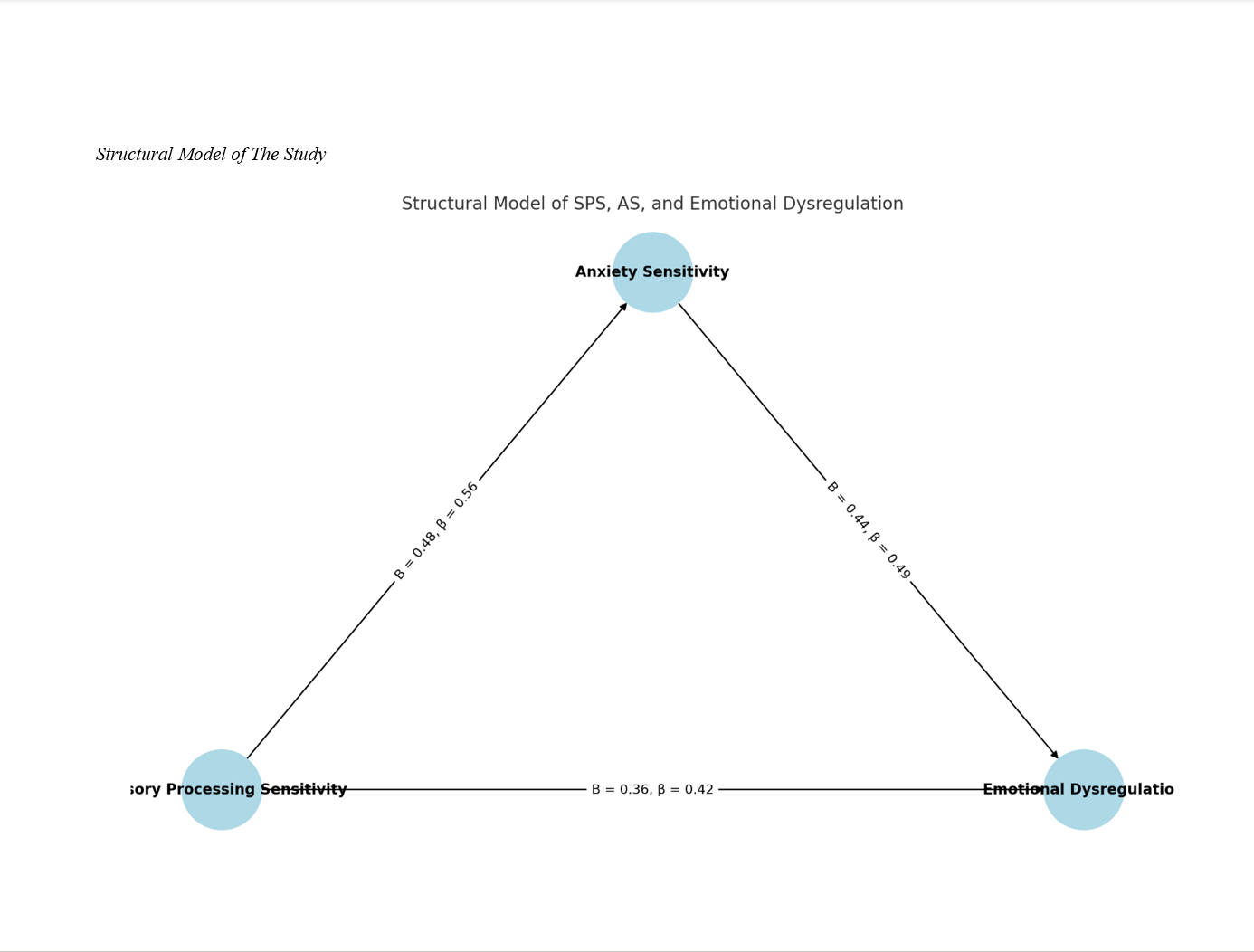
This study aimed to investigate the impact of sensory processing sensitivity on emotional dysregulation in gifted students, examining the mediating role of anxiety sensitivity in this relationship. The research employed a descriptive correlational design, involving a sample of 390 gifted secondary school students from Isfahan city, selected based on Morgan and Krejcie’s sampling table. Participants completed three validated Likert-based instruments: the Highly Sensitive Person Scale (HSPS), the Anxiety Sensitivity Index-3 (ASI-3), and the Difficulties in Emotion Regulation Scale (DERS). Data analysis was conducted using SPSS-27 for descriptive statistics and Pearson correlation analysis, and AMOS-21 for structural equation modeling (SEM) to assess direct, indirect, and total effects among the variables. Model fit was evaluated using standard indices including RMSEA, CFI, TLI, and GFI. Pearson correlation coefficients indicated significant positive relationships between sensory processing sensitivity, anxiety sensitivity, and emotional dysregulation (r = .56 to .67, p < .001). The SEM results showed that sensory processing sensitivity had a significant direct effect on emotional dysregulation (β = .42, p < .001), and on anxiety sensitivity (β = .56, p < .001). Anxiety sensitivity also directly predicted emotional dysregulation (β = .49, p < .001). Importantly, anxiety sensitivity partially mediated the relationship between sensory processing sensitivity and emotional dysregulation, with a significant indirect effect (β = .28, p < .001). The model demonstrated excellent fit indices (CFI = .96, RMSEA = .052, χ²/df = 2.07). The findings underscore the importance of recognizing and addressing anxiety sensitivity as a key psychological mechanism linking sensory traits and emotional dysregulation in gifted youth. Interventions that integrate emotional regulation and sensitivity awareness may enhance educational and psychological outcomes for this population.
Downloads
References
Akgül, G. (2021). Teachers’ Metaphors and Views About Gifted Students and Their Education. Gifted Education International, 37(3), 273-289. https://doi.org/10.1177/0261429421988927
Bardzińska, D. (2024). Gifted Student as Perceived by Male and Female Teachers – Research Report. Special School, LXXXV(1), 39-50. https://doi.org/10.5604/01.3001.0054.5270
Bonte, A. D., McCaffrey, C. A., Wisdom, H. K., Locke, M. E., Torgerson, N. G., & Lucero, T. (2024). Auditory Processing Disorders and Vision Processing Disorders in Twice-Exceptionality (2e): Are These Foundational Factors Being Overlooked? Journal for the Education of the Gifted, 47(1), 30-53. https://doi.org/10.1177/01623532231214568
Braslauskienė, R., Jacynė, R., Kuprienė, L., & Ponamorenko, M. (2023). Peculiarities of Education of Gifted Students in Gymnasium: Views of Lithuanian and Ukrainian Teachers. Society Integration Education Proceedings of the International Scientific Conference, 1, 503-515. https://doi.org/10.17770/sie2023vol1.7079
Gabrijelčič, M. K., & Seničar, M. Ž. (2024). The Active Role of Gifted Students in the Preparation and Evaluation of Individualized Programs. Revija Za Elementarno Izobraževanje, 385-402. https://doi.org/10.18690/rei.4488
GİRgİN, N., Atasayar, M., & Canli, F. (2023). Teachers' Perceptions, Opinions and Training Needs About the Guidance, Diagnosis and Education of Individuals With Special Talents. Turkish Journal of Applied Social Work. https://doi.org/10.54467/trjasw.1325697
Güler, E. K., & Ulusoy, F. (2025). A Gifted High School Student’s Abstraction Process of Divisibility Rules. Kastamonu Eğitim Dergisi, 33(1), 1-16. https://doi.org/10.24106/kefdergi.1628219
Hemingway, S. (2023). Referral, Identification, and Retention of Underrepresented Gifted Students. International Journal for Talent Development and Creativity, 10(1-2), 205-216. https://doi.org/10.7202/1099953ar
Kuehl, R., Azano, A. P., & Mata, R. (2025). Addressing Equity Challenges and Expanding Opportunities in Gifted Education for Rural Multilingual Learners. Journal of Advanced Academics. https://doi.org/10.1177/1932202x251336494
KuŞCİ, E., & ÇElİK, S. (2022). Öğretmen Görüşlerine Göre Okul Yöneticilerinin Algı Yönetimini Kullanım Düzeyleri. Journal of Social Research and Behavioral Sciences, 8(16), 844-857. https://doi.org/10.52096/jsrbs.8.16.59
Michalak, R. (2022). Teachers’ Experiences in Working With Cognitively Gifted Students. Multidisciplinary Journal of School Education, 11(2 (22)), 163-187. https://doi.org/10.35765/mjse.2022.1122.08
Muneera, R., Diab, A., & Al-Abbasi, A. (2023). Overexcitabilities as Predictors of Creative Personality Among Gifted and Ordinary Students in the State of Kuwait. Jordan Journal of Educational Sciences, 19(2), 423-447. https://doi.org/10.47015/19.2.10
Oh, S. (2024). Exploring Gifted School Students’ Process-Based Assessment Performance Using GeoGebra: Focused on the Quadratic Curves. Kor SCH Mathematics Soc, 27(2), 241-255. https://doi.org/10.30807/ksms.2024.27.2.007
Rhaissa Andrêssa Ramos de, S., & Fleith, D. d. S. (2021). Emotional Development of Gifted Students: Comparative Study About Overexcitabilities. Psico-USF, 26(4), 733-743. https://doi.org/10.1590/1413-82712021260411
Shaidenko, N. A., Kipurova, S., Sergeeva, A. V., Filatova, M. V., & Shelispanskaya, E. (2021). Development of Creativity of a Future Teacher as a Condition for Their Effective Work With Gifted Students. SHS Web of Conferences, 117, 06005. https://doi.org/10.1051/shsconf/202111706005
Shin, M.-K. (2022). How Pre-Service Elementary Teachers Depict Science Gifted Education. Korean Science Education Society for the Gifted, 14(2), 73-81. https://doi.org/10.29306/jseg.2022.14.2.73
Smith, C. K., & Wood, S. M. (2020). Supporting the Career Development of Gifted Students: New Role and Function for School Psychologists. Psychology in the Schools, 57(10), 1558-1568. https://doi.org/10.1002/pits.22344
Thomas, M., & Mascharka, S. (2023). Using Student Profiles to Identify for Gifted and Talented Services. 19-37. https://doi.org/10.4018/978-1-6684-6677-3.ch002
Yildiz, D. G., & Durmaz, B. (2021). A Gifted High School Student’s Generalization Strategies of Linear and Nonlinear Patterns via Gauss’s Approach. Journal for the Education of the Gifted, 44(1), 56-80. https://doi.org/10.1177/0162353220978295
Zakaria, Z., Ali, M. Z. M., Wan Ahmad Zakry Wan, K., Islieh, A. R. I. S., Usop, R., Spawi, M., Amin, A. F. M., & Mohamad, M. (2023). Quran Memorization as a Vital Identification Process of Gifted and Talented Muslim Students. Creative Education, 14(04), 810-829. https://doi.org/10.4236/ce.2023.144053
Downloads
Additional Files
Publication Timeline
- Submitted
- Revised
- Accepted
Issue
Section
License
Copyright (c) 2025 Ahmad Abedi (Author); Sara Nejatifar (Corresponding Author)

This work is licensed under a Creative Commons Attribution-NonCommercial 4.0 International License.