Independent and Interactive Effects of Combined Aerobic–Resistance Training and Coenzyme Q10 Supplementation on Amyloidogenic Pathway Markers and IDE-Dependent Amyloid Clearance in the Hippocampus of Male Wistar Rats With Amyloid-β-Induced Alzheimer-Like Pathology
DOI:
https://doi.org/10.61838/Keywords:
Alzheimer-like pathology, amyloid-β, combined training, coenzyme Q10, hippocampus, insulin-degrading enzymeAbstract
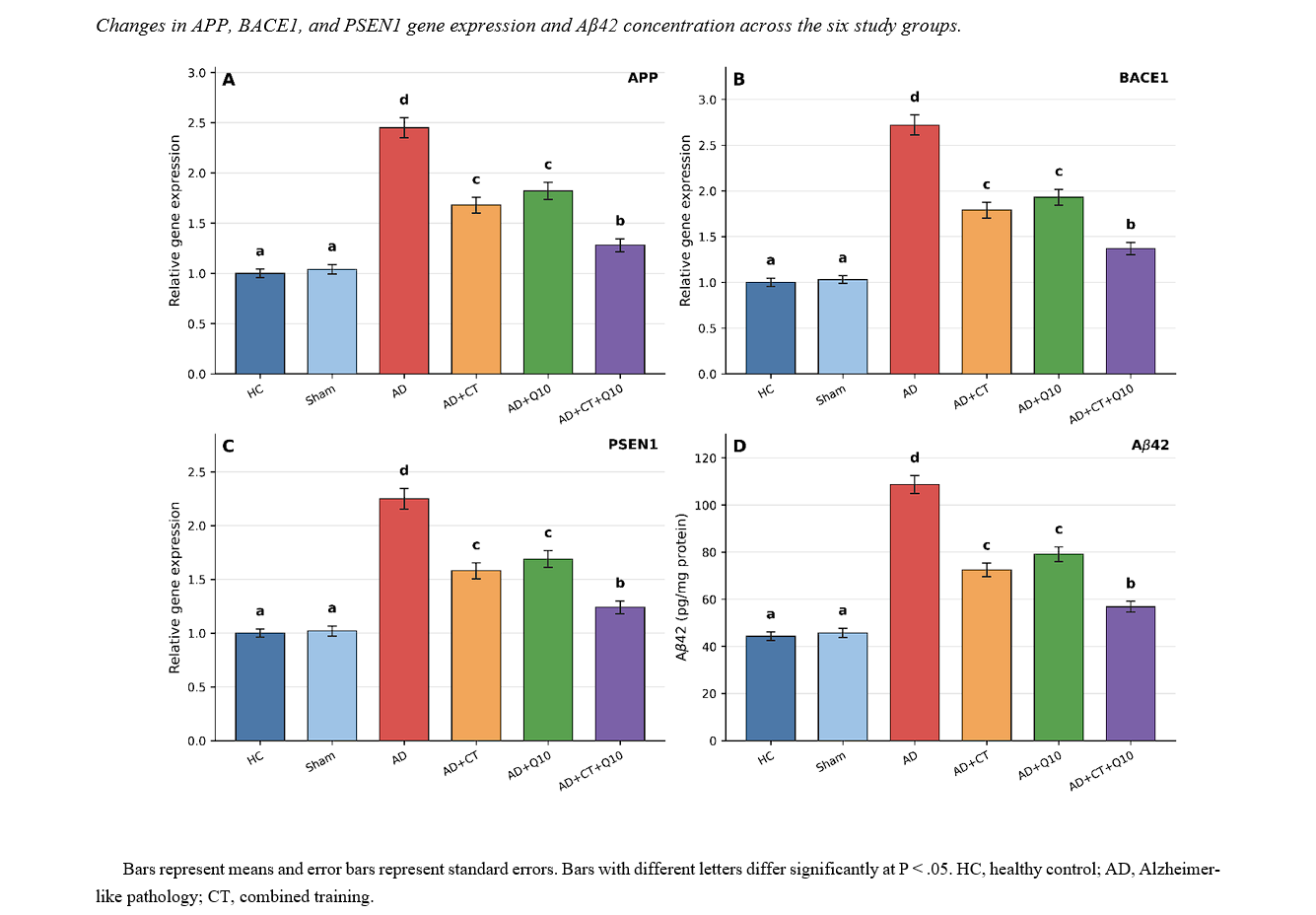
Alzheimer-like pathology is associated with increased amyloid-β production and impaired peptide clearance. This study investigated the independent and interactive effects of combined aerobic-resistance training and coenzyme Q10 supplementation on hippocampal markers of amyloidogenic processing and insulin-degrading enzyme (IDE)-dependent clearance. Forty-eight male Wistar rats were allocated to six groups (n = 8): healthy control, sham, Alzheimer-like pathology, Alzheimer-like pathology plus combined training, Alzheimer-like pathology plus coenzyme Q10, and Alzheimer-like pathology plus combined training and coenzyme Q10. Alzheimer-like pathology was induced by intracerebroventricular Aβ1-42 administration. The combined training protocol and a diet containing 0.4% coenzyme Q10 were applied for 12 weeks. Hippocampal APP, BACE1, PSEN1, and IDE gene expression was measured by real-time PCR; Aβ42 concentration was measured by ELISA; and IDE activity was determined enzymatically. One-way ANOVA with Tukey testing and 2 × 2 two-way ANOVA were used. Model induction significantly increased APP, BACE1, PSEN1, and Aβ42 and reduced IDE expression and activity. Training and coenzyme Q10 each significantly attenuated all alterations. The combined-intervention group showed the most favorable means across all outcomes. Significant training-by-supplementation interactions were observed for BACE1 and Aβ42, but not for APP, PSEN1, IDE expression, or IDE activity. Combined aerobic-resistance training and coenzyme Q10 supplementation improved the balance between markers related to amyloid production and IDE-dependent clearance in this rat model. The findings are limited to hippocampal molecular outcomes in an experimentally induced Alzheimer-like condition and require confirmation using protein-level, histological, cognitive, and translational assessments.
Downloads
References
Adlard, P. A., Perreau, V. M., Pop, V., & Cotman, C. W. (2005). Voluntary exercise decreases amyloid load in a transgenic model of Alzheimer’s disease. Journal of Neuroscience, 25(17), 4217–4221. https://doi.org/10.1523/JNEUROSCI.0496-05.2005
Bentinger, M., Tekle, M., & Dallner, G. (2010). Coenzyme Q—Biosynthesis and functions. Biochemical and Biophysical Research Communications, 396(1), 74–79. https://doi.org/10.1016/j.bbrc.2010.02.147
Buzsáki, G., & Tingley, D. (2018). The hippocampus as a sequence generator. Trends in Cognitive Sciences, 22(10), 853–869. https://doi.org/10.1016/j.tics.2018.07.006
Cassilhas, R. C., Lee, K. S., Fernandes, J., Oliveira, M. G. M., Tufik, S., Meeusen, R., & de Mello, M. T. (2012). Spatial memory is improved by aerobic and resistance exercise through divergent molecular mechanisms. Neuroscience, 202, 309–317. https://doi.org/10.1016/j.neuroscience.2011.11.029
Farris, W., Mansourian, S., Chang, Y., Lindsley, L., Eckman, E. A., Frosch, M. P., Eckman, C. B., Tanzi, R. E., Selkoe, D. J., & Guenette, S. (2003). Insulin-degrading enzyme regulates the levels of insulin, amyloid β-protein, and the β-amyloid precursor protein intracellular domain in vivo. Proceedings of the National Academy of Sciences of the United States of America, 100(7), 4162–4167. https://doi.org/10.1073/pnas.0230450100
Haass, C., Kaether, C., Thinakaran, G., & Sisodia, S. (2012). Trafficking and proteolytic processing of APP. Cold Spring Harbor Perspectives in Medicine, 2(5), a006270. https://doi.org/10.1101/cshperspect.a006270
Hardy, J., & Selkoe, D. J. (2002). The amyloid hypothesis of Alzheimer’s disease: Progress and problems on the road to therapeutics. Science, 297(5580), 353–356. https://doi.org/10.1126/science.1072994
Hernández-Camacho, J. D., Bernier, M., López-Lluch, G., & Navas, P. (2018). Coenzyme Q10 supplementation in aging and disease. Frontiers in Physiology, 9, Article 44. https://doi.org/10.3389/fphys.2018.00044
Intlekofer, K. A., & Cotman, C. W. (2013). Exercise counteracts declining hippocampal function in aging and Alzheimer’s disease. Neurobiology of Disease, 57, 47–55. https://doi.org/10.1016/j.nbd.2012.06.011
Qiu, W. Q., Walsh, D. M., Ye, Z., Vekrellis, K., Zhang, J., Podlisny, M. B., Rosner, M. R., Safavi, A., Hersh, L. B., & Selkoe, D. J. (1998). Insulin-degrading enzyme regulates extracellular levels of amyloid β-protein by degradation. Journal of Biological Chemistry, 273(49), 32730–32738. https://doi.org/10.1074/jbc.273.49.32730
Scheltens, P., De Strooper, B., Kivipelto, M., Holstege, H., Chételat, G., Teunissen, C. E., Cummings, J., & van der Flier, W. M. (2021). Alzheimer’s disease. The Lancet, 397(10284), 1577–1590. https://doi.org/10.1016/S0140-6736(20)32205-4
Selkoe, D. J., & Hardy, J. (2016). The amyloid hypothesis of Alzheimer’s disease at 25 years. EMBO Molecular Medicine, 8(6), 595–608. https://doi.org/10.15252/emmm.201606210
Vassar, R., Bennett, B. D., Babu-Khan, S., Kahn, S., Mendiaz, E. A., Denis, P., Teplow, D. B., Ross, S., Amarante, P., Loeloff, R., Luo, Y., Fisher, S., Fuller, J., Edenson, S., Lile, J., Jarosinski, M. A., Biere, A. L., Curran, E., Burgess, T., ... Citron, M. (1999). β-Secretase cleavage of Alzheimer’s amyloid precursor protein by the transmembrane aspartic protease BACE. Science, 286(5440), 735–741. https://doi.org/10.1126/science.286.5440.735
Downloads
Publication Timeline
- Submitted
- Revised
- Accepted