The Effectiveness of the Teaching Games for Understanding Model in Badminton Service Learning: A Systematic Review and Meta-Analysis
Keywords:
Teaching Games for Understanding, badminton, service learning, meta-analysis, game-based pedagogy, physical educationAbstract
Objective: The badminton serve is a fundamental technical skill that influences rally initiation and overall performance. Traditional instruction often isolates technique from tactical decision-making, limiting meaningful skill transfer. The Teaching Games for Understanding (TGfU) model offers a constructivist, game-centered approach that integrates cognitive, affective, and psychomotor learning. However, its specific application to badminton service learning has received limited empirical attention. This study aimed to systematically evaluate the effectiveness of TGfU in badminton service learning and identify moderating variables influencing its impact.
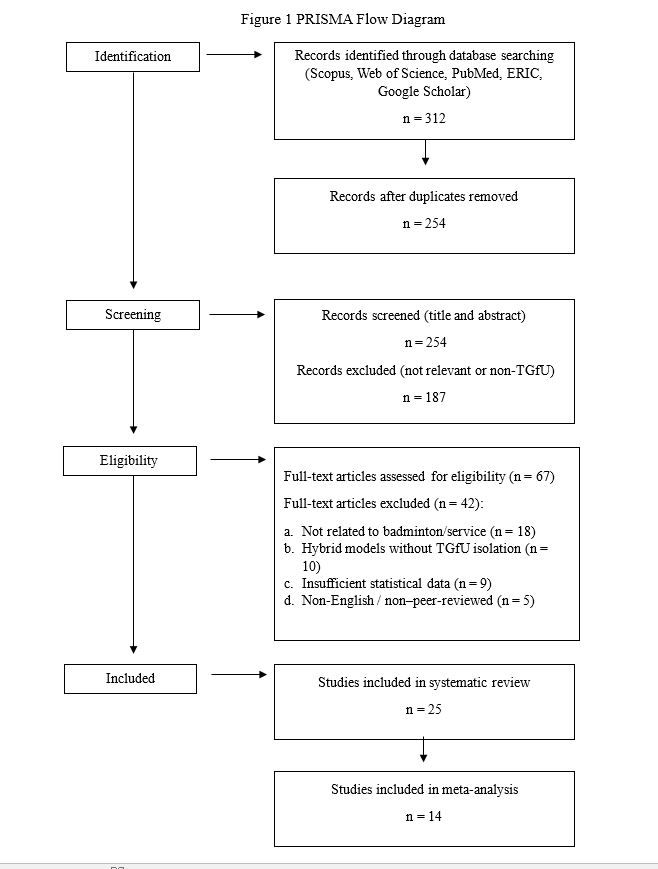
Methods: A systematic review and meta-analysis were conducted following PRISMA 2020 guidelines. Data were collected from Scopus, Web of Science, PubMed, ERIC, and Google Scholar databases (2020–2024). Twenty-five empirical studies met inclusion criteria, and fourteen were quantitatively analyzed using Comprehensive Meta-Analysis (CMA) software. Effect sizes (Cohen’s d), heterogeneity (I²), and subgroup analyses (age, intervention duration, learning domain) were computed to determine the pooled effect and variability across studies.
Results:The findings revealed a statistically significant, moderate-to-large overall effect of TGfU on badminton service-learning outcomes (d = 0.74; 95% CI [0.52–0.96], p < 0.001). The model showed the highest impact on psychomotor accuracy (d = 0.82*), followed by cognitive understanding (d = 0.70*) and motivation (d = 0.61*). Longer interventions and adolescent learners demonstrated stronger effects.
Conclusion: In conclusion, TGfU effectively enhances technical execution, tactical cognition, and engagement in badminton service learning. The model’s constructivist nature positions it as a powerful pedagogical framework for integrating skill precision with game-based understanding in sport education.
Downloads