The Effectiveness of the Dutch Cognitive-Behavioral Therapy Protocol for Hoarding Disorder: A Pilot Study
DOI:
https://doi.org/10.61838/kman.prien.4725Keywords:
Hoarding disorder, CBT, Treatment effect, ClutterAbstract
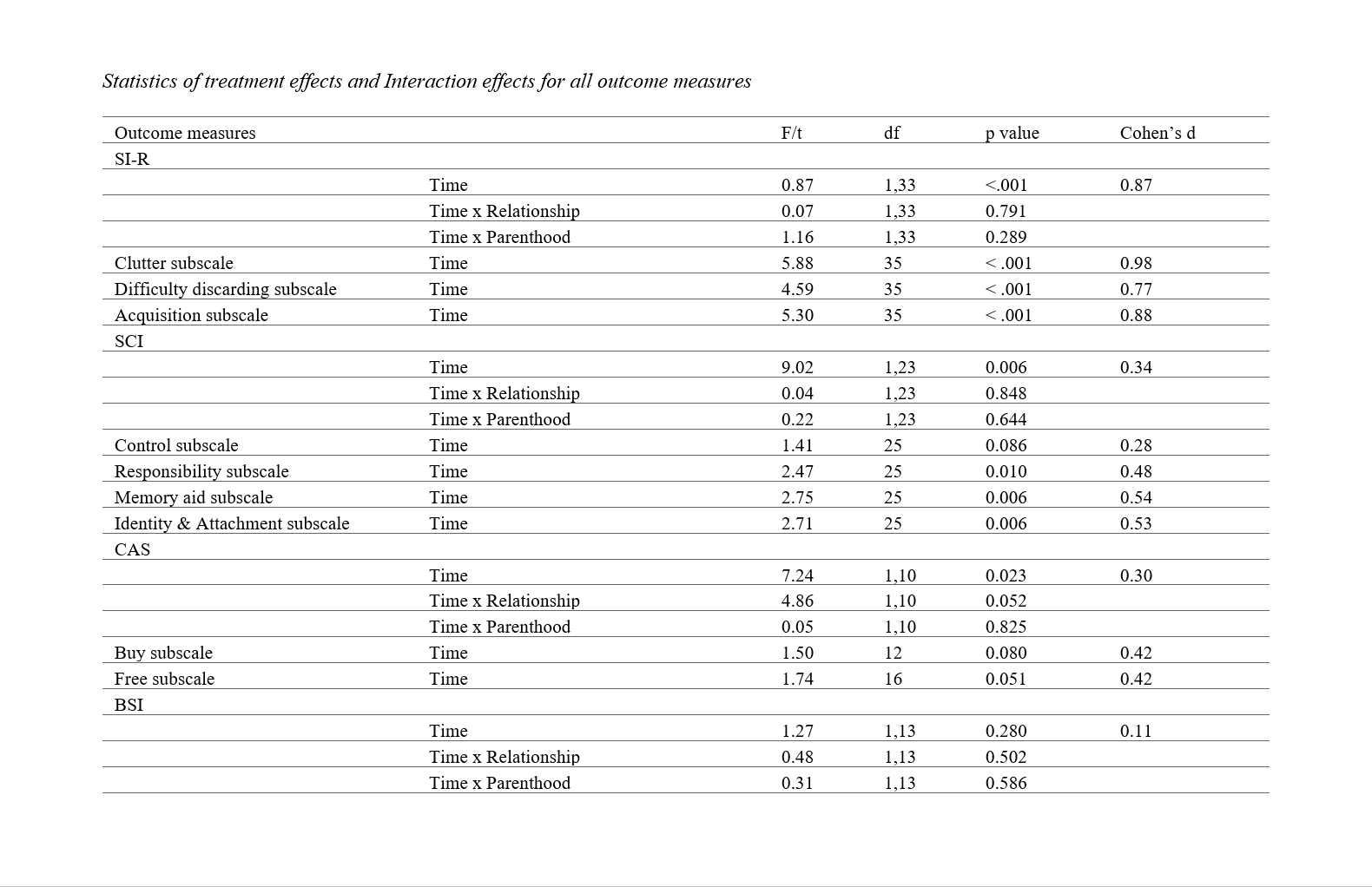
In this pilot study, the effectiveness of the Dutch cognitive-behavioral therapy (CBT) protocol for hoarding disorder was investigated for the first time in adult patients with hoarding disorder (N=36). A rather unique feature of this protocol is the intensive collaboration with home counselors. Results demonstrated a significant decline in hoarding related symptoms during treatment (d = .87)), including reduced acquisition of items (d = 0.88), reduced clutter (d = .98), and less difficulty discarding items (d = .0.77). Furthermore, patients reported significantly less excessive acquisition of items post-treatment (d = 0.30). Moreover, there were significant changes in underlying hoarding cognitions from pre- to post-treatment (d = 0.34). More specifically, there was a significant decrease in beliefs related to 1) identity and attachment (d = 0.53), 2) responsibility for objects (d = 0.48), and 3) using items as memory aids (d = 0.54) from pre- to post-treatment. No significant change was observed during treatment in the patients' cognitions related to the need for control over personal possessions (p = .086; d = 0.28). Furthermore, there was no significant decrease in symptoms of psychopathology from pre- to post-treatment (p = .586; d = 0.11). Finally, additional analyses indicated that whether patients were having a relationship and/or were having children was not significantly related to treatment outcome (all p’s > .052). This pilot study is a first step in mapping the effect of CBT in Dutch patients with hoarding disorder, which will hopefully contribute to making treatment more widely available for these patients in the long term.
Downloads
References
American Psychiatric, A. (2013). The Diagnostic and Statistical Manual of Mental Disorders: DSM 5. Washington, DC. https://doi.org/10.1176/appi.books.9780890425596
Archer, C. A., Moran, K., Garza, K., & et al. (2019). Relationship between symptom severity, psychiatric comorbidity, social/occupational impairment, and suicidality in hoarding disorder. Journal of Obsessive-Compulsive and Related Disorders, 21, 158-164. https://doi.org/10.1016/j.jocrd.2018.11.001
Ayers, C. R., Ly, P., Howard, I., Mayes, T., Porter, B., & Iqbal, Y. (2014). Hoarding severity predicts functional disability in late-life hoarding disorder patients. International Journal of Geriatric Psychiatry, 29(7), 741-746. https://doi.org/10.1002/gps.4057
Bodryzlova, Y., Audet, J. S., Bergeron, K., & O'Connor, K. (2019). Group cognitive-behavioral therapy for hoarding disorder: Systematic review and meta-analysis. Health & Social Care in the Community, 27(3), 517-530. https://doi.org/10.1111/hsc.12598
Bratiotis, C., Muroff, J., & Lin, N. X. Y. (2021). Hoarding Disorder: Development in Conceptualization, Intervention, and Evaluation. Focus (Am Psychiatr Publ), 19(4), 392-404. https://doi.org/10.1176/appi.focus.20210016
Cath, D. C., Nizar, K., Boomsma, D., & Mathews, C. A. (2017). Age-Specific Prevalence of Hoarding and Obsessive Compulsive Disorder: A Population-Based Study. American Journal of Geriatric Psychiatry, 25(3), 245-255. https://doi.org/10.1016/j.jagp.2016.11.006
Chasson, G. S., Carpenter, A., Ewing, J., & et al. (2014). Empowering families to help a loved one with hoarding disorder: pilot study of Family-As-Motivators training. Behaviour Research and Therapy, 63, 9-16. https://doi.org/10.1016/j.brat.2014.08.016
Craske, M. G., Treanor, M., Zbozinek, T. D., & Vervliet, B. (2022). Optimizing exposure therapy with an inhibitory retrieval approach and the OptEx Nexus. Behaviour Research and Therapy, 152. https://doi.org/10.1016/j.brat.2022.104069
Crone, C., Angel, Z., Isemann, S., & Norberg, M. M. (2020). Clutter-Buddies: A Volunteer program to assist clients undergoing group cognitive behavioural therapy. Journal of Obsessive-Compulsive and Related Disorders, 27. https://doi.org/10.1016/j.jocrd.2020.100559
David, J., Crone, C., & Norberg, M. M. (2022). A critical review of cognitive behavioural therapy for hoarding disorder: How can we improve outcomes? Clinical Psychology & Psychotherapy, 29(2), 469-488. https://doi.org/10.1002/cpp.2660
Derogatis, L. R. (1993). BSI Brief Symptom Inventory. Administration, Scoring, and Procedures Manual. Minneapolis, MN: National Computer Systems. https://hazards.colorado.edu/nhcdata/chernobyl/ChData/ScalesInstruments/Scales%20and%20Indices/Scale%20Construction%20Instructions/BSI.pdf
Derogatis, L. R., & Spencer, P. M. (1982). The Brief Symptom Inventory (BSI): Administration, and Procedures Manual-I. Baltimore, MD: Clinical Psychometric Research. https://doi.org/10.1037/t00789-000
Dozier, M. E., Chabaud, S., Krafft, J., Nix, C. A., Schaff, B., Yee, K., & Stewart, M. G. (2025). Psychosocial impact of hoarding symptoms in college students and the potential for early intervention. Journal of American College Health, 73(8), 3290-3296. https://doi.org/10.1080/07448481.2024.2400566
Edwards, V., Salkovskis, P. M., & Bream, V. (2023). Do they really care? Specificity of social support issues in hoarding disorder and obsessive-compulsive disorder. British Journal of Clinical Psychology, 62, 573-591. https://doi.org/10.1111/bjc.12426
Fournier, M., & Korteweg, M. (2016). Behandelprotocol verzamelstoornis: handleiding voor de therapeut en werkboek voor de cliënt. Boom uitgevers, Amsterdam. https://www.boom.nl/psychologie/100-1412_Behandelprotocol-Verzamelstoornis
Frost, R. O., Steketee, G., & Grisham, J. (2004). Measurement of compulsive hoarding: saving inventory-revised. Behaviour Research and Therapy, 42(10), 1163-1182. https://doi.org/10.1016/j.brat.2003.07.006
Frost, R. O., Steketee, G., & Tolin, D. F. (2011). Comorbidity in hoarding disorder. Depression and Anxiety, 28(10), 876-884. https://doi.org/10.1002/da.20861
Frost, R. O., Steketee, G., & Williams, L. (2002). Compulsive buying, compulsive hoarding, and obsessive-compulsive disorder. Behaviour Therapy, 33, 201-214. https://doi.org/10.1016/S0005-7894(02)80025-9
Frost, R. O., Tolin, D. F., Steketee, G., Fitch, K. E., & Selbo-Bruns, A. (2009). Excessive acquisition in hoarding. Journal of Anxiety Disorders, 23(5), 632-639. https://doi.org/10.1016/j.janxdis.2009.01.013
Grassi, G., Scillitani, E., Moradei, C., Cecchelli, C., van Ameringen, M., & Rodriguez, C. I. (2025). Long-term changes of hoarding symptoms among adults with attention-deficit/hyperactivity disorder (ADHD) treated with methylphenidate. Journal of Psychiatric Research. https://pubmed.ncbi.nlm.nih.gov/40768777/
Grisham, J. R., Frost, R. O., Steketee, G., Kim, H. J., & Hood, S. (2006). Age of onset of compulsive hoarding. Journal of Anxiety Disorders, 20, 675-686. https://doi.org/10.1016/j.janxdis.2005.07.004
Guzick, A. G., Chabaud, S., Garrett, C., & Storch, E. A. (2022). Anxiety, depression, and rejection towards parents among individuals who grew up in a hoarded home. Annals of Clinical Psychiatry, 34(1), e1-e12. https://doi.org/10.12788/acp.0053
Larkin, P., Sheppard, S. B., Bratiotis, C., & Woody, S. R. (2025). Stigmatizing attitudes and endorsement of coercive interventions for hoarding. Journal of Obsessive-Compulsive and Related Disorders, 44, 100933. https://doi.org/10.1016/j.jocrd.2024.100933
Linkovski, O., Zwerling, J., Cordell, E., Sonnenfeld, D., Willis, H., La Lima, C. N., & et al. (2018). Augmenting Buried in Treasures with in-home decluttering practice: Pilot study in hoarding disorder. Journal of Psychiatric Research, 107, 145-150. https://doi.org/10.1016/j.jpsychires.2018.10.001
McGrath, M., Russell, A. M., & Masterson, C. (2024). 'A more human approach… I haven't found that really': experiences of hoarding difficulties and seeking help. Behavioural and Cognitive Psychotherapy, 52(1), 1-13. https://doi.org/10.1017/S1352465823000425
Muhlbauer, J. E., Ferrao, Y. A., Eppingstall, J., Albertella, L., do, M. C. R., Miguel, E. C., & Fontenelle, L. F. (2021). Predicting marriage and divorce in obsessive-compulsive disorder. Journal of Sex & Marital Therapy, 47(1), 90-98. https://doi.org/10.1080/0092623X.2020.1804021
Nutley, S. K., Read, M., Martinez, S., Eichenbaum, J., Nosheny, R. L., Weiner, M., Mackin, R. S., & Mathews, C. A. (2022). Hoarding symptoms are associated with higher rates of disability than other medical and psychiatric disorders across multiple domains of functioning. BMC Psychiatry, 22, 647. https://doi.org/10.1186/s12888-022-04287-2
O'Brien, E., & Laws, K. R. (2025). Decluttering Minds: Psychological interventions for hoarding disorder - A systematic review and meta-analysis. Journal of Psychiatric Research, 181, 738-751. https://doi.org/10.1016/j.jpsychires.2024.12.029
Postlethwaite, A., Kellett, S., & Mataix-Cols, D. (2019). Prevalence of hoarding disorder: A systematic review and meta-analysis. Journal of Affective Disorders, 256, 309-316. https://pubmed.ncbi.nlm.nih.gov/31200169/
Prosser, R. M., Dennis, J. P., & Salkovskis, P. M. (2024). Understanding stigma in hoarding disorder: A systematic review. Journal of Obsessive-Compulsive and Related Disorders, 41, 100872. https://doi.org/10.1016/j.jocrd.2024.100872
Rodgers, N., McDonald, S., & Wootton, B. M. (2021). Cognitive behavioral therapy for hoarding disorder: An updated meta-analysis. Journal of Affective Disorders, 290, 128-135. https://pubmed.ncbi.nlm.nih.gov/33993079/
Schulte-van Maaren, Y. W., Carlier, I. V., Zitman, F. G., van Hemert, A. M., de Waal, M. W., van Noorden, M. S., & Giltay, E. J. (2012). Reference values for generic instruments used in routine outcome monitoring: the Leiden Routine Outcome Monitoring Study. BMC Psychiatry, 12, 203. https://doi.org/10.1186/1471-244X-12-203
Steketee, G., & Frost, R. O. (2006). Compulsive Hoarding and Acquiring. Oxford University Press. https://psycnet.apa.org/record/2006-23296-000
Steketee, G., Frost, R. O., & Kyrios, M. (2003). Cognitive aspects of compulsive hoarding. Cognitive Therapy and Research, 27, 463-479. https://doi.org/10.1023/A:1025428631552
Timpano, K. R., Bainter, S. A., Goodman, Z. T., Tolin, D. F., Steketee, G., & Frost, R. O. (2020). A Network Analysis of Hoarding Symptoms, Saving and Acquiring Motives, and Comorbidity. Journal of Obsessive-Compulsive and Related Disorders, 25. https://doi.org/10.1016/j.jocrd.2020.100520
Tolin, D. F., Fitch, K. E., Frost, R. O., & Steketee, G. (2010). Family Informants' Perceptions of Insight in Compulsive Hoarding. Cognitive Therapy and Research, 34, 69-81. https://doi.org/10.1007/s10608-008-9217-7
Tolin, D. F., Frost, R. O., Steketee, G., & Muroff, J. (2015). Cognitive behavioral therapy for hoarding disorder: a meta-analysis. Depression and Anxiety, 32(3), 158-166. https://doi.org/10.1002/da.22327
Tolin, D. F., Worden, B. L., & Levy, H. C. (2025). State of the science: Hoarding disorder and its treatment. Behavior Therapy, 56(4), 667-679. https://doi.org/10.1016/j.beth.2025.03.002
Ustün, T. B., Chatterji, S., Kostanjsek, N., Rehm, J., Kennedy, C., Epping-Jordan, J., Saxena, S., von Korff, M., Pull, C., & Project, W. N. J. (2010). Developing the World Health Organization Disability Assessment Schedule 2.0. Bulletin of the World Health Organization, 88(11), 815-823. https://doi.org/10.2471/BLT.09.067231
Weiss, E. R., Landers, A., Todman, M., & Roane, D. M. (2020). Treatment outcomes in older adults with hoarding disorder: The impact of self-control, boredom and social support. Australasian Journal on Ageing, 39(4), 375-380. https://doi.org/10.1111/ajag.12817
Williams, M., & Viscusi, J. A. (2016). Hoarding disorder and a systematic review of treatment with cognitive behavioral therapy. Cognitive Behaviour Therapy, 45(2), 93-110. https://doi.org/10.1080/16506073.2015.1133697
Worden, B. L., & Tolin, D. F. (2023). A pilot exploration of ADHD symptoms in hoarding disorder: Co-occurring disorders or part of the hoarding syndrome? Journal of Affective Disorders Reports, 13, 100588. https://www.sciencedirect.com/science/article/pii/S2666915323001270
Downloads
Additional Files
Publication Timeline
- Submitted
- Revised
- Accepted