Unsupervised Clustering of Executive Function Patterns in Children with Exceptional Cognitive Abilities
DOI:
https://doi.org/10.61838/kman.prien.4967Keywords:
Executive functions, cognitive flexibility, exceptional cognitive ability, unsupervised clustering, child developmentAbstract
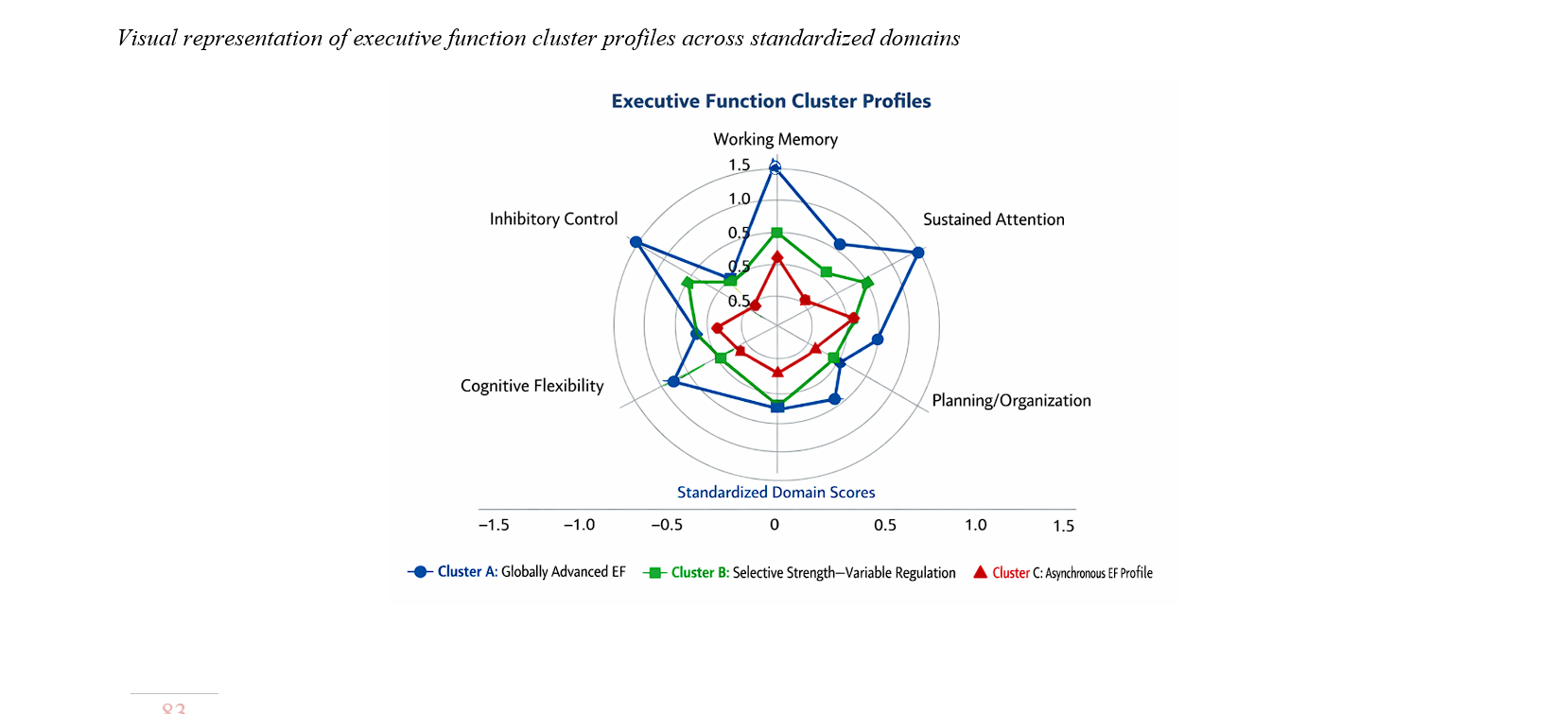
The objective of this study was to identify and characterize distinct executive function profiles among children with exceptional cognitive abilities using unsupervised clustering techniques. This quantitative, cross-sectional study was conducted with a sample of school-aged children with documented exceptional cognitive abilities in South Africa. Executive functions were assessed using a multi-method battery comprising performance-based measures of working memory, inhibitory control, cognitive flexibility, planning, and sustained attention, alongside parent- and teacher-rated executive function scales. Following data screening and standardization, unsupervised clustering analyses were performed using hierarchical and partition-based algorithms to identify naturally occurring executive function patterns. Model fit and cluster validity were evaluated using internal validity indices, and cluster stability was examined through resampling procedures. Unsupervised clustering analyses supported a three-cluster solution, revealing statistically distinct executive function profiles. Multivariate comparisons indicated significant between-cluster differences across all executive function domains, with large effect sizes observed for working memory, inhibitory control, and cognitive flexibility. Cluster membership was significantly associated with classroom engagement and behavioral self-regulation indicators, while age differences across clusters were nonsignificant. The findings demonstrate substantial heterogeneity in executive functioning among children with exceptional cognitive abilities, highlighting the presence of globally advanced, selectively strong, and asynchronous executive function profiles. These results underscore the value of person-centered, data-driven approaches in understanding cognitive regulation in high-ability populations and emphasize the need for individualized assessment and educational support.
Downloads
References
Acikgoz, F., & Karaca, A. (2025). The effect of a mindfulness-based cognitive therapy program on depression, anxiety, stress, and cognitive flexibility in nursing students: A randomized clinical trial. Journal of Professional Nursing, 56(1), 94-103. https://doi.org/10.1016/j.profnurs.2024.12.005
Akman, T. P. (2024). Cognitive Flexibility as a Predictor of Optimism in University Students. Education Mind. https://doi.org/10.58583/em.3.2.10
Azadi Pour, G., & Shoqi, B. (2023). The Effect of Cognitive Flexibility on Subjective Well-being with the Mediation of Wisdom in Second-grade High School Students in Paveh City. Journal of New Ideas in Psychology, 18(22), 1-11. https://www.magiran.com/paper/2702522/the-effect-of-cognitive-flexibility-on-mental-well-being-with-mediation-role-of-wisdom-in-the-second-year-high-school-students-of-paveh-city$?lang=en
Dağgöl, G. D. (2023). Online self-regulated learning and cognitive flexibility through the eyes of English-major students. Acta Educationis Generalis, 13(1), 107-132. https://doi.org/10.2478/atd-2023-0006
Eyinç, A., Tunç, E. N., & SezgİN, E. (2025). The Mediating Role of Cognitive Flexibility i̇n the Relationship Between Altruism and Moral Values of Child Development Students. 6(1), 97-112. https://doi.org/10.70813/ssd.1553840
Fakhrabadi, F. (2023). The Effectiveness of Mindfulness-Based Cognitive Therapy on Cognitive Flexibility and Psychological Well-Being in Middle School Female Students Payame Noor University, Mazandaran Province, Sari Center].
Far, F. T., Ghanadzadegan, H., & Heydari, S. (2024). A Comparison of the Effectiveness of Emotional Cognitive Regulation Strategies and Self-Regulated Learning Strategies on Academic Self-Concept and Cognitive Flexibility in Elementary School Students With Specific Learning Disabilities in Reading. Injoeacs, 5(5), 124-132. https://doi.org/10.61838/kman.ijecs.5.5.14
Karakuş, İ. (2024). University students' cognitive flexibility and critical thinking dispositions. Frontiers in psychology, 15, 1420272. https://doi.org/10.3389/fpsyg.2024.1420272
Khosravi Pour, Z., Toosi, D., & Mazaheri Pour, F. (2024). The Relationship Between Positive School Orientation and Academic Well-being of Students with the Mediating Role of Cognitive Flexibility. Applied Psychological Research, 15(3), 97-112. https://journals.ut.ac.ir/article_98012.html
Mohammadlou, M., Sotoude Asl, N., Ghorbani, R., & Talepasand, S. (2024). The Effectiveness of Cognitive Rehabilitation on Improving Selective Attention, Cognitive Flexibility and Academic Progress of Students with Specific Learning Disorders. Journal of Applied Psychological Research, 15(1), 317-340. https://japr.ut.ac.ir/article_94180.html
Negahdari, S., & Sayf, M. H. (2022). Presenting a causal model of cognitive flexibility and social media addiction: The mediating role of self-efficacy, psychological well-being and cognitive empathy among high school students in Shiraz. Social Cognition, 11(22), 53-65. https://sc.journals.pnu.ac.ir/article_9901.html
Norouzi, H., Hatami, N., & Sadri, D. (2024). The effectiveness of group psychodrama therapy and cognitive-behavioral play therapy on executive functions (working memory, response inhibition, cognitive flexibility, and emotional self-regulation) in male students with social anxiety disorder. Neuropsychology, 9(35), 1-17. https://www.pachjournal.com
Pourjaberi, B., Shirkavand, N., & Ashoori, J. (2023). The Effectiveness of Cognitive Rehabilitation Training on Prospective Memory and Cognitive Flexibility in Individuals with Depression. International Journal of Education and Cognitive Sciences, 4(3), 45-53. https://doi.org/10.61838/kman.ijecs.4.3.5
Sadeghi, F., & Yousofi, Z. (2023). Cognitive flexibility and academic anxiety among Iranian students. https://civilica.com/doc/2054202/
Schäfer, J., Reuter, T., Leuchter, M., & Karbach, J. (2024). Executive functions and problem-solving: The contribution of inhibition, working memory, and cognitive flexibility to science problem-solving performance in elementary school students. Journal of Experimental Child Psychology, 244, 105962. https://doi.org/10.1016/j.jecp.2024.105962
Solati, A. A., Eslami, M., & Ejadi, Z. (2023). Investigating the Effectiveness of Emotional Self-Regulation Skills on Students' Cognitive Flexibility and Working Memory. Journal of Assessment and Research in Applied Counseling (JARAC), 5(3), 113-118. https://doi.org/10.61838/kman.jarac.5.3.15
Solati, A. A., Eslami, M., & Ejadi, Z. (2024). Examining the Effectiveness of Emotional Self-Regulation Skills on Cognitive Flexibility and Working Memory of Students. Jayps, 5(9), 74-80. https://doi.org/10.61838/kman.jayps.5.9.9
Tavakoli, S., Abbasi, F., Heydari, B., & Akhondzadeh, M. (2024). Comparing the Effectiveness of Cognitive Behavioral Play Therapy and Gestalt Play Therapy on Vandalistic Behaviors, Impulsivity, and Cognitive Flexibility in Aggressive Male Elementary Students. Journal of Assessment and Research in Applied Counseling (JARAC), 6(3), 28-36. https://doi.org/10.61838/kman.jarac.6.3.4
Tekin, O. E. (2022). The mediating role of cognitive defusion in the relationship between rumination and psychological flexibility (acceptance) of university students. International Journal of Eurasian Education and Culture, 7(18), 1581-1627. https://doi.org/10.35826/ijoecc.605
Zhao, H., Zhang, Z., & Heng, S. (2024). Grit and college students' learning engagement: Serial mediating effects of mastery goal orientation and cognitive flexibility. Current Psychology, 43(8), 7437-7450. https://doi.org/10.1007/s12144-023-04904-7
Downloads
Additional Files
Publication Timeline
- Submitted
- Revised
- Accepted