Deep Learning–Based Detection of Anxiety and Perfectionism Patterns in High-Ability Youth
DOI:
https://doi.org/10.61838/kman.prien.4968Keywords:
High-ability youth, Anxiety, Perfectionism, Deep learning, Multimodal analysisAbstract
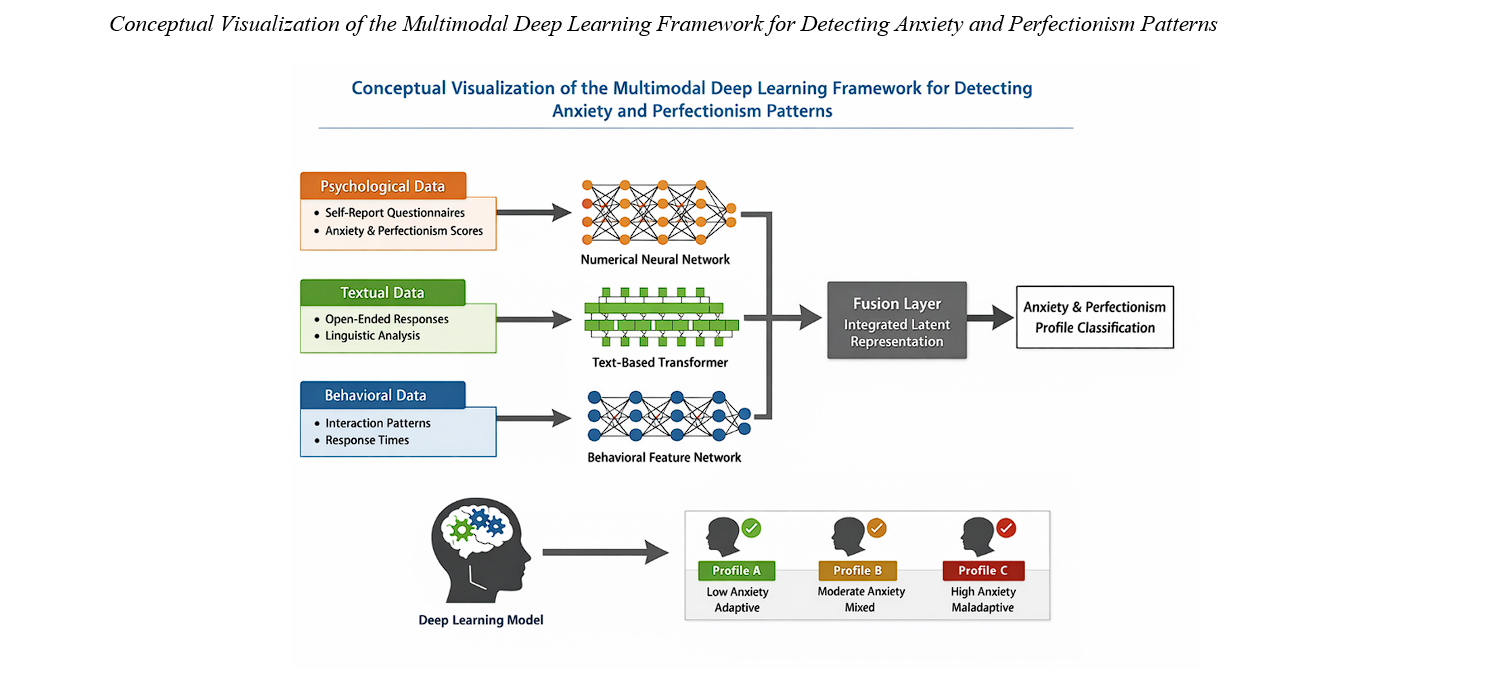
The objective of this study was to identify and classify latent patterns of anxiety and perfectionism among high-ability adolescents using a multimodal deep learning framework. This quantitative, cross-sectional study was conducted on a sample of high-ability youth aged 12 to 18 years in Germany. Participants were recruited from secondary schools and gifted education programs and completed standardized self-report measures assessing anxiety and multidimensional perfectionism through a secure digital platform. In addition to numerical questionnaire data, open-ended textual responses related to academic experiences and self-expectations were collected, along with behavioral interaction indicators such as response times. Data were analyzed using a multimodal deep learning architecture integrating feedforward neural networks for numerical features and transformer-based models for textual data. Feature fusion was performed in a shared latent space, and supervised learning was applied to classify anxiety–perfectionism profiles. Model performance was evaluated using accuracy, precision, recall, F1-score, and area under the receiver operating characteristic curve. Inferential analyses indicated that the multimodal deep learning model significantly outperformed single-modality models in detecting anxiety and perfectionism patterns. Latent profile analysis based on learned representations revealed three distinct psychological profiles: low-anxiety adaptive perfectionism, moderate mixed perfectionism, and high-anxiety maladaptive perfectionism. The high-anxiety maladaptive profile constituted the largest subgroup, and linguistic and behavioral features contributed significantly to classification accuracy beyond self-report measures alone. The findings demonstrate that multimodal deep learning approaches can effectively uncover nuanced and clinically meaningful anxiety–perfectionism profiles in high-ability youth, offering a robust foundation for early identification and targeted psychological support.
Downloads
References
Abazari, R. (2023). The effectiveness of schema therapy in reducing perfectionism in female university entrance exam candidates with test anxiety [Master's thesis, Islamic Azad University, Tiran Branch. https://civilica.com/doc/1764402/
Bahreini Moghim Jiroft, N., Golparvar, M., & Aghaei, A. (2023). Comparison of the Effectiveness of Educational Perfectionism Schema Based Strategies Training with Cognitive Behavior Training on Test Anxiety and Academic Burnout among Female Students with Educational Perfectionism. Journal of Educational Psychology Studies, 20(49), 20-21. https://doi.org/10.22111/jeps.2023.42744.5095
Bakhshi, R., & Sedigh Arfaei, F. (2021). The effectiveness of emotional intelligence training mediated by social self-efficacy on social anxiety and perfectionism of sixth grade elementary school female students. Journal of Educational Psychology Studies, 18(43), 35-17. https://jeps.usb.ac.ir/article_6477.html
Dobos, B., Piko, B. F., & Mellor, D. (2021). What makes university students perfectionists? The role of childhood trauma, emotional dysregulation, academic anxiety, and social support. Scandinavian journal of psychology, 62(3), 443-447. https://doi.org/10.1111/sjop.12718
Esmaeili, M., Tabe Bordbar, F., & Fatemi Haghigi, Z. (2023). The Mediating Role of School Anxiety in the Relationship Between Academic Perfectionism and Academic Self-Concept with Academic Expectations Stress in Students. Research in Educational Systems, 17(63), 86-101. https://www.jiera.ir/article_192972.html?lang=en
Ghasemipour Kordmahalleh, M., & Bazazian, S. (2016). The relationship between parenting styles and perfectionism with social anxiety of gifted students. Quarterly Journal of Behavioral Sciences, 5(15), 101-114. https://journals.iau.ir/article_701920.html
Ghorbannezhad, A. (2022). Prediction of perfectionism dimensions based on positive and negative meta-emotions in students. Journal of Psychological Dynamics in Mood Disorders (PDMD), 1(3), 42-49. https://ijpdmd.com/article_180524.html
Hamblin, E. (2018). Stress in college students: associations with anxiety and perfectionism. https://egrove.olemiss.edu/hon_thesis/320/
Hoshmandi, R., Fatolahhzadeh, N., & Rostami, M. (2019). Comparison of primary school children by perfectionism, anxiety, maternal parenting style and emotional intelligence [Research]. Rooyesh-e-Ravanshenasi Journal(RRJ), 7(12), 183-198. http://frooyesh.ir/article-1-517-en.html
Jafari, F., Mousavi, F., & Emamipour, S. (2015). The Role of Perfectionism and Achievement Goals in Predicting Test Anxiety Among First-Year Female Middle School Students. Educational and Learning Research, 12(2), 65-78. https://www.magiran.com/paper/1527602/the-role-of-perfectionism-goal-orientation-to-predict-of-test-anxiety-in-high-school-girl-students?lang=en
Jeon, E. Y., You, Y.-k., Lee, W.-k., & Yu, E.-y. (2024). The Influences of Maladaptive Perfectionism on Career Anxiety: The Double Mediating Effects of Generalized Anxiety and Conflict Experience With a Professor of Graduate Students. Korean Association for Learner-Centered Curriculum and Instruction, 24(7), 245-261. https://doi.org/10.22251/jlcci.2024.24.7.245
Joukar KamalAbadi, M., Rajabi, S., & Savabet, F. (2021). The Effectiveness of Cyber-Psychology Cognitive Behavioral Training in Reducing Perfectionism and Anxiety in the Student Elite Community. Journal of Applied Psychological Research, 11(4), 317-336. https://japr.ut.ac.ir/article_79963_en.html
Kuftyak, E. V. (2022). Procrastination, stress and academic performance in students. ARPHA Proceedings, 5, 965-974. https://doi.org/10.3897/ap.5.e0965
Macedo, A., Soares, M. J., Amaral, A. P., Nogueira, V., Madeira, N., Roque, C., Marques, M., Maia, B., Bos, S., Valente, J., & Pereira, A. T. (2015). Repetitive negative thinking mediates the association between perfectionism and psychological distress. Personality and individual differences, 72, 220-224. https://doi.org/10.1016/j.paid.2014.08.024
Mohammadi, A., & Roshan Chasli, R. (2020). The relationship between perfectionism and social anxiety symptoms with self-compassion mediation among students studying at Shahed University. Biquarterly Journal of Cognitive Strategies in Learning, 8(15), 161-181.
Mokhlasi, S. (2023). Path analysis of the relationship between perfectionism and binge eating disorder with anxiety as a mediator in female university students Khayyam University, Faculty of Literature and Humanities].
Nam, Y. J., & Lee, B. K. (2020). The Moderating Effects of Coping Style on the Relationship Between Perfectionistic Self- Presentation and Social Anxiety in College Students. Korean Journal of Stress Research, 28(1), 10-16. https://doi.org/10.17547/kjsr.2020.28.1.10
Rajaeinia, A. (2022). Effectiveness of Cognitive Behavior Group Therapy on decreasing perfectionism, increasing positive affect and mental performance in Female Clergies. International Journal of Education and Cognitive Sciences, 2(4), 45-53. https://doi.org/10.22034/injoeas.2022.160688
Rezaei, P., Ilaghi, M., & Masoumian, N. (2024). The Triangle of Anxiety, Perfectionism, and Academic Procrastination: Exploring the Correlates in Medical and Dental Students. BMC Medical Education, 24(1). https://doi.org/10.1186/s12909-024-05145-3
Sattari, M., & Erfani, N. (2019). The Effect of Mindfulness-Based Cognitive Therapy on Negative Perfectionism, Stress, and Anxiety in Female Students of Secondary School. Journal of the Faculty of Medicine, Mashhad University of Medical Sciences, 62(5), 1834-1845. https://mjms.mums.ac.ir/article_17418.html
Sheikhi, G., Rajab Poor, M., & Sheibani, H. (2019). Relationship between Perfectionism and Anxiety and Emotional Cognitive Regulation with Students' Academic Engagement in Payame Noor University of Piranshahr. Irainian Journal of Culture in The Islamic University, 9(2), 271-294. https://www.magiran.com/paper/2047014
Tyler, J. M., Panichelli-Mindel, S. M., Sperrazza, C., & Levitt, M. F. (2019). A Pilot Study Exploring the Relationship Between Perfectionism and Anxiety in an Urban Middle School. Journal of Psychoeducational Assessment, 37(8), 989-1001. https://doi.org/10.1177/0734282918819949
Wang, H. T., & Yu, X. (2024). The Influence of Family Upbringing on Test Anxiety of College Students: The Mediating Role of Perfectionism. Applied & Educational Psychology, 5(3). https://doi.org/10.23977/appep.2024.050314
Zafari, S., & Khademi Ashkzari, M. (2020). The structural model of the role of cognitive emotion regulation strategies, mindfulness and perfectionism in predicting emotional problems in students [Research]. Journal of Psychological Science, 19(87), 321-328. https://doi.org/10.29252/psychosci.19.87.321
Zhao, M., Li, J., Lin, Y., Zhang, B., & Shi, Y. (2022). The effect of perfectionism on test anxiety and the mediating role of sense of coherence in adolescent students. Journal of affective disorders, 310, 142-149. https://www.sciencedirect.com/science/article/pii/S0165032722005110
Downloads
Additional Files
Publication Timeline
- Submitted
- Revised
- Accepted