Differential Effects of Cognitive Load on Working Memory in Students with Linguistic Versus Perceptual Dyslexia
DOI:
https://doi.org/10.61838/kman.prien.5123Keywords:
Working memory, linguistic dyslexia, perceptual dyslexia, N-Back task, cognitive loadAbstract
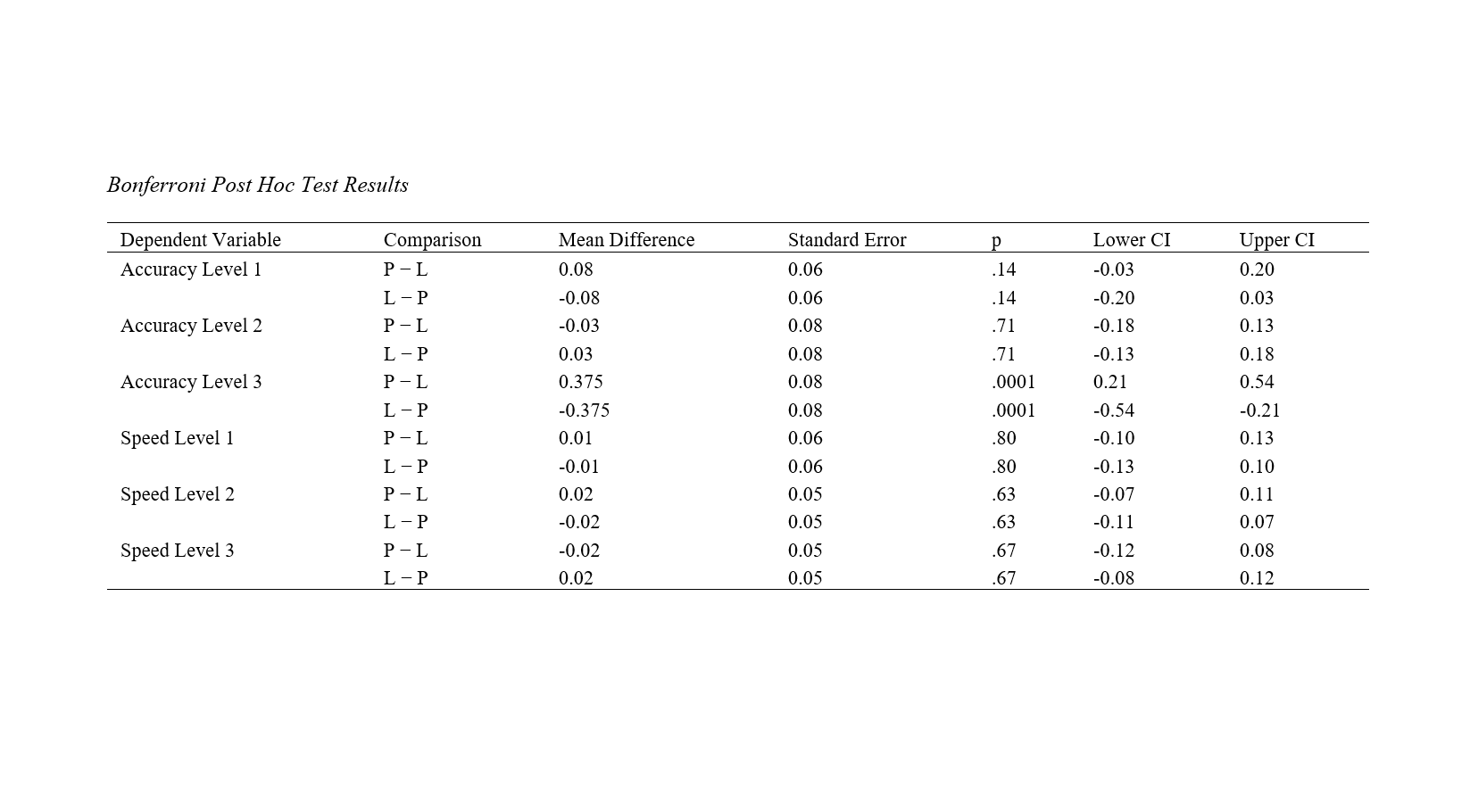
Children with dyslexia do not demonstrate homogeneous neuropsychological characteristics. The present study aimed to compare verbal working memory performance under different levels of cognitive load between two primary dyslexia subgroups, namely perceptual and linguistic types. In this comparative research design, 35 Persian-speaking children aged 7 to 10 years were selected through purposive sampling. Diagnostic and subgroup classification procedures were conducted based on the criteria of the Diagnostic and Statistical Manual of Mental Disorders (DSM-5), the Reading Test (Pour-Etemad & Jahani, 2001), Raven’s Colored Progressive Matrices, the Conners Parent Rating Scale, and the application of Baker’s balance model framework. The primary assessment instrument was a computerized verbal N-Back task. The collected data were analyzed using multivariate analysis of variance (MANOVA). The findings indicated a significant interaction between subgroup type and cognitive load level. Although the performance of the two groups was similar at lower task demands (1-Back and 2-Back conditions), a clear differentiation emerged under high cognitive load conditions (2-Back), such that the accuracy of the perceptual subgroup was significantly higher than that of the linguistic subgroup. These results suggest that verbal working memory deficits in dyslexia are neither global nor stable; rather, they follow a cognitive load–dependent pattern specific to the linguistic subtype. The evidence provides compelling support for the existence of distinct cognitive architectures and underscores the necessity of designing targeted and individualized intervention programs.
Downloads
References
Alt, M., Fox, A., Levy, R., Hogan, T. P., Cowan, N., & Gray, S. (2022). Phonological working memory and central executive function differ in children with typical development and dyslexia. Dyslexia, 28(1), 20-39. https://doi.org/10.1002/dys.1691
American Psychiatric, A. (2013). Diagnostic and statistical manual of mental disorders. https://doi.org/10.1176/appi.books.9780890425596
Baddeley, A. D. (2017). Modularity, working memory and language acquisition. Second Language Research, 33(3), 299-311. https://doi.org/10.1177/0267658317709852
Bildiren, A. (2017). Reliability and Validity Study for the Coloured Progressive Matrices Test between the Ages of 3-9 for Determining Gifted Children in the Pre-School Period. Journal of Education and Training Studies, 5(11), 13-20. https://doi.org/10.11114/jets.v5i11.2570
Cainelli, E., Vedovelli, L., Carretti, B., & Bisiacchi, P. (2023). EEG correlates of developmental dyslexia: A systematic review. Annals of Dyslexia, 73(2), 184-213. https://doi.org/10.1007/s11881-022-00273-1
Carioti, D., Masia, M. F., Travellini, S., & Berlingeri, M. (2021). Orthographic depth and developmental dyslexia: A meta-analytic study. Annals of Dyslexia, 71(3), 399-438. https://doi.org/10.1007/s11881-021-00226-0
Cotton, S. M., Kiely, P. M., Crewther, D. P., Thomson, B., Laycock, R., & Crewther, S. G. (2005). A normative and reliability study for the Raven's Coloured Progressive Matrices for primary school aged children from Victoria, Australia. Personality and individual differences, 39(3), 647-659. https://doi.org/10.1016/j.paid.2005.02.015
Cowan, N. (2012). Working memory capacity. Psychology Press. https://api.taylorfrancis.com/content/books/mono/download?identifierName=doi&identifierValue=10.4324/9780203342398&type=googlepdf
Elgendi, M., Stewart, S. H., MacKay, E. J., & Deacon, S. H. (2021). Two aspects of psychological functioning in undergraduates with a history of reading difficulties: Anxiety and self-efficacy. Annals of Dyslexia, 71(1), 84-102. https://doi.org/10.1007/s11881-021-00221-5
Gadekallu, T. R., Yenduri, G., Kaluri, R., Rajput, D. S., Lakshmanna, K., Fang, K., & Wang, W. (2025). The role of GPT in promoting inclusive higher education for people with various learning disabilities: a review. Peerj Computer Science, 11, e2400. https://doi.org/10.7717/peerj-cs.2400
Gavril, L., Roșan, A., & Szamosközi, Ș. (2021). The role of visual-spatial attention in reading development: A meta-analysis. Cognitive Neuropsychology, 38(6), 387-407. https://doi.org/10.1080/02643294.2021.1969900
Germano, G. D., & Capellini, S. A. (2025). Dyslexia subtypes: Proposition of phonological and visual parameters in the Brazilian population. Caderno Pedagógico, 22(6), e15515. https://doi.org/10.54033/cadpedv22n6-128
Gray, S., Fox, A. B., Green, S., Alt, M., Hogan, T. P., Petscher, Y., & Cowan, N. (2019). Working memory profiles of children with dyslexia, developmental language disorder, or both. Journal of Speech, Language, and Hearing Research, 62(6), 1839-1858. https://doi.org/10.1044/2019_JSLHR-L-18-0148
Hernandez, N., Andersson, F., Edjlali, M., Hommet, C., Cottier, J., Destrieux, C., & Bonnet‐Brilhault, F. (2013). Cerebral functional asymmetry and phonological performance in dyslexic adults. Psychophysiology, 50(12), 1226-1238. https://doi.org/10.1111/psyp.12132
Ivanova, M., Dragoy, O., Kuptsova, S., Akinina, S. Y., Petrushevskii, A., Fedina, O., Turken, A., Shklovsky, V., & Dronkers, N. (2018). Neural mechanisms of two different verbal working memory tasks: A VLSM study. Neuropsychologia, 115, 25-41. https://doi.org/10.1016/j.neuropsychologia.2018.03.003
Leopold, D. R., Kim, H., Carlson, K. W., Rowe, M. A., Groff, B. R., Major, M. P., Willcutt, E. G., Cutting, L. E., & Banich, M. T. (2024). Stimulus shapes strategy: Effects of stimulus characteristics and individual differences in academic achievement on the neural mechanisms engaged during the N-back task. Developmental Cognitive Neuroscience, 66, 101372. https://doi.org/10.1016/j.dcn.2024.101372
Logie, R. H. (2014). Visuo-spatial working memory. Psychology Press. https://api.taylorfrancis.com/content/books/mono/download?identifierName=doi&identifierValue=10.4324/9781315804743&type=googlepdf
Lonergan, A., Doyle, C., Cassidy, C., MacSweeney Mahon, S., Roche, R. A., Boran, L., & Bramham, J. (2019). A meta-analysis of executive functioning in dyslexia with consideration of the impact of comorbid ADHD. Journal of Cognitive Psychology, 31(7), 725-749. https://doi.org/10.1080/20445911.2019.1669606
López-Resa, P., & Moraleda-Sepúlveda, E. (2023). Working memory capacity and text comprehension performance in children with dyslexia and dyscalculia: A pilot study. Frontiers in psychology, 14, 1191304. https://doi.org/10.3389/fpsyg.2023.1191304
Lorusso, M. L., Facoetti, A., & Bakker, D. J. (2011). Neuropsychological treatment of dyslexia: Does type of treatment matter? Journal of Learning Disabilities, 44(2), 136-149. https://doi.org/10.1177/0022219410391184
Lorusso, M. L., & Toraldo, A. (2023). Revisiting multifactor models of dyslexia: Do they fit empirical data and what are their implications for intervention? Brain Sciences, 13(2), 328. https://doi.org/10.3390/brainsci13020328
Maehler, C., & Schuchardt, K. (2016). Working memory in children with specific learning disorders and/or attention deficits. Learning and Individual Differences, 49, 341-347. https://doi.org/10.1016/j.lindif.2016.05.007
Mencarelli, L., Neri, F., Momi, D., Menardi, A., Rossi, S., Rossi, A., & Santarnecchi, E. (2019). Stimuli, presentation modality, and load‐specific brain activity patterns during n‐back task. Human Brain Mapping, 40(13), 3810-3831. https://doi.org/10.1002/hbm.24633
Nevo, E., & Bar‐Kochva, I. (2015). The relations between early working memory abilities and later developing reading skills: A longitudinal study from kindergarten to fifth grade. Mind, Brain, and Education, 9(3), 154-163. https://doi.org/10.1111/mbe.12089
O’Brien, G., & Yeatman, J. D. (2021). Bridging sensory and language theories of dyslexia: Toward a multifactorial model. Developmental science, 24(3), e13039. https://doi.org/10.1111/desc.13039
Owen, A. M., McMillan, K. M., Laird, A. R., & Bullmore, E. (2005). N‐back working memory paradigm: A meta‐analysis of normative functional neuroimaging studies. Human Brain Mapping, 25(1), 46-59. https://doi.org/10.1002/hbm.20131
Peng, P., Barnes, M., Wang, C., Wang, W., Li, S., Swanson, H. L., Dardick, W., & Tao, S. (2018). A meta-analysis on the relation between reading and working memory. Psychological bulletin, 144(1), 48-76. https://doi.org/10.1037/bul0000124
Peters, J. L., De Losa, L., Bavin, E. L., & Crewther, S. G. (2019). Efficacy of dynamic visuo-attentional interventions for reading in dyslexic and neurotypical children: A systematic review. Neuroscience & Biobehavioral Reviews, 100, 58-76. https://doi.org/10.1016/j.neubiorev.2019.02.015
Pham, A. V., & Hasson, R. M. (2014). Verbal and visuospatial working memory as predictors of children's reading ability. Archives of Clinical Neuropsychology, 29(5), 467-477. https://doi.org/10.1093/arclin/acu024
Rasouli Foshtami, A., Hashemi, T., Kiamarsi, A., & Ghaffari, A. (2022). Determination of psychometric indicators and standardization of intelligence test of children's raven colored progressive matrices in elementary school students. Quarterly Journal of Child Mental Health, 9(1), 158-175. https://doi.org/10.52547/jcmh.9.1.11
Rottschy, C., Langner, R., Dogan, I., Reetz, K., Laird, A. R., Schulz, J. B., Fox, P. T., & Eickhoff, S. B. (2012). Modelling neural correlates of working memory: A coordinate-based meta-analysis. NeuroImage, 60(1), 830-846. https://doi.org/10.1016/j.neuroimage.2011.11.050
Sakhai, F., Mazaheri, S., Golmohammadi, G., & Asadollahpour, F. (2025). Prevalence of developmental dyslexia among primary school children in Iran: A systematic review and meta-analysis. Iranian Journal of Psychiatry, 20(2), 223-235. https://doi.org/10.18502/ijps.v20i2.17096
Shany, M., Asadi, I., & Share, D. L. (2023). Accuracy-disability versus rate-disability subtypes of dyslexia: A validation study in Arabic. Scientific Studies of Reading, 27(2), 136-159. https://doi.org/10.1080/10888438.2022.2136511
Shao, J., Cui, Z., & Bao, Y. (2025). Adaptive sports programs as catalysts for social inclusion and cognitive flexibility in inclusive physical education: The mediating roles of emotional resilience and empathy. BMC psychology, 13(1), 770. https://doi.org/10.1186/s40359-025-03092-2
Stein, J. (2019). The current status of the magnocellular theory of developmental dyslexia. Neuropsychologia, 130, 66-77. https://doi.org/10.1016/j.neuropsychologia.2018.03.022
Tarabya, B. M., Andria, S., & Khateb, A. (2025). Reading subtyping of Arabic-speaking university students: A contribution to the accuracy vs. rate model of dyslexia. Annals of Dyslexia. https://link.springer.com/article/10.1007/s11881-025-00323-4
Vandermosten, M., Boets, B., Luts, H., Poelmans, H., Golestani, N., Wouters, J., & Ghesquière, P. (2010). Adults with dyslexia are impaired in categorizing speech and nonspeech sounds on the basis of temporal cues. Proceedings of the National Academy of Sciences, 107(23), 10389-10394. https://doi.org/10.1073/pnas.0912858107
Vidyasagar, T. R. (2019). Visual attention and neural oscillations in reading and dyslexia: Are they possible targets for remediation? Neuropsychologia, 130, 59-65. https://doi.org/10.1016/j.neuropsychologia.2019.02.009
Wang, J., Huo, S., Wu, K. C., Mo, J., Wong, W. L., & Maurer, U. (2022). Behavioral and neurophysiological aspects of working memory impairment in children with dyslexia. Scientific reports, 12(1), 12571. https://doi.org/10.1038/s41598-022-16878-w
Wang, S., Allen, R. J., Lee, J. R., & Hsieh, C. E. (2015). Evaluating the developmental trajectory of the episodic buffer component of working memory and its relation to word recognition in children. Journal of Experimental Child Psychology, 133, 16-28. https://doi.org/10.1016/j.jecp.2015.01.002
Ziegler, J. C., Perry, C., & Zorzi, M. (2020). Learning to read and dyslexia: From theory to intervention through personalized computational models. Current Directions in Psychological Science, 29(3), 293-300. https://doi.org/10.1177/0963721420915873
Downloads
Additional Files
Publication Timeline
- Submitted
- Revised
- Accepted