The Relationship of Responsibility, Self-Esteem, and Peer Interaction with Perceived Social Competence in Gifted Students
DOI:
https://doi.org/10.61838/kman.prien.5402Keywords:
responsibility, self-esteem, peer interaction, perceived social competence, gifted studentsAbstract
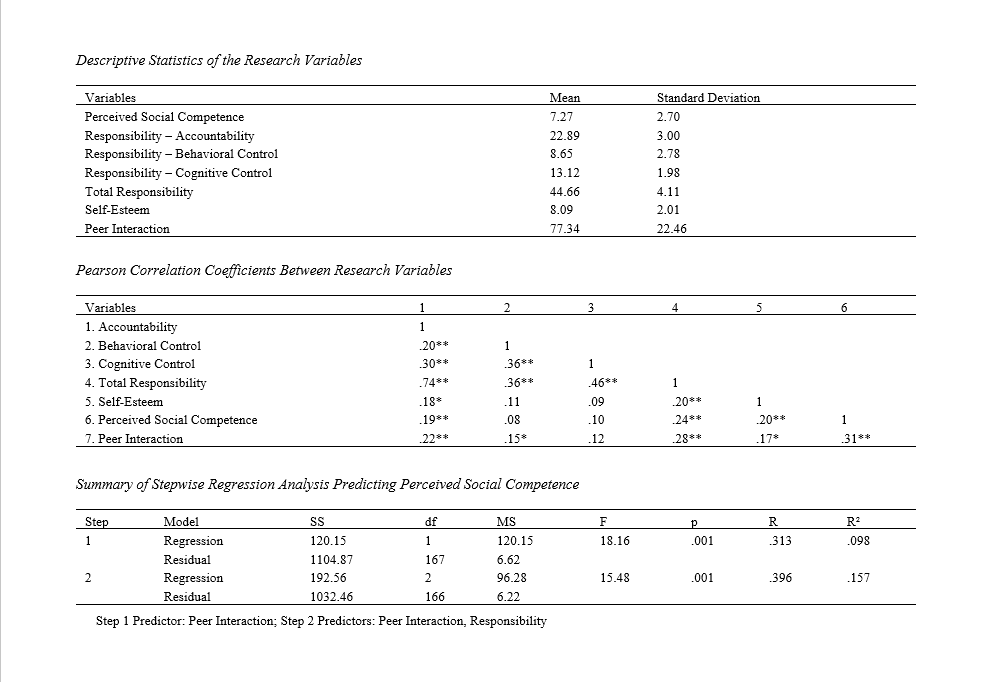
The present study was conducted to investigate the relationship between responsibility, self-esteem, and peer interaction with perceived social competence among gifted students. The statistical sample consisted of 169 gifted male middle school students who were selected through purposive sampling. Data were collected using the Responsibility Questionnaire, Self-Esteem Questionnaire, Peer Interaction Questionnaire, and Perceived Social Competence Questionnaire. Responsibility, self-esteem, and peer interaction were significantly associated with the perceived social competence of gifted students. Furthermore, responsibility and self-esteem had direct effects, whereas peer interaction had an indirect effect on the perceived social competence of these students. These findings may be useful in designing educational and counseling programs aimed at enhancing the social competence of gifted students. Considering the importance of social competence in the academic success and overall life outcomes of gifted students, the present study examined the role of cognitive, emotional, and social factors in this domain. The findings of this study may contribute to the development of effective strategies for improving the social competence of gifted students.
Downloads
References
Al-Shammari, Q. A., & Al-Arfaj, A. H. A. (2022). Envisioned Intellectuals. International journal of health sciences, 3445-3462. https://doi.org/10.53730/ijhs.v6ns9.13344
Aydin, Y. E., ÇOk, R., DengİZ, G., & TunÇ, E. (2022). Investigation of Peer Relationships of Gifted and Non-Gifted High School Students. Kastamonu Eğitim Dergisi, 30(1), 236-250. https://doi.org/10.24106/kefdergi.685221
Bean, B. M., & Rickert, N. P. (2024). The Impact of Academic Development Structures on Self-Perception: Honors Versus Nonhonors University Students. Journal of Advanced Academics, 35(3), 392-411. https://doi.org/10.1177/1932202x241237281
Cash, T. N., & Lin, T. J. (2021). Psychological Well-Being of Intellectually and Academically Gifted Students in Self-Contained and Pull-Out Gifted Programs. Gifted Child Quarterly, 66(3), 188-207. https://doi.org/10.1177/00169862211032987
Coutinho-Souto, W. K. S., & Fleith, D. d. S. (2022). Giftedness and ADHD: A Systematic Literature Review. Revista de Psicología, 40(2), 1175-1211. https://doi.org/10.18800/psico.202202.019
Dimitrijević, A. A., Šimon, J., Marjanović, Z. J., & Podlešek, A. (2025). Teachers’ Views of Academically Gifted Students Through the Lens of the COVID-19 Pandemic: A Qualitative Study in Three Countries. Gifted Child Quarterly, 69(4), 351-366. https://doi.org/10.1177/00169862241302823
García, A. M. C., Llopis-Bueno, M. J., & Insa, L. I. L. (2021). Emotional Intelligence Profiles and Self-Esteem/Self-Concept: An Analysis of Relationships in Gifted Students. International journal of environmental research and public health, 18(3), 1006. https://doi.org/10.3390/ijerph18031006
Jawabreh, R., Danju, İ., & Salha, S. (2022). Exploring the Characteristics of Gifted Pre-School Children: Teachers’ Perceptions. Sustainability, 14(5), 2514. https://doi.org/10.3390/su14052514
Kara, E., & Aslan, H. (2025). Cyber Victimization and Subjective Well-Being: Protective Roles of Self-Esteem and Social Support Among Turkish Gifted Youths. BMC psychology, 13(1). https://doi.org/10.1186/s40359-025-02636-w
Kaymakci, G., & Tonbul, B. G. (2024). Investigation of Psychological Resilience in Gifted Adolescents. Maarif Mektepleri Uluslararası Eğitim Bilimleri Dergisi, 8(1), 1-25. https://doi.org/10.46762/mamulebd.1373473
Klarin, M., Šašić, S. Š., & Proroković, A. (2023). The Social, Cognitive and Socio-Demographic Profile of Potentially Gifted Children. Revija Za Elementarno Izobraževanje. https://doi.org/10.18690/rei.3116
Lee, H. (2024). Academic and Affective Effects of Enrichment Programs From Parents’ Perspectives. Adv Res Sci, 2(2), 1-10. https://doi.org/10.54026/ars/1020
Makkonen, T., Lavonen, J., & Tirri, K. (2022). Factors That Help or Hinder the Development of Talent in Physics: A Qualitative Study of Gifted Finnish Upper Secondary School Students. Journal of Advanced Academics, 33(4), 507-539. https://doi.org/10.1177/1932202x221111828
Maralani, F. M., & Pfeiffer, S. I. (2024). The Unique Social-Emotional Challenges That Bright Immigrant Youth Face. Gifted Education International, 41(1), 137-157. https://doi.org/10.1177/02614294241279354
Mohamed, A., & Elhoweris, H. (2022). Perceptions of Preschool Teachers of the Characteristics of Gifted Learners in Abu Dhabi: A Qualitative Study. Frontiers in psychology, 13. https://doi.org/10.3389/fpsyg.2022.1051697
Nannings, M., Weerdenburg, M. v., Petrie, J. A. C. v. d. Z., & Hoogeveen, L. (2025). Social–Emotional and Educational Needs of Higher Education Students With High Abilities: A Systematic Review. Behavioral Sciences, 15(6), 819. https://doi.org/10.3390/bs15060819
Papadopoulos, D. (2021a). Examining the Relationships Among Cognitive Ability, Domain-Specific Self-Concept, and Behavioral Self-Esteem of Gifted Children Aged 5–6 Years: A Cross-Sectional Study. Behavioral Sciences, 11(7), 93. https://doi.org/10.3390/bs11070093
Papadopoulos, D. (2021b). Parenting the Exceptional Social-Emotional Needs of Gifted and Talented Children: What Do We Know? Children, 8(11), 953. https://doi.org/10.3390/children8110953
Park, H., Chang, T. F., & Qin, D. B. (2024). Adjustment and Family Dynamics Among Academically Gifted Chinese and European American Adolescents. Family Relations, 73(3), 1860-1879. https://doi.org/10.1111/fare.12993
Raoof, K., Shokri, O., Fathabadi, J., & Panaghi, L. (2024). Unpacking the Underachievement of Gifted Students: A Systematic Review of Internal and External Factors. Heliyon, 10(17), e36908. https://doi.org/10.1016/j.heliyon.2024.e36908
Saß, S., Köller, O., & Zimmermann, F. (2025). Smart but Maladapted? Differences in the Psychological Functioning of Intellectually Gifted Students Compared With Average-Ability Students. Gifted Child Quarterly, 69(3), 219-236. https://doi.org/10.1177/00169862241310871
Slobodin, O., Prior, Y. M., Noufi, T., & Pinson, H. (2025). Family Income and Parental Perceptions of Gifted Education: The Mediating Role of Parents’ Trust in Their Child’s Resilience. Gifted Child Quarterly, 70(1), 20-34. https://doi.org/10.1177/00169862251343632
Snyder, F., & Khan, F. (2024). Character Strengths: Theory and Intervention. Gifted Education International, 41(1), 76-91. https://doi.org/10.1177/02614294241292913
Svendsen, B., & Burner, T. (2023). Gifted Students and Gradeless Formative Assessment: A Case Study From Norway. Journal for the Education of the Gifted, 46(3), 259-275. https://doi.org/10.1177/01623532231180883
Tourreix, E., Besançon, M., & Gonthier, C. (2023). Non-Cognitive Specificities of Intellectually Gifted Children and Adolescents: A Systematic Review of the Literature. Journal of Intelligence, 11(7), 141. https://doi.org/10.3390/jintelligence11070141
Verma, G. S., & Thakur, R. (2024). A Study to Assess the Effectiveness of a Tailored Psychosocial Intervention on Self-Esteem of Adolescents Studying in Selected High Schools of Jabalpur. International Journal of Advanced Psychiatric Nursing, 6(1), 19-23. https://doi.org/10.33545/26641348.2024.v6.i1a.142
Watts, J. (2022). Elementary-Age Gifted Males’ Self-Perceptions of Giftedness and School Practices. Journal of Education, 204(1), 44-57. https://doi.org/10.1177/00220574221088503
Zanetti, M. A., Intra, F. S., Taverna, L., Brighi, A., & Marinoni, C. (2024). The Influence of Gifted Children’s Stress Management on Parental Stress Levels. Children, 11(5), 538. https://doi.org/10.3390/children11050538
Downloads
Additional Files
Publication Timeline
- Submitted
- Revised
- Accepted