CatBoost Prediction of Social Anxiety Among Students with Specific Learning Disabilities: Contributions of Rejection Sensitivity, Self-Compassion, and Peer Victimization
DOI:
https://doi.org/10.61838/kman.prien.5423Keywords:
Social Anxiety, Specific Learning Disabilities, Rejection Sensitivity, Self-Compassion, Peer VictimizationAbstract
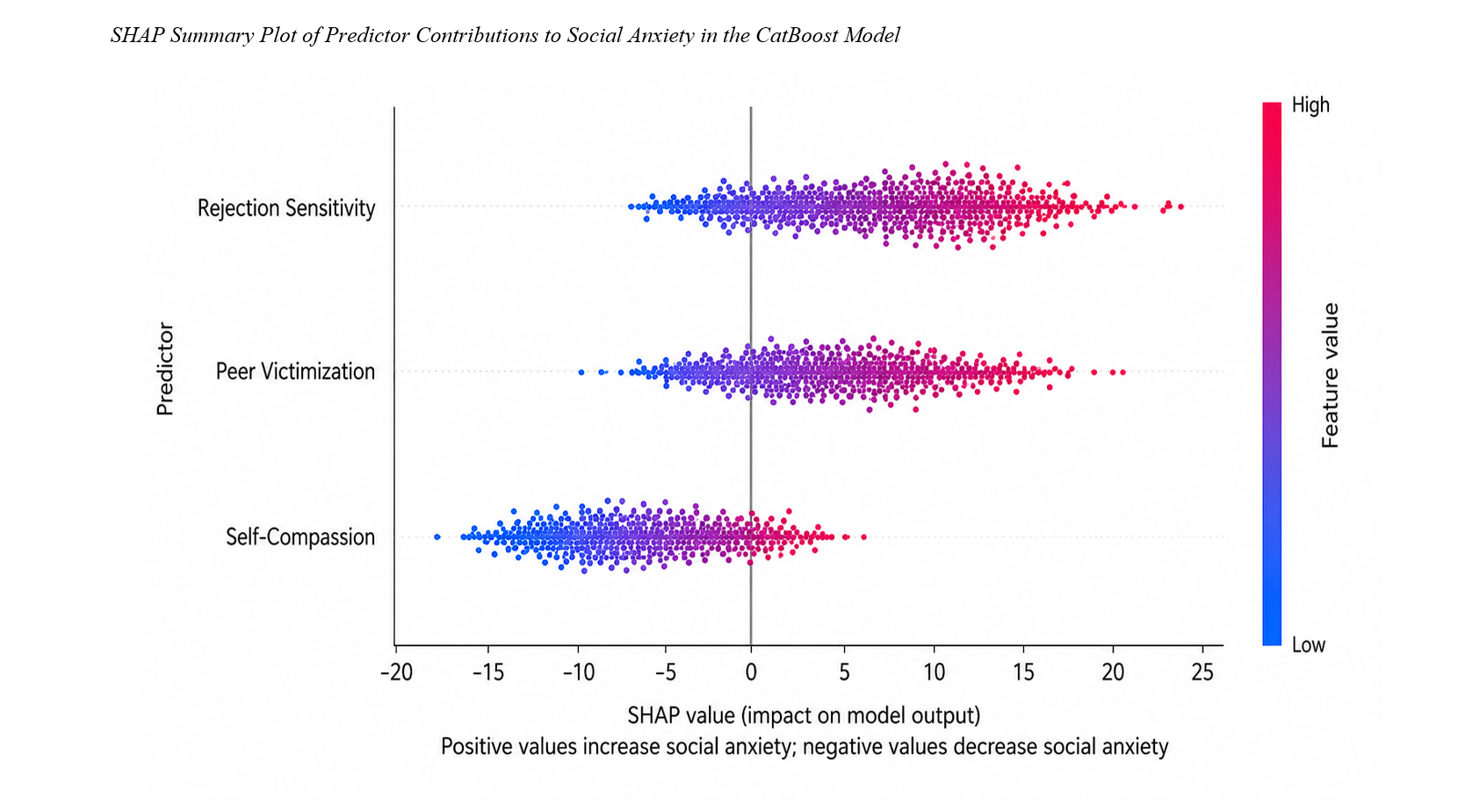
The present study aimed to develop and evaluate a CatBoost machine learning model for predicting social anxiety among students with specific learning disabilities based on rejection sensitivity, self-compassion, and peer victimization, while determining the relative contribution of each predictor to model performance. This cross-sectional predictive study was conducted among 428 students with specific learning disabilities enrolled in secondary schools in Santiago, Chile. Participants completed standardized measures assessing social anxiety, rejection sensitivity, self-compassion, and peer victimization. Following data preprocessing and preliminary statistical analyses, a CatBoost machine learning algorithm was implemented to predict social anxiety levels. The dataset was divided into training (80%) and testing (20%) subsets, and hyperparameter optimization was performed using five-fold cross-validation. Model performance was evaluated using the coefficient of determination (R²), root mean square error (RMSE), mean absolute error (MAE), and mean absolute percentage error (MAPE). Feature importance analysis and SHAP (Shapley Additive Explanations) values were calculated to identify the relative influence and directional effects of the predictors. The CatBoost model demonstrated strong predictive performance, accounting for 81.2% of the variance in social anxiety scores within the testing dataset (R² = .812). The model yielded low prediction errors (RMSE = 5.08, MAE = 3.94, MAPE = 8.46%), indicating high accuracy and generalizability. Feature importance analysis revealed that rejection sensitivity was the strongest predictor of social anxiety (41.82%), followed by peer victimization (34.67%) and self-compassion (23.51%). SHAP analyses showed that higher levels of rejection sensitivity and peer victimization were associated with increased social anxiety, whereas higher self-compassion was associated with lower social anxiety. Correlational analyses further indicated significant positive associations between social anxiety, rejection sensitivity, and peer victimization, alongside a significant negative association between social anxiety and self-compassion. The findings demonstrate that social anxiety among students with specific learning disabilities is strongly influenced by interpersonal vulnerability factors and psychological resilience resources. Rejection sensitivity and peer victimization represent significant risk factors, whereas self-compassion serves as an important protective factor. CatBoost modeling provides an effective and interpretable approach for identifying students at risk and may support the development of targeted school-based prevention and intervention programs aimed at improving emotional well-being and social functioning.
Downloads
References
Agoglia, I. S. (2022). If Not Now, When? Reclaiming Academic Journals as a Space of Kindness. Journal of Cognitive Historiography, 7(1-2). https://doi.org/10.1558/jch.23400
Ahmed, G. K., Metwaly, N. A., Elbeh, K., Galal, M. S., & Shaaban, I. (2022). Risk Factors of School Bullying and Its Relationship With Psychiatric Comorbidities: A Literature Review. The Egyptian Journal of Neurology Psychiatry and Neurosurgery, 58(1). https://doi.org/10.1186/s41983-022-00449-x
Aledeh, M., Sokan‐Adeaga, A. A., Adam, H., Aledeh, S., & Kotera, Y. (2024). Suggesting Self-Compassion Training in Schools to Stop Cyberbullying: A Narrative Review. Discover Psychology, 4(1). https://doi.org/10.1007/s44202-023-00110-5
Bemmouna, D., & Weiner, L. (2023). Linehan’s Biosocial Model Applied to Emotion Dysregulation in Autism: A Narrative Review of the Literature and an Illustrative Case Conceptualization. Frontiers in Psychiatry, 14. https://doi.org/10.3389/fpsyt.2023.1238116
Finardi, G., Paleari, F. G., & Fincham, F. D. (2022). Parenting a Child With Learning Disabilities: Mothers’ Self-Forgiveness, Well-Being, and Parental Behaviors. Journal of Child and Family Studies, 31(9), 2454-2471. https://doi.org/10.1007/s10826-022-02395-x
Gagliano, A., Costanza, C., Modica, I. D., Carucci, S., Donno, F., Germanò, E., Abbate, C. S., Roccella, M., & Vetri, L. (2024). Neurodevelopmental Disorders and Suicide: A Narrative Review. Journal of clinical medicine, 13(6), 1627. https://doi.org/10.3390/jcm13061627
García, I. S., Valera-Pozo, M., Sanchez-Azanza, V. A., Adrover‐Roig, D., & Aguilar‐Mediavilla, E. (2021). Associations Between Self, Peer, and Teacher Reports of Victimization and Social Skills in School in Children With Language Disorders. Frontiers in psychology, 12. https://doi.org/10.3389/fpsyg.2021.718110
Gordon, H. R., & Levesque, A. (2025). School Cultures, Peer Cultures, and Inequality: Gender in K‐12 Schooling. Sociology Compass, 19(9). https://doi.org/10.1111/soc4.70112
Harsono, C. S., & Febriyana, N. (2026). Understanding and Addressing Bullying in Children and Adolescents. Journal of Korean Academy of Child and Adolescent Psychiatry, 37(1), 51-62. https://doi.org/10.5765/jkacap.250040
Hesselink, A. (2023). Adverse Childhood Experiences (ACEs) and the Link to Antisocial, Delinquent, and Criminal Behaviors. https://doi.org/10.5772/intechopen.1001823
Hui, y., Huang, J., Xie, Z., & Wáng, Y. (2026). The Longitudinal Association Between Peer Victimization and Adolescent Depression: A Moderated Mediation Model. https://doi.org/10.21203/rs.3.rs-8615948/v1
K., S., T., N., & A., A. (2023). The Impact of Traditional Bullying on Adolescent Mental Health: A Comprehensive Review. International Journal for Multidisciplinary Research, 5(3). https://doi.org/10.36948/ijfmr.2023.v05i03.4138
Kiing, J. S. H., Ragen, E. S., Sulaiman, M., Goh, W. S., Tan, N. J. H., Ng, S. H., Luo, Y., Samuel, M., Young, D., & Loh, V. W. K. (2025). Bullying and Depression Among Adolescents in East Asia: A Scoping Review on Prevalence Rates, Risk and Protective Factors. Frontiers in Psychiatry, 16. https://doi.org/10.3389/fpsyt.2025.1497866
Li, M. (2025). Challenges in Inclusion: Peer Acceptance, Rejection, Belonging and Bullying Among SEND Students in Chinese Rural Schools. Journal of Research in Special Educational Needs, 25(4), 1237-1251. https://doi.org/10.1111/1471-3802.70040
Luoma, J. B., Shahar, B., Lear, M. K., Pilecki, B., & Wagner, A. C. (2021). Potential Processes of Change in MDMA‐Assisted Therapy for Social Anxiety Disorder: Enhanced Memory Reconsolidation, Self‐transcendence, and Therapeutic Relationships. Human Psychopharmacology Clinical and Experimental, 37(3). https://doi.org/10.1002/hup.2824
Marini, M., Filippo, G. D., Bonuomo, M., Torregiani, G., & Livi, S. (2023). Perceiving Oneself to Be Integrated Into the Peer Group: A Protective Factor Against Victimization in Children With Learning Disabilities. Brain Sciences, 13(2), 263. https://doi.org/10.3390/brainsci13020263
Meiri, Elwaleed, Abdalla, Aldawsari, Haifa, & Sh. (2024). Effect of Self-Compassion on Physical Deformities in Adolescents Considering Some Variables. Evolutionary Studies in Imaginative Culture, 1427-1437. https://doi.org/10.70082/esiculture.vi.1360
Meiri, E. A. F., & Aldawsari, H. (2024). The Relationship Between Self-Compassion and Symptoms of Physical Deformities in Adolescents. International Journal of Religion, 5(10), 62-70. https://doi.org/10.61707/k7jrbm31
Mihaela-Corina, B. (2022). Prevention of Bullying in Educational Institutions. International Journal of Legal and Social Order, 1(1). https://doi.org/10.55516/ijlso.v1i1.62
Múzquiz, J., García, A. M. P., & Bermúdez, J. (2022). Relationship Between Direct and Relational Bullying and Emotional Well-Being Among Adolescents: The Role of Self-Compassion. Current Psychology, 42(18), 15874-15882. https://doi.org/10.1007/s12144-022-02924-3
Qiu, T., Wang, S., Hu, D., Feng, N., & Cui, L. (2024). Predicting Risk of Bullying Victimization Among Primary and Secondary School Students: Based on a Machine Learning Model. Behavioral Sciences, 14(1), 73. https://doi.org/10.3390/bs14010073
Seabra, D., Gato, J., Petrocchi, N., & Salvador, M. d. C. (2023). Shame Experiences and Psychopathology: The Mediating Role of Self-Compassion and Social Support in Sexual Minority Individuals. Journal of Evidence-Based Psychotherapies, 22(1), 137-152. https://doi.org/10.24193/jebp.2023.1.6
Serenity, K., Komariah, M., & Sriati, A. (2023). The Implementation of Mindfulness-Based Intervention to Overcome Anxiety in Adolescents: A Narrative Review. Real in Nursing Journal, 6(2), 110. https://doi.org/10.32883/rnj.v6i2.2472
Shen, Y., Zhou, Y., Ren, S., Li, Y., Li, Y., Zhou, R., Fan, X., & Xie, G. (2025). Relations Between Peer Bullying and Adolescent Depression: The Mediating Effect of Cellphone Usage. Frontiers in Psychiatry, 16. https://doi.org/10.3389/fpsyt.2025.1486628
SoĞAnci, S., & Kulesza, E. (2023). Psychosocial Effects of Dyslexia in Terms of Students, Parents, and School Community– Research Review. Turkish Journal of Special Education Research and Practice, 5(1), 1-17. https://doi.org/10.37233/trsped.2023.0134
Sood, A. K., Sharma, D., Sharma, M., & Dey, R. (2024). Prevalence and Repercussions of Stress and Mental Health Issues on Primary and Middle School Students: A Bibliometric Analysis. Frontiers in Psychiatry, 15. https://doi.org/10.3389/fpsyt.2024.1369605
Sun, S., Guy, A. A., Zelaya, D. G., & Operario, D. (2022). Mindfulness for Reducing Minority Stress and Promoting Health Among Sexual Minority Men: Uncovering Intervention Principles and Techniques. Mindfulness, 13(10), 2473-2487. https://doi.org/10.1007/s12671-022-01973-w
Sutherland, O. (2025). Determinants of Anxiety in Neurodivergent and Functionally Disabled Youth: Findings From Growing Up in New Zealand. Neurodiversity, 3. https://doi.org/10.1177/27546330251378646
Weinberg, J. R., & Cooper, J. M. (2025). Providing LGBTQIA+ Affirming Mental Health Services in Schools: A Cultural Adaptation of Dialectical Behavior Therapy Skills Training for Emotional Problem Solving for Adolescents (DBT STEPS-A). School Psychology, 40(2), 159-172. https://doi.org/10.1037/spq0000665
Downloads
Additional Files
Publication Timeline
- Submitted
- Revised
- Accepted