The Mediating Role of Islamic Lifestyle in the Relationship Between Social Media Use and Sleep Disorder with Academic Achievement
DOI:
https://doi.org/10.61838/kman.prien.5500Keywords:
Social Media Use, Sleep Disorder, Islamic Lifestyle, Academic Achievement, AdolescentsAbstract
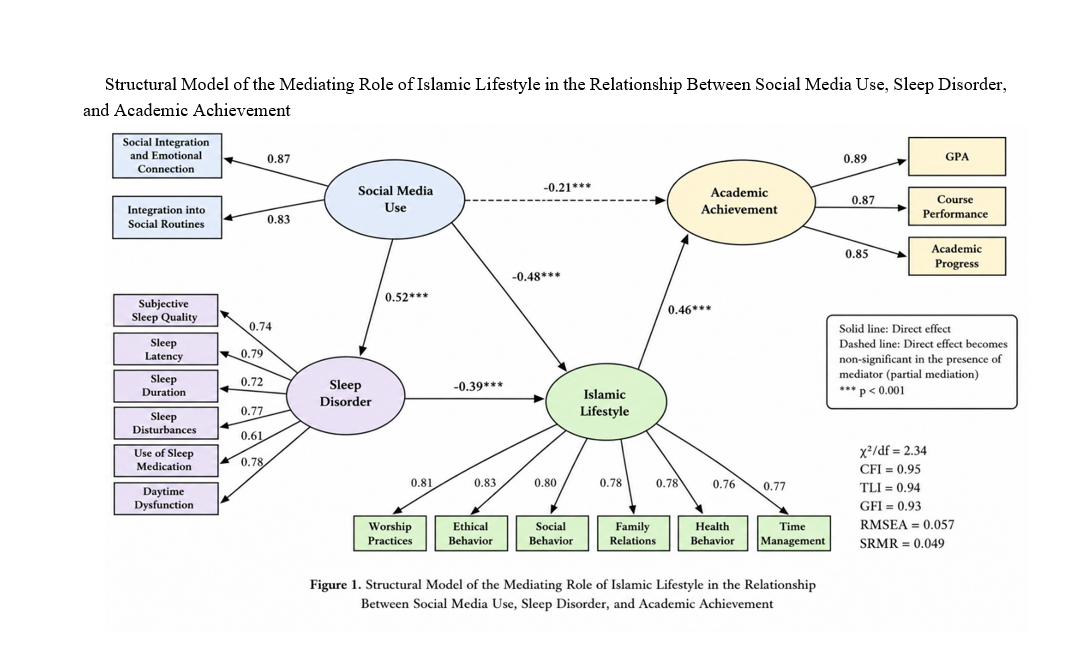
The present study aimed to investigate the mediating role of Islamic lifestyle in the relationship between social media use and sleep disorder with academic achievement among high school students in Tehran. This study was conducted using a descriptive-correlational design based on structural equation modeling. The statistical population included high school students in Tehran during the 2025–2026 academic year, from whom 420 students were selected using multistage cluster sampling. Data were collected using the Social Media Use Integration Scale developed by Jenkins-Guarnieri et al. (2013), the Pittsburgh Sleep Quality Index developed by Buysse et al. (1989), and the Islamic Lifestyle Questionnaire developed by Kaviani (2010). Academic achievement was assessed through students’ grade point averages obtained from school records. Data analysis was performed using SPSS-27 and AMOS-24 software through descriptive statistics, Pearson correlation coefficients, and structural equation modeling. The findings demonstrated that social media use had a significant positive effect on sleep disorder (β = 0.52, p < 0.001) and a significant negative effect on Islamic lifestyle (β = -0.48, p < 0.001). Sleep disorder significantly and negatively predicted academic achievement (β = -0.39, p < 0.001), whereas Islamic lifestyle had a significant positive effect on academic achievement (β = 0.46, p < 0.001). Furthermore, the indirect effect of social media use on academic achievement through Islamic lifestyle was statistically significant (β = -0.18, p < 0.001), confirming the mediating role of Islamic lifestyle in the proposed model. The structural model demonstrated satisfactory fit indices (CFI = 0.95, RMSEA = 0.057, χ²/df = 2.34). The findings indicate that excessive social media use and sleep disorder negatively influence students’ academic achievement, while Islamic lifestyle serves as a protective and mediating factor that enhances behavioral regulation and educational functioning.
Downloads
References
Abolfathi, M., Dehdari, T., Zamani‐Alavijeh, F., Taghdisi, M. H., Ashtarian, H., Rezaei, M., & Irandoost, S. F. (2022). Identification of the Opportunities and Threats of Using Social Media Among Iranian Adolescent Girls. Heliyon, 8(4), e09224. https://doi.org/10.1016/j.heliyon.2022.e09224
Akulwar-Tajane, I., Parmar, K. K., Naik, P. H., & Shah, A. V. (2020). Rethinking Screen Time During COVID-19: Impact on Psychological Well-Being in Physiotherapy Students. International Journal of Clinical and Experimental Medicine Research, 4(4), 201-216. https://doi.org/10.26855/ijcemr.2020.10.014
Al‐Thani, H. (2024). Exploring the Challenges and Prospects for Sustainable Wellbeing in Qatar: Stakeholder Perspectives. https://doi.org/10.20944/preprints202405.1273.v1
Ali, Z., Janarthanan, J., & Mohan, P. (2024). Understanding Digital Dementia and Cognitive Impact in the Current Era of the Internet: A Review. Cureus. https://doi.org/10.7759/cureus.70029
AlSaqqaf, A., Ali, A., Yakup, H., Tanis, R., Chuan, H., Ibrahim, F., & Hu, K. (2024). Technology as a Threat to Local Values and Culture Among Students: A Case Study in Sabah, Malaysia. International Journal of Social Science Research, 12(2), 385. https://doi.org/10.5296/ijssr.v12i2.22117
amoumri, A. e. (2025). Late-Night Digital Engagement, Academic Fatigue, and Their Impact on Academic Performance Among Moroccan Secondary Students. https://doi.org/10.21203/rs.3.rs-7837474/v1
Chen, G. Y. (2024). Impact of Internet Usage and Video Gaming on the Academic Performance of Postgraduate Students in a Prestigious Taiwanese University. https://doi.org/10.2139/ssrn.4772917
Chia, M., Komar, J., Chua, T. B. K., & Tay, L. Y. (2022). Associations Between Parent Attitudes and on- And Off-Screen Behaviours of Preschool Children in Singapore. International journal of environmental research and public health, 19(18), 11508. https://doi.org/10.3390/ijerph191811508
Cremasco, M. M., Mulasso, A., Moroni, A., Testa, A., Degan, R., Rainoldi, A., & Rabaglietti, E. (2021). Relation Among Perceived Weight Change, Sedentary Activities and Sleep Quality During COVID-19 Lockdown: A Study in an Academic Community in Northern Italy. International journal of environmental research and public health, 18(6), 2943. https://doi.org/10.3390/ijerph18062943
Dhiman, B. (2024). Impact of Instagram on the Physical and Mental Well-Being of Indian Youth: A Critical Review. https://doi.org/10.20944/preprints202406.0695.v1
Farrukh, S., Sardar Md Rezaul Islam, R., Babar, S., Alam, M. F., & Imtiaz, M. (2025). From Screens to Serenity: Evaluating the Effect of Digital Detox on Mental and Physiological Health. https://doi.org/10.21203/rs.3.rs-6572563/v1
Guo, H., Ma, J., Chua, T. B. K., Tay, L. Y., Chia, M., & Kim, H. (2022). Associations Between Parents’ Digital Media Habits, Engagement, Awareness, and Movement Guidelines Among Preschool-Age Children: International Ipreschooler Surveillance Study. International journal of environmental research and public health, 19(17), 10484. https://doi.org/10.3390/ijerph191710484
Hayba, N., Shi, Y., & Allman‐Farinelli, M. (2021). Enabling Better Physical Activity and Screen Time Behaviours for Adolescents From Middle Eastern Backgrounds: Semi-Structured Interviews With Parents. International journal of environmental research and public health, 18(23), 12787. https://doi.org/10.3390/ijerph182312787
Holmäng, H., Larsson, M., Knez, R., & Carlén, K. (2025). Online Inside and Out: Upper Secondary Students' Expectations of a Mental Health Interactive Program in Sweden. Frontiers in Public Health, 13. https://doi.org/10.3389/fpubh.2025.1657404
Ijaz, K., Andleeb, N., & Abbas, K. (2024). Development and Validation of Scale SMPS for Assessment of Procrastination Due to Social Media Among University Students. J. Asian Dev. Studies, 13(2), 555-567. https://doi.org/10.62345/jads.2024.13.2.45
Ishaq, B., Østby, L., & Johannessen, A. (2021). Muslim Religiosity and Health Outcomes: A Cross-Sectional Study Among Muslims in Norway. SSM - Population Health, 15, 100843. https://doi.org/10.1016/j.ssmph.2021.100843
Islam, M. R., Jannath, S., Moona, A. A., Akter, S., Hossain, M. J., & Islam, S. M. A. (2021). Association Between the Use of Social Networking Sites and Mental Health of Young Generation in Bangladesh: A Cross‐sectional Study. Journal of Community Psychology, 49(7), 2276-2297. https://doi.org/10.1002/jcop.22675
Islam, M. S., Sujan, M. S. H., Tasnim, R., Ferdous, M. Z., Masud, J. H. B., Kundu, S., Mosaddek, A. S. M., Choudhuri, M. S. K., Kırcaburun, K., & Griffiths, M. D. (2020). Problematic Internet Use Among Young and Adult Population in Bangladesh: Correlates With Lifestyle and Online Activities During the COVID-19 Pandemic. Addictive Behaviors Reports, 12, 100311. https://doi.org/10.1016/j.abrep.2020.100311
Kanu, I. A., Kanyip, P. B., Paul, P. M., Kamai, P. H., Onukwuba, M., Omenukwa, P. C., & Vasumu, I. (2024). Influence of Media on Religio-Cultural Development and Academic Performance of Youths in Nigeria. International Journal of Religion, 5(10), 2164-2173. https://doi.org/10.61707/nfed6t84
Korcz, A., Krzysztoszek, J., Bronikowski, M., Łopatka, M., & Bojkowski, Ł. (2023). Associations Between Physical Activity, Screen Time, Sleep Time and Selected Academic Skills in 8/9-Year-Old Children. BMC public health, 23(1). https://doi.org/10.1186/s12889-023-16230-5
Lusianawati, H., Sulaeman, S., Sianipar, G., & Rasmita, D. (2023). The Impact of Digital Lifestyles on Young People's Health: Social Media Abuse, Physical Inactivity and Psychological Impacts. West Science Interdisciplinary Studies, 1(09), 773-782. https://doi.org/10.58812/wsis.v1i09.211
Martínez-Murciano, M. C. (2025). Relationships Between Problematic Internet Use, Physical Activity, and Mental Health in University Students. https://doi.org/10.21203/rs.3.rs-8441713/v1
Mushtaque, I., Khan, M. R., Zahra, R., Fatima, S. M., Ejaz, M., Lak, T. A., Rizwan, M., Awais‐E‐Yazdan, M., & Raza, M. (2022). Prevalence of Coronavirus Anxiety, Nomophobia, and Social Isolation Among National and Overseas Pakistani Students. Journal of Population and Social Studies, 30, 408-422. https://doi.org/10.25133/jpssv302022.024
Ngonso, B. F., Ukhurebor, K. E., Egielewa, P. E., Ndunagu, J. N., & Yaah-Nyakko, N. K. (2024). Impact of Social Media on Secondary Schools’ Youths Within Edo North, Edo State, Nigeria: A Psychological Perspective. Journal of Education and E-Learning Research, 11(1), 181-192. https://doi.org/10.20448/jeelr.v11i1.5419
Nutley, S. B., Burén, J., & Thorell, L. B. (2023). COVID-19 Restrictions Resulted in Both Positive and Negative Effects on Digital Media Use, Mental Health, and Lifestyle Habits. International journal of environmental research and public health, 20(16), 6583. https://doi.org/10.3390/ijerph20166583
Presta, V., Guarnieri, A., Laurenti, F., Mazzei, S., Arcari, M. L., Mirandola, P., Vitale, M., Chia, M., Condello, G., & Gobbi, G. (2024). The Impact of Digital Devices on Children’s Health: A Systematic Literature Review. Journal of Functional Morphology and Kinesiology, 9(4), 236. https://doi.org/10.3390/jfmk9040236
Purificacion, A. J. B., & Vallespin, M. R. (2024). Understanding the Multifaceted Impacts of Social Media Addiction on Minors: A Comprehensive Analysis of Psychological, Behavioral, and Physiological Dimensions. International Journal of Current Science Research and Review, 07(05). https://doi.org/10.47191/ijcsrr/v7-i5-20
Raza, N. (2024). Impact of Smartphone Addiction on Sleep Patterns in University Students in Pakistan. International journal of psychology, 9(4), 15-29. https://doi.org/10.47604/ijp.2873
Shobana, P., C, A., & Alam, I. (2023). Social Media Addiction and Healthy Lifestyle Among Post Graduate Students: A Social Work Perspective. International Journal of Social Sciences and Management, 10(2), 25-30. https://doi.org/10.3126/ijssm.v10i2.54227
Thomas, N. M., Choudhari, S. G., Gaidhane, A., & Zahiruddin, Q. S. (2022). ‘Digital Wellbeing’: The Need of the Hour in Today’s Digitalized and Technology Driven World! Cureus. https://doi.org/10.7759/cureus.27743
Upendra, S., & Kaur, J. (2024). Break From Digital Screen Using Digital Detox Program in Nursing Students. Nursing and Health Sciences, 26(3). https://doi.org/10.1111/nhs.13157
Venguidesvarane, A. G., Varadarajan, S., Rajamohan, M., & Varadarajan, S. (2025). Impact of COVID-19 Lockdown on Screen Time and Sleep Quality Among Medical and Allied-Health Undergraduates in Chennai: A Cross-Sectional Study. Cureus. https://doi.org/10.7759/cureus.94899
Villodres, G. C. (2025). Sex-Based Differences in Lifestyle Behaviours, Self-Esteem, and Academic Performance: A Structural Equation Model in High-Socioeconomic-Status School-Aged Youth From Southern Spain. Children, 12(11), 1459. https://doi.org/10.3390/children12111459
Xie, F., & Li, M. (2025). The Role of FOMO and Mindfulness in the Relationship Between Mobile Phone Dependence and Sleep Quality Among Chinese Youth: A Mediating and Moderating Analysis. Frontiers in psychology, 16. https://doi.org/10.3389/fpsyg.2025.1632396
Yousafzai, A. K., & Fatima, R. (2025). Understanding Body Image Issues Among Young Pakistani Adults in the Age of Social Media. https://doi.org/10.21203/rs.3.rs-7578713/v1
Zaini, A. W., & Hamidah, T. (2023). Transformation of Traditional Values to the Phenomenon of Santri Courtship in the Digital Era. Jurnal Islam Nusantara, 7(2), 211. https://doi.org/10.33852/jurnalnu.v7i2.508
Zehra, U. U. B., Khan, R., Tindyala, E., Venkatesh, K., Mansoor, I., Zehra, M., Ejaz, A. A., Tanveer, F., Aslam, M., & Sadia, R. (2025). Screen Time as a Factor for Attention Deficit Hyperactivity Disorder (ADHD) in Children: A Systematic Review. https://doi.org/10.1101/2025.04.29.25325745
Downloads
Additional Files
Publication Timeline
- Submitted
- Revised
- Accepted