Comparison of the Effectiveness of Mindfulness Intervention and Perceptual–Motor Games on Attention Problems in Students with Attention-Deficit/Hyperactivity Disorder
DOI:
https://doi.org/10.61838/kman.prien.5612Keywords:
Attention-Deficit/Hyperactivity Disorder (ADHD), mindfulness, perceptual–motor games, attention problems, students.Abstract
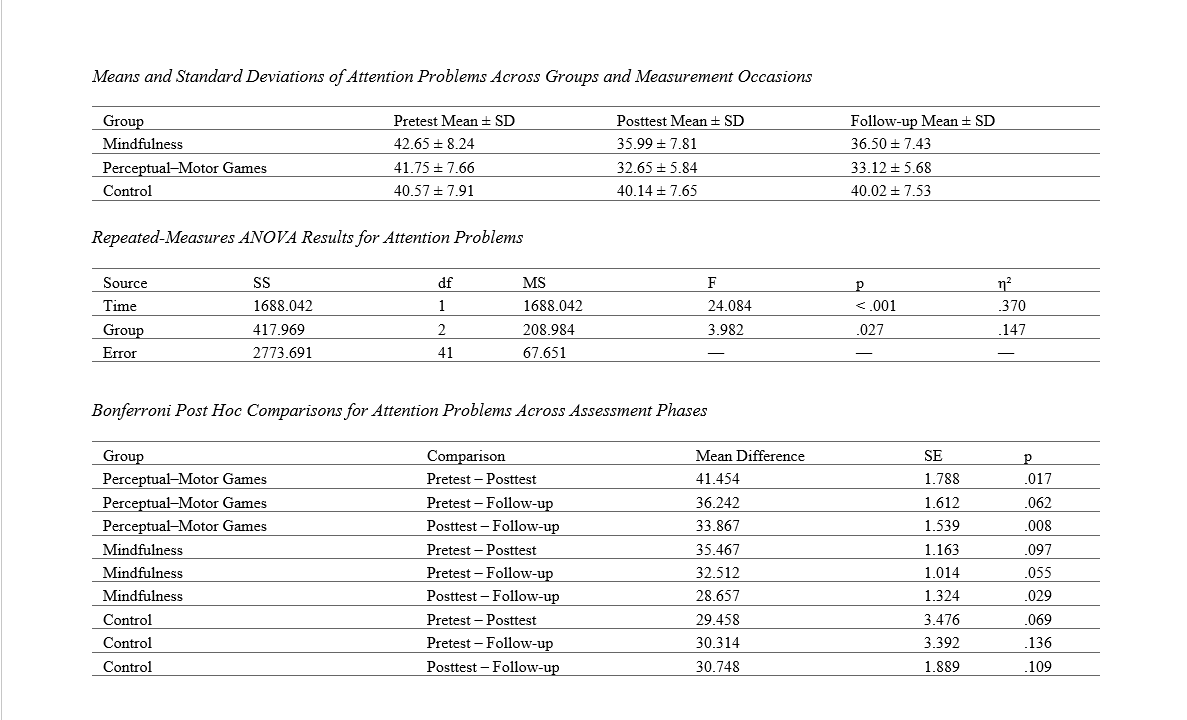
Attention-Deficit/Hyperactivity Disorder (ADHD) is one of the most common neurodevelopmental disorders in children and is associated with deficits in attention and executive functioning. Given the limitations of pharmacological treatments, the present study aimed to compare the effectiveness of mindfulness training and perceptual–motor games on attention problems in students with ADHD. The study employed an experimental design with pretest, posttest, follow-up, and a control group. The statistical population consisted of all male students in the fourth to sixth grades of elementary school in Tabriz during the 2024–2025 academic year. A sample of 45 participants was selected using a multistage cluster sampling method and randomly assigned to three groups of 15 participants each (mindfulness, perceptual–motor games, and control). Research instruments included the Child Symptom Inventory-4 (CSI-4) and the Conners Neuropsychological Scale. Data were analyzed using repeated-measures analysis of variance and the Bonferroni post hoc test. The findings indicated that both interventions significantly reduced attention problems (p < .05). The observed effects remained stable at the six-week follow-up assessment. Comparison of group means demonstrated that perceptual–motor games were more effective than mindfulness training. Mindfulness and perceptual–motor game interventions can be utilized as complementary strategies for reducing attention problems in children with ADHD. Furthermore, the findings suggest greater durability of the effects of multisensory and motor-based activities compared to cognitive training exercises. It is recommended that these interventions be implemented in schools and rehabilitation centers and be further investigated in future studies with larger samples and longer follow-up periods.
Downloads
References
Afrouz, G., Ghasemzadeh, S., & Taziki, T. (2014). The Effectiveness of Mood Regulation Skills Training on Self-Concept and Social Competence of Students with Learning Disabilities. Learning Disabilities, 3(3), 6-24.
Amini, M. M., Azhadi, S. M., & Mansourjoozan, Z. (2019). The Effect of a Course of Equine Therapy on Psychological Indicators and Sensory-Motor Function in Children with Attention-Deficit/Hyperactivity Disorder. Journal of Disability Studies, 9(9), 1-5.
Ceulemans, A., Titeca, D., Loeys, T., Hoppenbrouwers, K., & Rousseau, S. (2021). Enumeration of Small and Large Numerosities in Adolescents with Mathematical Learning Disorders. Research in Developmental Disabilities, 35, 27-35.
Dobrosavljevic, M., Solares, C., Cortese, S., & Andershed, H. (2020). Prevalence of Attention-Deficit/Hyperactivity Disorder in Older Adults: A Systematic Review and Meta-Analysis. Neuroscience & Biobehavioral Reviews, 118, 282-289.
Elzohairy, N. W., Elzlbany, G. A. M., Khamis, B. I., El-Monshed, A. H., & Ramadan Atta, M. H. (2024). Mindfulness-Based Training Effect on Attention, Impulsivity, and Emotional Regulation among Children with ADHD: The Role of Family Engagement in Randomized Controlled Trials. Archives of Psychiatric Nursing, 53(5). https://doi.org/10.1016/j.apnu.2024.10.001
Español-Martín, G., Pagerols, M., Prat, R., Rivas, C., & Ramos, J. A. (2023). The Impact of Attention-Deficit/Hyperactivity Disorder and Specific Learning Disorders on Academic Performance in Spanish Children from a Low-Middle- and a High-Income Population. Frontiers in Psychiatry, 14, 1-15. https://doi.org/10.3389/fpsyt.2023.1136994
Gaastra, G. F., Groen, Y., Tucha, L., & Tucha, O. (2016). The Effects of Classroom Interventions on Off-Task and Disruptive Classroom Behavior in Children with Symptoms of Attention-Deficit/Hyperactivity Disorder: A Meta-Analytic Review. PLoS One, 11(2), 1-19. https://www.ncbi.nlm.nih.gov/pubmed/26886218
Ghasabi, S., Bafandeh Gharamaleki, H., & Mohammadi, A. (2018). Comparison of the Effectiveness of Verbal Self-Instruction and Perceptual-Motor Games on Attention Span of Students with Attention-Deficit/Hyperactivity Disorder. Child Mental Health, 7(1), 281-294.
Johnston, C., Mash, E. J., Miller, N., & Ninowski, J. E. (2012). Parenting in Adults with Attention-Deficit/Hyperactivity Disorder (ADHD). Clinical psychology review, 32(4), 215-228. https://www.ncbi.nlm.nih.gov/pubmed/22459785
Katherine, N., Jessica, C., Andrea, G., Bridget, T., Andrea, D., & Candice, L. (2023). Do Children with Attention-Deficit/Hyperactivity Disorder Symptoms Become Socially Isolated? Longitudinal Within-Person Associations in a Nationally Representative Cohort. Jaacap Open, 1(1), 12-23. https://doi.org/10.1016/j.jaacop.2023.02.001
Lelong, S., Mattos, P., Fontenele, J. M., & Franco, J. (2021). How Effective Is Fine Motor Training in Children with ADHD? A Systematic Review. BMC pediatrics, 21(1), 2916. https://doi.org/10.1186/s12887-021-02916-5
Li, X. (2025). Physical Activity Interventions and Executive Function in Children: A Systematic Review and Meta-Analysis. Journal of affective disorders, 364, 102-115. https://doi.org/10.1016/j.jad.2025.02.185
Mortimer, N., Sanchez-Mora, C., Rovira, P., & Vilar-Ribo, L. (2020). Transcriptome Profiling in Adult Attention-Deficit Hyperactivity Disorder. European Neuropsychopharmacology, 41, 160-166.
Pain, G., & Laridi, I. (2016). Human Motor Development. https://doi.org/10.4324/9781315213040
Pirian, F., & Farsi, A. (2020). The Effect of Perceptual-Motor and Mindfulness Exercises on Attention Networks and Response Accuracy of Children with Attention-Deficit/Hyperactivity Disorder. Rehabilitation Medicine, 10(1), 133-145.
Rafikhah, M., Arjmandnia, A., Shokouhi-Yekta, M., Hassanzadeh, S., & Moghadamzadeh, A. (2021). Construction and Validation of the Preliminary Version of a Picture-Computerized Test of Executive Functions. Psychological Science, 20(104), 1235-1249.
Richmond, S., Kirk, H., Gaunson, T., Bennett, M., Bellgrove, M. A., & Cornish, K. (2022). Digital Cognitive Training in Children with Attention-Deficit/Hyperactivity Disorder: A Study Protocol of a Randomised Controlled Trial. BMJ open, 12(6), 1-12. https://doi.org/10.1136/bmjopen-2021-055385
Sadasivan, A. (2013). Neuropsychological Intervention for Specific Learning Disorder: An Innovative Approach. Neuropsychological Rehabilitation, 155-175.
Soltani Kouhbanani, S., & Rothenberger, A. (2021). Sustainability of Perceptual-Motor Skill Reconstruction Program Effects in Children with ADHD: A Follow-Up Study. Sustainability, 13(11), 6210. https://doi.org/10.3390/su13116210
Sultan, M. A., Nawaz, F. A., Alattar, B., Khalaf, E., Shadan, S., El-Abiary, N., Tegginmani, S., Qasba, R. K., & Jogia, J. (2025). Assessing the Impact of Mindfulness Programs on Attention-Deficit/Hyperactivity Disorder in Children and Adolescents: A Systematic Review. BMC pediatrics, 25(1), Article 32. https://doi.org/10.1186/s12887-024-05310-z
van de Weijer-Bergsma, E., Formsma, A. R., de Bruin, E. I., & Bögels, S. M. (2012). The Effectiveness of Mindfulness Training on Behavioral Problems and Attentional Functioning in Adolescents with ADHD. Journal of Child and Family Studies, 21(5), 775-787. https://doi.org/10.1007/s10826-011-9531-7
Venkata, J. A., & Panicker, A. S. (2013). Prevalence of Attention Deficit Hyperactivity Disorder in Primary School Children. Indian Journal of Psychiatry, 55(4), 338-342. https://doi.org/10.4103/0019-5545.120544
Wang, T., & Huang, H. (2012). The Performance on a Computerized Attention Assessment System between Children with and without Learning Disabilities. Procedia - Social and Behavioral Sciences, 64, 202-208.
Wang, Y., Li, H., Zhang, T., & Chen, X. (2025). The Impact of Long-Term Exercise on Motor Skills in Children with ADHD: A Three-Level Meta-Analysis. Frontiers in psychology, 16, 12219924. https://doi.org/10.3389/fpsyg.2025.12219924
Zablotsky, B., Black, L. I., Maenner, M. J., & Schieve, L. A. (2019). Prevalence and Trends of Developmental Disabilities among Children in the United States: 2009-2017. Pediatrics, 144(4), e20190811.
Zakopoulou, V., Pashou, T., Tzavelas, P., & Christodoulides, P. (2014). Learning Difficulties: A Retrospective Study of Their Comorbidity and Continuity as Indicators of Adult Criminal Behaviour in 18-70-Year-Old Prisoners. Research in Developmental Disabilities, 34(11), 3660-3667.
Zhao, L., Zhang, H., & Chen, Y. (2025). Comparative Effects of Different Physical Activity Interventions on Inhibitory Control in Children with ADHD: A Network Meta-Analysis. Frontiers in Psychiatry, 16, 1601765. https://doi.org/10.3389/fpsyt.2025.1601765
Ziereis, S., & Jansen, P. (2015). Effects of Physical Activity on Executive Function and Motor Performance in Children with ADHD. Research in Developmental Disabilities, 38, 181-191.
Downloads
Additional Files
Publication Timeline
- Submitted
- Revised
- Accepted