Enhancing Emotion Regulation and Critical Thinking in Hearing-Impaired Individuals through Sensory Integration Therapy: A Randomized Controlled Trial
Keywords:
Sensory Integration Therapy, Emotion Regulation, Critical Thinking, Hearing ImpairmentsAbstract
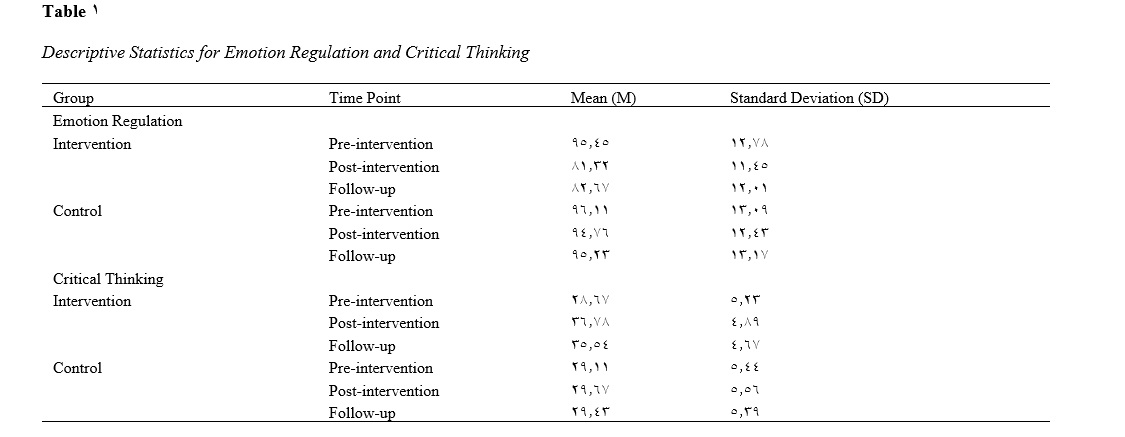
This study aimed to evaluate the effectiveness of Sensory Integration Therapy (SIT) in improving emotion regulation and critical thinking skills in individuals with hearing impairments. A randomized controlled trial was conducted with 30 participants (15 in the intervention group receiving SIT and 15 in the control group). The intervention consisted of ten 75-minute SIT sessions over a two-month period. Emotion regulation and critical thinking were measured at three time points: pre-intervention, post-intervention, and two-month follow-up, using the Difficulties in Emotion Regulation Scale (DERS) and Watson-Glaser Critical Thinking Appraisal (WGCTA), respectively. Data were analyzed using repeated measures ANOVA and Bonferroni post-hoc tests. Significant improvements in emotion regulation were observed in the intervention group from pre-intervention (M = 95.45, SD = 12.78) to post-intervention (M = 81.32, SD = 11.45), and maintained at follow-up (M = 82.67, SD = 12.01). The control group showed no significant changes. For critical thinking, the intervention group’s scores increased significantly from pre-intervention (M = 28.67, SD = 5.23) to post-intervention (M = 36.78, SD = 4.89), and remained high at follow-up (M = 35.54, SD = 4.67). The control group’s scores did not change significantly. ANOVA results indicated significant main effects for time and group for both variables (p < .001), with significant interaction effects (p < .001). Sensory Integration Therapy significantly improves emotion regulation and critical thinking in individuals with hearing impairments, with effects sustained over a two-month follow-up. These findings support the use of SIT as an effective intervention for enhancing cognitive and emotional skills in this population.
Downloads
References
Aghaziarati, A., Ashori, M., & Norouzi, G. (2021). Analyzing and Discovering the Challenges of Raising a Child with Hearing Loss from the Perspective of Parents with Normal Hearing and the Adolescents with Hearing Loss: A Pilot Study. Journal of Family Research, 17(2), 283-301.https://dx.doi.org/10.52547/jfr.17.2.283
Aghaziarati, A., Ashori, M., Norouzi, G., & Hallahan, D. P. (2023). The effectiveness of mindful parenting on cognitive and behavioral emotion regulation in mothers of children with hearing loss. KAUMS Journal (FEYZ), 27(1), 825-833.http://dx.doi.org/10.48307/FMSJ.2023.27.1.76
Aghaziarati, A., Nejatifar, S., & Ashori, M. (2021). Comparison of Executive Functions, Emotional Intelligence, and Motivated Strategies for Learning in Adolescents with Normal Hearing and Those with Hearing Impairment Using either Hearing Aids or Cochlear Implantation. Pajouhan Scientific Journal, 19(2), 35-42.https://doi.org/10.29252/psj.19.2.32
Allen, S., Knott, F., Branson, A., & Lane, S. J. (2021). Coaching Parents of Children With Sensory Integration Difficulties: A Scoping Review. Occupational Therapy International, 2021, 1-11.https://doi.org/10.1155/2021/6662724
Ashori, M., & Aghaziarati, A. (2022). The relationships among social-emotional assets and resilience, empathy and behavioral problems in deaf and hard of hearing children. Current Psychology, 1-9.https://doi.org/10.1007/s12144-022-03152-5
Azab, S. N., & Kamel, A. M. A. (2015). Correlation Between Anxiety Related Emotional Disorders and Language Development in Hearing-Impaired Egyptian Arabic Speaking Children. Journal of Communication Disorders Deaf Studies & Hearing Aids, 03(03).https://doi.org/10.4172/2375-4427.1000137
Azizi, M., FarokhSiri, Y., Kazemi Bahman abad, F., & Zamani, Z. (2023). The effectiveness of mindfulness-based group therapy on controlling rumination and difficulty in regulating emotions in adolescents with obsessive-compulsive disorder [Research]. Rooyesh-e-Ravanshenasi Journal(RRJ), 12(2), 219-228.http://frooyesh.ir/article-1-4382-en.html
Case-Smith, J., Weaver, L., & Fristad, M. A. (2014). A Systematic Review of Sensory Processing Interventions for Children With Autism Spectrum Disorders. Autism, 19(2), 133-148.https://doi.org/10.1177/1362361313517762
Devlin, S., Healy, O., Leader, G., & Hughes, B. M. (2010). Comparison of Behavioral Intervention and SensoryIntegration Therapy in the Treatment of Challenging Behavior. Journal of Autism and Developmental Disorders, 41(10), 1303-1320.https://doi.org/10.1007/s10803-010-1149-x
Eshagh Neymvari, N., Abolghasemi, S., & Hamzehpoor Haghighi, T. (2023). Analysis of structural equations in the relationship between family communication patterns with tendency to critical thinking and students' happiness with the mediating role of cognitive flexibility in students. Journal of Adolescent and Youth Psychological Studies (JAYPS), 4(1), 49-60.https://doi.org/10.61838/kman.jayps.4.1.6
Hall, J. W., & Fernandes, M. A. (1983). Temporal Integration, Frequency Resolution, and Off-Frequency Listening in Normal-Hearing and Cochlear-Impaired Listeners. The Journal of the Acoustical Society of America, 74(4), 1172-1177.https://doi.org/10.1121/1.390040
Hammad, M. A., & Awed, H. S. (2022). Thinking Styles and Their Relationship With Self-Efficacy Among Deaf and Hard-ofHearing Adolescent Students. Current Psychology, 42(29), 25880-25893.https://doi.org/10.1007/s12144-022-03597-8
Kreider, C. M., Bendixen, R., Huang, Y. J., & Lim, Y. (2014). Review of Occupational Therapy Intervention Research in the Practice Area of Children and Youth 2009–2013. American Journal of Occupational Therapy, 68(2), e61-e73.https://doi.org/10.5014/ajot.2014.011114
Lo, J.-S., Lo, C.-H., Huang, S.-C., & Wang, W. (2019). Application of User Experience and Design Thinking to the Construction of a Class Assistance System for Hearing- And SpeechImpaired People. Sustainability, 11(24), 7191.https://doi.org/10.3390/su11247191
Lv, J., Sun, Z., Li, H., & Hou, Y. (2023). The Role of Negative Perfectionism and the Relationship between Critical Thinking and the Halo Effect: Insights from Corporate Managers in Human Resources. Behavioral Sciences, 13(7), 533.https://www.mdpi.com/2076-328X/13/7/533
Parham, L. D., Cohn, E. S., Spitzer, S., Koomar, J. A., Miller, L., Burke, J., Brett-Green, B., Mailloux, Z., May-Benson, T. A., Roley, S. S., Schaaf, R. C., Schoen, S., & Summers, C. A. (2007). Fidelity in Sensory Integration Intervention Research. American Journal of Occupational Therapy, 61(2), 216-227.https://doi.org/10.5014/ajot.61.2.216
Parsakia, K. (2023). The Effect of Chatbots and AI on The SelfEfficacy, Self-Esteem, Problem-Solving and Critical Thinking of Students. Health Nexus, 1(1), 71-76.https://doi.org/10.61838/hn.1.1.14
Pekçetin, S., Akı, E., Üstünyurt, Z., & Kayıhan, H. (2016). The Efficiency of Sensory Integration Interventions in Preterm Infants. Perceptual and Motor Skills, 123(2), 411-423.https://doi.org/10.1177/0031512516662895
Pfeiffer, B., May-Benson, T. A., & Bodison, S. (2017). State of the Science of Sensory Integration Research With Children and Youth. American Journal of Occupational Therapy, 72(1), 7201170010p7201170011-7201170010p7201170014.https://doi.org/10.5014/ajot.2018.721003
Reynolds, S., Glennon, T. J., Ausderau, K., Bendixen, R., MillerKuhaneck, H., Pfeiffer, B., Watling, R., Wilkinson, K., & Bodison, S. (2017). Using a Multifaceted Approach to Working With Children Who Have Differences in Sensory Processing and Integration. American Journal of Occupational Therapy, 71(2), 7102360010p7102360011-7102360010p7102360010.https://doi.org/10.5014/ajot.2017.019281
Schaaf, R. C., Benevides, T., Kelly, D., & Mailloux, Z. (2012). Occupational Therapy and Sensory Integration for Children With Autism: A Feasibility, Safety, Acceptability and Fidelity Study. Autism, 16(3), 321-327.https://doi.org/10.1177/1362361311435157
Shoham, N., Lewis, G., Favarato, G., & Cooper, C. (2018). Prevalence of Anxiety Disorders and Symptoms in People With Hearing Impairment: A Systematic Review. Social Psychiatry and Psychiatric Epidemiology, 54(6), 649-660.https://doi.org/10.1007/s00127-018-1638-3
Stellern, J., Xiao, K. B., Grennell, E., Sanches, M., Gowin, J. L., & Sloan, M. E. (2023). Emotion regulation in substance use disorders: a systematic review and meta-analysis. Addiction, 118(1), 30-47.https://doi.org/10.1111/add.16001
Taubin, D., Berger, A., Greenwald, D., Greenwald, H., Burke, C., Gongora, D. S., & Wilens, T. (2023). A systematic review of virtual reality therapies for substance use disorders: Impact on secondary treatment outcomes. The American Journal on Addictions, 32(1), 13-23.https://doi.org/https://doi.org/10.1111/ajad.13342
Wang, G., Wang, R.-Y., Liu, T.-L., Zhuo, Y., & Shen, K. (2021). Application of Hybrid Multiple Attribute Decision-Making Model to Explore the Design Strategies of Children’s Facilities in Neighborhood Open Spaces Based on Sensory Integration Theory. Journal of Healthcare Engineering, 2021, 1-11.https://doi.org/10.1155/2021/5556172
Willis, D. N., Dowling, A. P. C., Deehan, T., & O'Reilly, P. G. (2023). Exploring the Impact of Trauma and the Role of Compassion Before and After a Phase-orientated Intervention for Complex Trauma. European Journal of Trauma & Dissociation, 7(1), 100308.https://www.sciencedirect.com/science/article/pii/S2468749922000503

Downloads
Additional Files
Published
Submitted
Revised
Accepted
Issue
Section
License

This work is licensed under a Creative Commons Attribution-NonCommercial 4.0 International License.