Community Integration and Social Participation for Adults with Intellectual Disabilities
DOI:
https://doi.org/10.61838/kman.prien.2.4.2Keywords:
Intellectual disabilities, community integration, social participation, support systems, accessibility, inclusive policies, assistive technologyAbstract
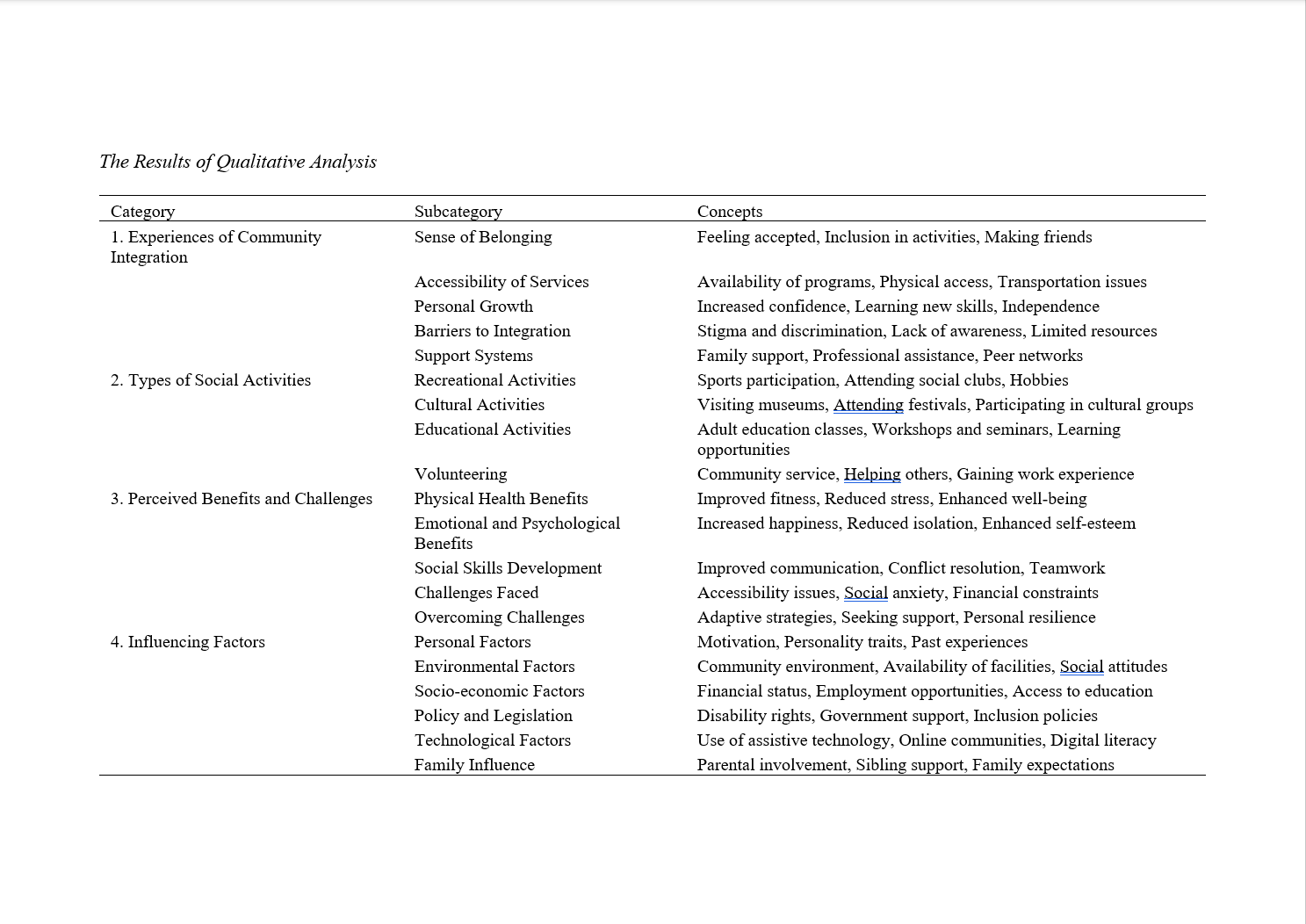
The objective of this study was to explore the experiences and perceptions of community integration and social participation among adults with intellectual disabilities (ID). This qualitative research employed semi-structured interviews to gather in-depth data from 27 adults with intellectual disabilities. Participants were recruited through purposive sampling from various community centers, support groups, and social service organizations. Data were collected until theoretical saturation was achieved. Thematic analysis was used to analyze the transcribed interviews, identifying key themes and subthemes that captured the essence of the participants' experiences and perceptions. The study identified four main themes: experiences of community integration, types of social activities, perceived benefits and challenges, and influencing factors. Participants reported a strong sense of belonging and personal growth through community activities, despite facing barriers such as stigma, accessibility issues, and financial constraints. Support systems, including family, professionals, and peer networks, played a crucial role in facilitating participation. Recreational, cultural, and educational activities, as well as volunteering, provided significant physical, emotional, and social benefits. Technological advancements, inclusive policies, and personal resilience were identified as critical factors influencing community integration. The findings highlight the importance of enhancing accessibility, support systems, and inclusive policies to promote community integration and social participation for adults with intellectual disabilities. Addressing the identified barriers and leveraging facilitators can improve their quality of life and well-being. Future research should employ mixed-methods approaches, include longitudinal studies, and consider the perspectives of family members, caregivers, and professionals to provide a more comprehensive understanding of the factors influencing community participation.
Downloads
References
Ashley, D., Fossey, E., & Bigby, C. (2019). The Home Environments and Occupational Engagement of People With Intellectual Disabilities in Supported Living. British Journal of Occupational Therapy, 82(11), 698-709.https://doi.org/10.1177/0308022619843080
Borland, R. L., Hu, N., Tonge, B. J., Einfeld, S., & Gray, K. M. (2020). Participation in Sport and Physical Activity in Adults With Intellectual Disabilities. Journal of Intellectual Disability Research, 64(12), 908-922.https://doi.org/10.1111/jir.12782
Cameron, L. A., Tonge, B. J., Howlin, P., Einfeld, S., Stancliffe, R. J., & Gray, K. M. (2022). Social and Community Inclusion Outcomes for Adults With Autism With and Without Intellectual Disability in Australia. Journal of Intellectual Disability Research, 66(7), 655-666.https://doi.org/10.1111/jir.12953
Carnemolla, P., Kelly, J. L., Donnelley, C., Healy, A., & Taylor, M. (2021). “If I Was the Boss of My Local Government”: Perspectives of People With Intellectual Disabilities on Improving Inclusion. Sustainability, 13(16), 9075.https://doi.org/10.3390/su13169075
Craig, D., & Bigby, C. (2014). “She's Been Involved in Everything as Far as I Can See”: Supporting the Active Participation of People With Intellectual Disability in Community Groups. Journal of Intellectual & Developmental Disability, 40(1), 12-25.https://doi.org/10.3109/13668250.2014.977235
Danker, J., Strnadová, I., Tso, M., Loblinzk, J., Cumming, T. M., & Martin, A. J. (2022). ‘It Will Open Your World Up’: The Role of Mobile Technology in Promoting Social Inclusion Among Adults With Intellectual Disabilities. British Journal of Learning Disabilities, 51(2), 135-147.https://doi.org/10.1111/bld.12500
Djordjevic, M., Glumbić, N., Brojčin, B., Banković, S., & Pavlović, V. Ž. (2023). Differences in Pragmatic Communication Skills of Adults With Intellectual Disabilities and Dual Diagnoses. Frontiers in Psychiatry, 14.https://doi.org/10.3389/fpsyt.2023.1072736
Emerson, E. (2011). Health Status and Health Risks of the “Hidden Majority” of Adults With Intellectual Disability. Intellectual and Developmental Disabilities, 49(3), 155-165.https://doi.org/10.1352/1934-9556-49.3.155
Emerson, E., Hatton, C., Robertson, J., & Baines, S. (2014). Perceptions of Neighbourhood Quality, Social and Civic Participation and the Self Rated Health of British Adults With Intellectual Disability: Cross Sectional Study. BMC public health, 14(1).https://doi.org/10.1186/1471-2458-14-1252
Fisher, M. H., Baird, J. V., Currey, A. D., & Hodapp, R. M. (2016). Victimisation and Social Vulnerability of Adults With Intellectual Disability: A Review of Research Extending Beyond Wilson and Brewer. Australian Psychologist, 51(2),114-127.https://doi.org/10.1111/ap.12180
McCausland, D., Murphy, E., McCarron, M., & McCallion, P. (2021). The Potential for Person-Centred Planning to Support the Community Participation of Adults With an Intellectual Disability. Journal of Intellectual Disabilities, 26(3), 603-623.https://doi.org/10.1177/17446295211022125
Safari, M. C., Wass, S., & Thygesen, E. (2023). Digital Technology Design Activities—A Means for Promoting the Digital Inclusion of Young Adults With Intellectual Disabilities. British Journal of Learning Disabilities, 51(2), 238-249.https://doi.org/10.1111/bld.12521
Tsang, B., Leung, C. N. W., & Chan, R. W. (2022). A Feasibility Study on Social Competence Intervention for Chinese Adolescents and Adults With Comorbid Autism Spectrum Disorder and Intellectual Disability. Journal of Applied Research in Intellectual Disabilities, 35(5), 1131-1139.https://doi.org/10.1111/jar.12998
Wilson, N. J., Jaques, H., Johnson, A., & Brotherton, M. (2016).From Social Exclusion to Supported Inclusion: Adults With Intellectual Disability Discuss Their Lived Experiences of a Structured Social Group. Journal of Applied Research in Intellectual Disabilities, 30(5), 847-858.https://doi.org/10.1111/jar.12275
Witsø, A. E., & Hauger, B. (2018). ‘It’s Our Everyday Life’ – The Perspectives of Persons With Intellectual Disabilities in Norway. Journal of Intellectual Disabilities, 24(2), 143-157.https://doi.org/10.1177/1744629518774174
Downloads
Additional Files
Publication Timeline
Issue
Section
License

This work is licensed under a Creative Commons Attribution-NonCommercial 4.0 International License.